Tennis Court Lines: Names, Widths and Layout for Ontario Courts
Most people only notice tennis court lines when a ball lands near one. A shot clips the baseline, someone calls it out, someone else swears it was in, and a ten minute argument follows. Builders see the same lines very differently. To us they are the last step of a long chain of decisions about slope, surface, colour and layout, and a line that is off by an inch can mean repainting an entire court.
This guide explains every line on a tennis court, what it is called, how wide it should be and where it sits, using the official ITF Rules of Tennis. It then covers the practical side: how lines are laid out and applied, what the options are on hard, clay and turf surfaces, how pickleball lines fit onto a tennis court, and what Ontario weather does to line paint over time. If you are planning a new court, our guide to the steps involved in building a tennis court from scratch shows where line marking falls in the sequence.
The Short Answer: What Are the Lines on a Tennis Court?
A tennis court has a baseline at each end, two sets of sidelines (singles and doubles), a service line on each side of the net, a centre service line that splits the service boxes, and a short centre mark on each baseline. The court is 78 feet (23.77 m) long, 27 feet (8.23 m) wide for singles and 36 feet (10.97 m) wide for doubles.
Those figures come from Rule 1 of the 2026 ITF Rules of Tennis. The same layout is used on hard courts, clay, Har-Tru, grass and turf, which is why the surface underneath has to be built accurately before any paint goes on. If you want the wider picture of court size, our guide on how large a tennis court is covers the space around the lines too.
Tennis Court Lines at a Glance
| Line | Where it is | What it does in play |
|---|---|---|
| Baseline | Back edge of the court at each end | Marks the limit of the court for rallies and where the server stands behind |
| Singles sideline | Inner side boundary, 27 ft (8.23 m) apart | Out of bounds line for singles |
| Doubles sideline | Outer side boundary, 36 ft (10.97 m) apart | Out of bounds line for doubles |
| Service line | Parallel to the net, 21 ft (6.40 m) from it | Back edge of the service boxes |
| Centre service line | Halfway between the singles sidelines, running from the net to the service line | Divides each service area into left and right service courts |
| Centre mark | Short tick at the middle of each baseline | Shows the server where the centre of the court is |
The alley, the 4.5 foot strip between the singles and doubles sidelines, is not a line of its own. It is the space between two lines, and it is in play for doubles but out for singles. The 4.5 feet is our arithmetic (36 ft minus 27 ft, divided by two), and it matches what players see on any court.
How Wide Are Tennis Court Lines?
Under the ITF rules, most tennis court lines are between 1 inch (2.5 cm) and 2 inches (5 cm) wide. The baselines can be up to 4 inches (10 cm) wide, while the centre service line and centre mark are 2 inches (5 cm) wide. All court measurements are taken to the outside edge of the lines.
That last sentence matters more than it looks. It means the 78 by 36 foot rectangle includes the width of the boundary lines, so a line is painted inward from the measurement, not centred on it. A layout crew who measures to the middle of a line ends up with a court that is a fraction too big or too small.
| Line or mark | Width or size under the ITF rules | Layout note |
|---|---|---|
| Baseline | Up to 4 in (10 cm) wide | Measured to the outside edge, so a wider baseline adds width inside the court |
| Centre service line | 2 in (5 cm) wide | Halfway between the singles sidelines |
| Centre mark | 2 in (5 cm) wide and 4 in (10 cm) long | Drawn inside the court, bisecting each baseline |
| All other lines | Between 1 in (2.5 cm) and 2 in (5 cm) wide | Sidelines and service lines fall in this range |
| Line colour | All lines the same colour, clearly contrasting with the surface | Lines of different colours are not permitted |
A lot of club courts use lines that are 2 inches wide all the way round for simplicity. That is within the rule for everything except a baseline that has been widened, and it is the kind of detail worth agreeing before the crew shows up. Our deeper dive into how tennis court dimensions evolved has some of the history behind these numbers.
Where Each Line Sits on the Court
The service lines sit 21 feet (6.40 m) from the net on each side. The centre service line runs from the net to the service line. The singles sidelines sit 4.5 feet inside the doubles sidelines, and the baselines mark the back of the court at 39 feet (11.89 m) from the net.
The ITF rules state the 78 foot length, the two widths and the 21 foot service line distance directly. The other figures in the table below follow from those, and we have marked them as calculated so nobody mistakes our arithmetic for a rule.
| Measurement | Figure | Source |
|---|---|---|
| Court length | 78 ft (23.77 m) | ITF Rule 1 |
| Singles width | 27 ft (8.23 m) | ITF Rule 1 |
| Doubles width | 36 ft (10.97 m) | ITF Rule 1 |
| Net to service line | 21 ft (6.40 m) | ITF Rule 1 |
| Net to baseline | 39 ft (11.89 m) | Calculated: half of 78 ft |
| Service line to baseline | 18 ft (5.49 m) | Calculated: 39 ft minus 21 ft |
| Width of each service box | 13.5 ft (4.11 m) | Calculated: half of 27 ft |
| Alley width | 4.5 ft (1.37 m) | Calculated: (36 ft minus 27 ft) divided by 2 |
Net posts sit outside all of this, three feet beyond the doubles sidelines, so the line layout and the post layout have to be planned together. We walk through that side of the job in our guide to tennis net height and net post planning, and the guide to tennis court net systems covers the hardware.
Is the Ball In When It Touches a Line?
Yes. The ITF rules say a ball that touches a line is regarded as touching the court bounded by that line, so a ball that clips any part of a line is good. That is why accurate line width and clear contrast matter to players: the line is part of the court, not a boundary beside it.
Do the Lines Count for Singles and Doubles Differently?
Only the sidelines change. In doubles the outer sideline is the boundary, and in singles the inner one is. The service line, the centre service line and the baselines work the same way in both formats. On a court that is used for both, the two sets of sidelines stay painted permanently, which is why you always see the alley lines on a standard court.
Line Colour and Contrast
The ITF requires every line to be the same colour and to contrast clearly with the surface. White is the usual choice on a coloured hard court because it reads well against green, blue and most other acrylic colours. The surface colours themselves are a design choice, and our guide to sport court colour options in Ontario goes through how the playing area and the surround affect visibility.
Two practical points come up on most projects. First, a pale surface colour weakens the contrast of a white line, so a court with light grey or tan acrylic needs more attention to line visibility than a dark green one. Second, if the court will also carry pickleball lines, the second set needs a different colour from the tennis lines so players can tell them apart, even though the ITF wants one colour for the tennis lines. We come back to that in the pickleball section below.
How Court Lines Are Laid Out
Line layout is a measuring job, and it is done in a set order. A crew starts from fixed reference points, usually the net post sleeves or a surveyed centre point, and works outward so errors do not add up.
The Usual Sequence
- Fix the centre. Mark the centre of the net line and the centre of each baseline from the net post positions or a surveyed point.
- Set the baselines. Measure 39 feet each way from the net line along the court axis, to the outside edge of the baseline.
- Mark the sidelines. Measure out to the doubles width and then in to the singles width, keeping every measurement to the outside edge.
- Check the diagonals. The two diagonals of a rectangle are equal, so if they do not match, the court is not square and something has to be corrected before paint goes down.
- Place the service lines. Measure 21 feet from the net line on each side and mark the lines between the singles sidelines.
- Add the centre service line and centre marks. Mark the centre service line halfway between the singles sidelines, and the centre mark at the middle of each baseline.
- Tape or string the edges. The crew masks or strings both edges of each line before paint is applied.
The diagonal check is the one a lot of DIY layouts skip. A rectangle can have the right side lengths and still be a parallelogram, and the diagonals are how you find out. On a permanent court it is quick insurance against a mistake that would show up every time somebody serves.
Why the Surface Under the Lines Has to Be Right First
You cannot fix a bad slope with a good line. A court has to shed water, and the fall across it is built into the base during grading, long before any colour coat goes on. If the surface is flat in places and ponding in others, the lines will look straight on the ground but show water marks and staining after the first rain. Our articles on accurate grading for sports court drainage and the laser-guided grading process explain how that foundation is built, and CrowAll’s laser guided grading page describes the approach.
The timing matters too. On a new court the lines go on after the surface coats are in place and have cured, which is the last stage of the project. Our guide to how long tennis court construction takes shows where that fits in a full schedule, and the right drying and curing times always come from the coating manufacturer’s instructions for the product in use.
How Lines Are Made on Different Court Surfaces
The line rules are the same everywhere, but how the line gets onto the surface depends on what the surface is. A painted line that works on acrylic would not last a week on loose clay, and a taped line that suits a clay court looks wrong on a hard court.
| Surface | Usual line method | What to know |
|---|---|---|
| Acrylic hard court | Line paint applied over masked edges | Applied after the colour coats; use paint and procedures approved for the coating system |
| Soft asphalt or sealed asphalt | Line paint over the finished surface | Surface prep and product choice depend on the system in use |
| Har-Tru and other clay | Tape or plastic lines fixed to the surface | Loose material is brushed and rolled around the lines, so they need to stay fixed and flush |
| Artificial turf | Inlaid or tufted lines, or painted lines on suitable turf | Depends on the turf product and the manufacturer’s guidance |
| Temporary or shared courts | Removable tape or roll-down lines | Handy for short-term use, and the right product depends on the surface and how long it will stay down |
Painted Lines on Acrylic and Asphalt Courts
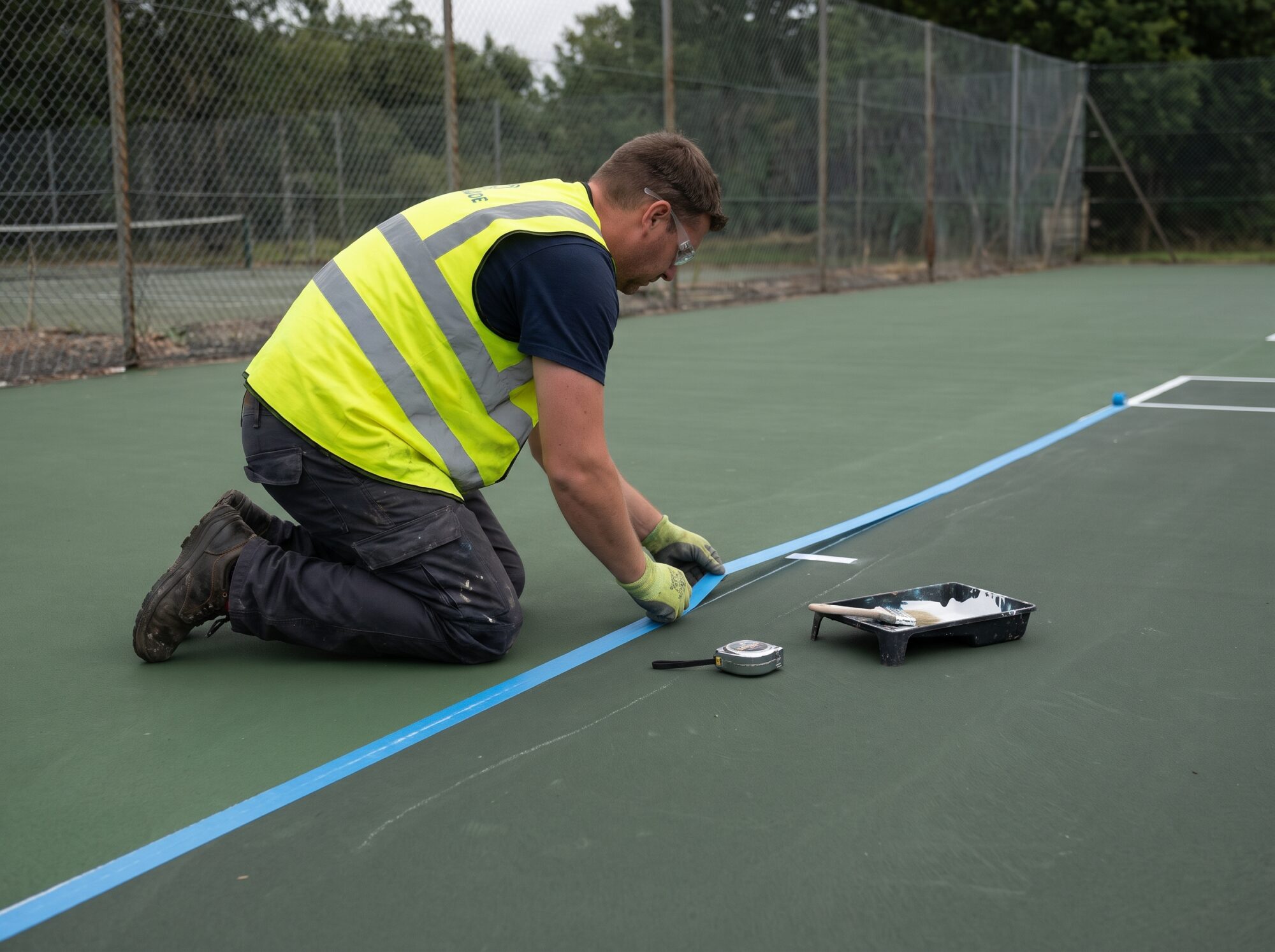
Most hard tennis courts in Ontario are acrylic coated, and the lines are painted on after the colour coats. The edges are masked with tape or guided by strings and straightedges, and the paint is applied in a controlled way so the line has crisp edges. The paint and the surface have to be compatible, which is why we always follow the coating manufacturer’s instructions for prep, application and cure time. Our guide to the role of acrylic sports court coating explains how the coating system works, and the article on soft asphalt in tennis court installation covers the base that many Ontario hard courts sit on.
Painted lines are also where weather matters during the job. Most coating and paint products list limits for temperature and for dry conditions before, during and after application. We do not give a single temperature here because it differs between products, and we would rather you check the manufacturer’s data sheet than rely on a rule of thumb. Our guide to the best time of year to build a sports court explains why scheduling matters across a full Ontario season.
Lines on Har-Tru and Clay Courts
Lines on a clay or Har-Tru court are normally a physical strip, usually tape or plastic, that is fixed to the surface. The loose playing surface is brushed and rolled right up to the line so it sits flush with it. That is different from painting, and it changes the maintenance routine, because lines need checking after winter and after heavy rain to make sure nothing has lifted. If you are comparing surfaces, our guides to Har-Tru tennis courts, ClayTech and Har-Tru and how to construct a clay tennis court go through the differences.
Lines on Artificial Turf
Turf tennis courts can carry inlaid lines, which are turf of a different colour fitted into the surface, or painted lines on turf that is made for it. Which one is right depends on the turf product, the infill and the installer’s guidance. Our articles on artificial turf compared with hard court for tennis and sport court turf infill are good background before you decide.
Pickleball Lines on a Tennis Court
A tennis court can carry pickleball lines, and many Ontario clubs and municipalities do exactly that. A pickleball court is 20 feet (6.10 m) wide and 44 feet (13.41 m) long, with lines 2 inches (5.08 cm) wide, so several fit on one tennis court. The non-volley zone, often called the kitchen, is 7 feet (2.13 m) deep on each side of the net.
Those figures come from the USA Pickleball rulebook, which also says court measurements are taken to the outside edge of the perimeter and non-volley zone lines and that the lines should be one colour that clearly contrasts with the surface. The rulebook sets a minimum playing area of 30 by 60 feet and recommends 34 by 64 feet for new construction and tournament play.
| Item | Tennis (ITF) | Pickleball (USA Pickleball) |
|---|---|---|
| Court size | 78 ft by 36 ft for doubles (23.77 m by 10.97 m) | 44 ft by 20 ft (13.41 m by 6.10 m) |
| Line width | 1 to 2 in, baseline up to 4 in | 2 in (5.08 cm) |
| Measured to | Outside edge of the lines | Outside edge of the perimeter and non-volley zone lines |
| Zone near the net | Service line at 21 ft (6.40 m) | Non-volley zone line at 7 ft (2.13 m) |
| Line colour | One colour, clearly contrasting with the surface | One colour, clearly contrasting with the surface |
Blended Lines, Tape and Permanent Painted Lines
There are three common ways to add pickleball lines to a tennis court, and each has trade-offs.
- Painted lines in a second colour. These are permanent and look tidy, but a busy mix of tennis and pickleball lines can confuse players if the colours are too close.
- Tape or roll-down lines. These are removable and suit courts that are shared on a schedule, but the right product depends on the surface, and tape left down for a long time can damage a coating.
- Blended lines, where the pickleball lines are painted in a tone close to the surface so they are less distracting for tennis. This is a design choice, and visibility for pickleball players has to be tested before it is committed to.
A net has to go with those lines, and the posts are different. Our articles on pickleball net height and pickleball courts compared with tennis courts go through the setups, and our guide to converting a tennis court into a pickleball court in Ontario explains how lines, posts and surface fit into one conversion plan. If you want the pickleball layout on its own, see the size and dimensions of a pickleball court, and for sites that want several sports on one pad, our guide to multi-sport court construction in Ontario shows how line sets are managed. Our comparison of tennis court dimensions and other racket sports is a handy companion.

Space Around the Lines: Run-Back and Side Room
Lines mark the court, but players need room beyond them. Rule 1 of the ITF Rules of Tennis does not set a clearance, but Appendix X gives guideline minimums for international play of 21 feet (6.40 m) from the baseline to the backstop and 12 feet (3.66 m) from the sideline to the sidestop. Many club and school courts are built with less, and the right figure for your site depends on who will play and what the land allows.
The Tennis Canada Tennis Court Design Standards are a useful second source. They state that outdoor courts should be built with a north-south orientation and base their layouts on the ITF recommended measurements, so check them when you are planning a new court. Fencing and run-back space are tied together, and our guide to tennis court fencing covers how the fence line affects usable space.
What Ontario Weather Does to Court Lines
Ontario courts go through freezing, thawing, snow cover, road salt tracked in on shoes and strong summer sun, and lines show the damage first because they are thin and sit on top of the surface. Paint wears where players stand most, especially behind the baseline and around the service boxes, and it fades under UV like any exterior coating.
The bigger issue is cracking. Water gets into a small crack, freezes, expands and widens it, and a crack that crosses a line breaks the line and can lift the coating around it. Our guide to sport court crack repair in Ontario explains how professionals fix and prevent cracks, and our article on seasonal tennis court upkeep covers the regular checks that catch them early.
| What you see | Likely cause | What to do |
|---|---|---|
| Lines faded or patchy | UV exposure and foot traffic wearing the paint | Plan to repaint lines, ideally with any resurfacing work |
| Line broken by a crack | Freeze-thaw movement or base settlement | Repair the crack properly first, then restore the line |
| Line edges ragged or peeling | Poor prep, wrong paint for the surface or moisture under the coating | Strip back and repaint with a compatible product |
| Lines look crooked or uneven width | Layout was not squared or masking moved | Re-measure, check diagonals and repaint |
| Staining along a line | Water ponding at a low spot | Look at the slope and drainage before repainting |
| Lines hard to see | Low contrast with a pale surface, or worn paint | Check colour contrast and refresh the lines |
A court that keeps showing the same line problem usually has a deeper cause, and repainting alone will not hold. Our article on tennis court maintenance versus replacement helps you decide whether repair or a bigger project is the right call.
When to Repaint the Lines or Resurface the Court
Lines are normally repainted as part of a resurfacing job, because new coating covers the old lines and the whole court is marked out again afterwards. That keeps colour and cure consistent and avoids a fresh coat sitting next to worn lines. Our guides to what tennis court resurfacing is and why it is necessary and how to tell when it is time to resurface go through the process, and the article on five signs you need resurfacing lists what to look for. For budgeting, our guide to how much it costs to resurface a tennis court is the place to start.
Painting lines alone is possible on a court whose surface is still in good shape. That is a smaller job, and a good contractor will look at the surface first to see whether new lines will bond properly. We do not quote a price or an interval here, because both depend on the surface, the product and the site.
Planning Court Lines for Your Property Type
The lines are the same for everyone, but the decisions around them are not.
Homeowners and Private Estates
A private court usually has one use in mind, which keeps the line plan simple. The main choices are colour contrast and whether you want pickleball lines added later. If you are still deciding whether to build, our guides to building a tennis court for home use and tennis court costs in 2026 are useful starting points, and our overview of the four types of tennis courts helps with the surface decision.
Clubs and Schools
Shared courts tend to be asked to do more than one job. If a club wants tennis, pickleball and junior play on the same pad, the line plan should be drawn on paper first, with colours chosen so each set can be read at a glance. Smaller courts for younger players exist and follow their own layouts, so ask the governing body for the right dimensions before marking anything. Our guide on choosing the right tennis court for kids covers that side of the decision.
Municipalities and Facility Managers
Public courts take heavy wear and often need to be multi-use, so lines get a lot of attention. Plan the line colours, the repainting cycle and the repair routine together, and write them into a maintenance schedule your crew can follow. Before any digging for posts or fence footings, confirm whether permits or locates are needed. Our guide on permits for sports courts covers the basics, and in Ontario, locates are arranged through Ontario Dig Authority.
Developers, Landscape Architects and Contractors
If a court is part of a bigger site, the line layout depends on the court’s position, orientation and surrounding paths, so it should be settled early. CrowAll’s landscape design page and our guide to sport court lighting show how those other pieces fit around a court, and good lighting makes lines easier to see after dark.
Planning Court Lines With CrowAll
Court lines are the last thing painted and the first thing people judge. CrowAll builds and resurfaces tennis courts across Ontario, and our why choose us and company profile pages explain how we work. You can see finished work in the gallery, browse the surfaces and products, read about our tennis court services and check the areas we serve.
If you are a homeowner, a club, a school, a municipality or a developer planning a new court or a resurfacing, contact CrowAll to talk through your site, your surface and the line layout you need. Our website describes free consultations and quotes, and we are glad to go through the layout with you before any paint goes on.
Frequently Asked Questions About Tennis Court Lines
What are the lines on a tennis court called?
The main lines are the baseline, the singles and doubles sidelines, the service line, the centre service line and the centre mark. The space between the singles and doubles sidelines is called the alley.
How wide are tennis court lines?
Most lines are between 1 and 2 inches (2.5 to 5 cm) wide under the ITF rules. Baselines can be up to 4 inches (10 cm) wide, and the centre service line and centre mark are 2 inches (5 cm) wide.
How big is a tennis court including the lines?
A tennis court is 78 feet (23.77 m) long, 27 feet (8.23 m) wide for singles and 36 feet (10.97 m) wide for doubles. All measurements are taken to the outside edge of the lines, so the lines are included in those figures.
How far is the service line from the net?
The service line is 21 feet (6.40 m) from the net on each side, running parallel to it between the singles sidelines.
How long is the centre mark on a tennis court?
The centre mark is 4 inches (10 cm) long and 2 inches (5 cm) wide. It sits inside the court, parallel to the singles sidelines, and bisects each baseline.
Is a ball in if it touches the line in tennis?
Yes. The ITF rules say a ball that touches a line is regarded as touching the court bounded by that line, so it counts as in.
What colour should tennis court lines be?
The ITF requires all lines to be one colour that clearly contrasts with the surface. White is the usual choice on coloured hard courts, and lines of different colours are not permitted for tennis.
What is the alley on a tennis court?
The alley is the 4.5 foot (1.37 m) strip between the singles sideline and the doubles sideline on each side. It is in play in doubles and out of bounds in singles.
How are tennis court lines painted?
On an acrylic hard court the lines are measured and squared, the edges are masked or guided, and line paint is applied after the colour coats. The paint and the process need to follow the coating manufacturer’s instructions for the system in use.
How do lines get put on a clay or Har-Tru court?
Lines on clay and Har-Tru are normally tape or plastic strips that are fixed to the surface, with the loose playing material brushed and rolled up to them so they sit flush.
Can you put pickleball lines on a tennis court?
Yes. A pickleball court is 44 by 20 feet (13.41 by 6.10 m) with lines 2 inches (5.08 cm) wide, so several fit on a tennis court. The lines can be painted, taped or blended, and the net and posts need their own plan.
How wide are pickleball lines?
Pickleball lines are 2 inches (5.08 cm) wide under the USA Pickleball rulebook, and measurements are taken to the outside edge of the perimeter and non-volley zone lines.
How often do tennis court lines need repainting?
There is no single interval, because it depends on the surface, the paint, how much the court is used and the weather. Lines are normally repainted with a resurfacing, and a contractor can tell you from the condition of the court.
Can you repaint tennis court lines without resurfacing the court?
Sometimes. If the surface is sound, new lines can be painted over it, but the surface has to be checked first to make sure the paint will bond. A cracked or failing surface should be repaired or resurfaced before lines are redone.
Why are my tennis court lines cracking or peeling?
Common causes are freeze-thaw cracking in the surface below, poor surface prep, a paint that does not suit the coating, or moisture trapped under the line. Fixing the cause matters more than repainting over it.
How much run-back room should a tennis court have behind the baseline?
The ITF Rules of Tennis do not set a figure in Rule 1, but Appendix X gives guideline minimums for international play of 21 feet (6.40 m) behind the baseline and 12 feet (3.66 m) beside the sideline. The right amount for your site depends on the players and the space available.
Does CrowAll build and resurface tennis courts in Ontario?
CrowAll builds and resurfaces tennis courts across Ontario, and its website describes free consultations and quotes. Contact the team to talk through your surface, line layout and project goals.