Tennis Net Height: Official Measurements and Net Post Planning for Ontario Courts
Walk onto any tennis court and the net looks like the simplest thing on it. A cable, some mesh, two posts. Then somebody pulls out a tape measure and finds the middle sitting two inches high, or one end noticeably taller than the other, and the whole rally feels slightly off. Net height is one of those numbers that players rarely think about and builders think about for months, because on a permanent court it is fixed by posts, footings and a surface that has to be right before the first ball is hit.
This guide gives the official tennis net height in inches, feet, centimetres and metres, shows where the numbers come from in the ITF Rules of Tennis, and walks through how to measure and adjust a net the right way. It also covers the part most pages skip: how net posts, footings, grading and surface choices affect the height you end up with on an Ontario court. If you are planning a new court, our guide to the steps involved in building a tennis court from scratch shows where the posts fit in the bigger sequence.
The Short Answer: How High Is a Tennis Net?
A tennis net is 3 feet 6 inches (1.07 m) high at the net posts and 3 feet (0.914 m) high at the centre. The centre is held down tightly by a strap, which is why the net dips in the middle. Both heights are measured from the playing surface to the top of the net.
That is the full rule under the International Tennis Federation, and it applies to singles and doubles. The same two numbers are used whether the court is hard, clay, Har-Tru or grass, which is why the surface underneath matters so much to the builder.
Tennis Net Height at a Glance
| Measurement point | Feet and inches | Inches | Centimetres | Metres |
|---|---|---|---|---|
| At the net posts | 3 ft 6 in | 42 | 106.7 | 1.07 |
| At the centre strap | 3 ft | 36 | 91.4 | 0.914 |
| Drop from posts to centre | 6 in | 6 | 15.2 | 0.152 |
The ITF publishes the post height as 3½ feet (1.07 m) and the centre as 3 feet (0.914 m). The inch and centimetre columns above are straight conversions of those figures, and the drop is simple subtraction.
What the ITF Rules Say About the Net
The net is covered in Rule 1 of the 2026 ITF Rules of Tennis, alongside the court itself. The rule is short but specific, and every part of it affects how a court is built. The net has to be fully extended so it fills the space between the two posts, the mesh has to be fine enough to stop a ball passing through, and the heights and fittings have to match the list below.
| Component | What the rule says | Why it matters on site |
|---|---|---|
| Net height at posts | 3½ ft (1.07 m) | Sets the top of the post or the cable position |
| Net height at centre | 3 ft (0.914 m), held down by a strap | Needs a strap anchor that will not move |
| Doubles net post position | Centres 3 ft (0.914 m) outside the doubles court on each side | Fixes where the sleeves go before the pad is poured |
| Net post size | No more than 6 in (15 cm) square or in diameter | Limits post and sleeve choices |
| Singles sticks | No more than 3 in (7.5 cm) square or in diameter, centres 3 ft (0.914 m) outside the singles court | Matters on courts used for singles with a doubles net |
| Centre strap width | Maximum 2 in (5 cm), completely white | Strap and anchor are chosen to suit |
| Band along the top | Between 2 in (5 cm) and 2½ in (6.35 cm) deep on each side, completely white | Sets the visible top edge that officials measure to |
| Cord or cable | Maximum diameter 1/3 in (0.8 cm) | Affects winch, post top and how much the net can sag |
Net Posts and Where They Stand
On a doubles court the centre of each post sits 3 feet outside the doubles sideline. The court is 36 feet wide for doubles, so the distance between post centres works out to 42 feet. That is our arithmetic from the ITF figures, but it is the number a builder uses when laying out sleeves, so it is worth knowing. Our guide on how large a tennis court is has the rest of the layout.
The ITF also caps post size at 6 inches. In practice that is why permanent tennis posts look fairly slim compared with the heavy posts on some other courts.
The Centre Strap and the Band
The strap is the part that makes the net dip. Without it the cable pulls the middle of the net up toward post height, and gravity pulls it down a different amount depending on tension. The strap removes that guesswork by pinning the centre at 3 feet. The band, the white fabric along the top, has to be between 2 and 2.5 inches deep on each side, so the top of the band is what you measure to.
Singles Sticks and Singles Play
Many club and school courts have a doubles net and play singles on it. The ITF allows that with singles sticks, which are thin supports placed 3 feet outside the singles court on each side so the net is held at the right height at the singles sidelines. The sticks must be no more than 3 inches in size. If your courts are used for both formats, ask your builder how sticks will be stored and fitted before the surface is finished.
How to Measure Tennis Net Height Properly
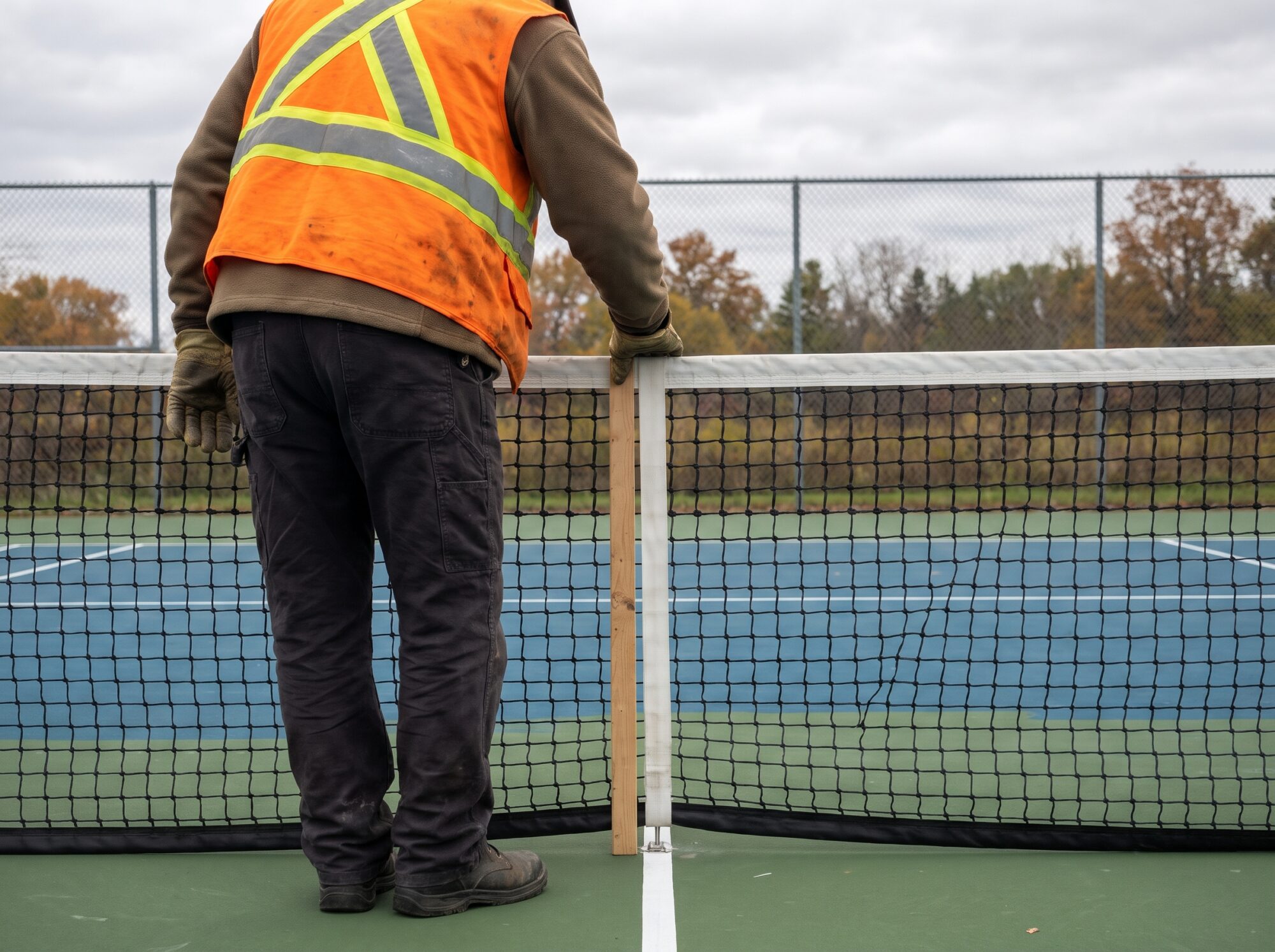
Net height gets checked more often than it gets checked well. A casual look from the baseline will not catch a net that is half an inch off. A tape measure, a steady hand and the right sequence will.
Step by Step
- Start at the centre. Hold a tape or a rigid measuring stick on the playing surface right beside the centre strap and read to the top of the white band. You are looking for 36 inches (91.4 cm).
- Check each post. Measure at the post on each side to the top of the band. You are looking for 42 inches (106.7 cm).
- Compare the two ends. If one post reads higher than the other, the net is not level across the court. That points to a post, a footing or the surface, not the net.
- Look along the net from the side. A healthy net rises smoothly from the centre to each post. A sag or a hump between them usually means the cable tension is wrong.
- Re-check the centre after you adjust the posts. Changing post tension moves the centre, and the strap may need a final tweak.
Tools That Make It Easier
A plain tape measure works. A rigid stick marked at 36 and 42 inches is faster and removes the problem of a tape bending under its own weight. Some clubs keep a gauge at the courts so coaches can check before a session. If you only have a racquet, a standard racquet length is a rough guide, but it will not catch a half inch.
How the Centre Gets Adjusted
The centre height is set at the strap, and most permanent systems let you lengthen or shorten the strap or move its anchor. The post end is normally adjusted by a winch or crank that tightens the cable. The exact hardware varies between net systems, so follow the instructions for your system. Our guide to tennis court net systems covers the common types and their maintenance.
Tennis Net Height vs Pickleball Net Height
A pickleball net is lower than a tennis net. Under the USA Pickleball rulebook, the net is 36 inches at the sidelines and 34 inches at the centre, so the posts are six inches lower and the centre is two inches lower than tennis. The details are in our dedicated guide to pickleball net height and net post planning.
| Item | Tennis (ITF) | Pickleball (USA Pickleball) |
|---|---|---|
| Height at posts or sidelines | 42 in (1.07 m) at the posts | 36 in (91.4 cm) at the sidelines |
| Height at centre | 36 in (0.914 m) | 34 in (86.4 cm) |
| Where the posts stand | 3 ft outside the doubles court | About a foot outside the sideline |
| Maximum post size | 6 in (15 cm) | 3 in (7.5 cm) |
The two layouts do not share posts. That matters for anyone planning a shared court, and it is the reason a tennis-to-pickleball conversion needs a plan for the posts and not just new lines. Our guide to converting a tennis court into a pickleball court in Ontario and the comparison of pickleball and tennis courts go through the options. For other sports, our dimension guides for volleyball and basketball cover net and rim heights separately.
Why the Net Dips in the Middle
The six-inch dip is part of the rule, not a sign of a tired net. The ITF specifies 3 feet at the centre and 3 feet 6 inches at the posts, and the strap is what holds the centre to that lower figure. If you see a net with no dip, it is set to the wrong height. If you see a net that dips more than six inches, the strap or cable needs attention.
Net Posts on a Permanent Tennis Court
On a portable net you can fix a mistake in minutes. On a permanent court the net height is locked in by decisions made during construction, and the posts are the biggest of them.
Where the Posts Go and How Far Apart
| Layout item | Figure | Source |
|---|---|---|
| Doubles court width | 36 ft (10.97 m) | ITF Rule 1 |
| Post centre outside each doubles sideline | 3 ft (0.914 m) | ITF Rule 1 |
| Distance between post centres | 42 ft (calculated: 36 + 3 + 3) | Calculated from ITF figures |
| Court length | 78 ft (23.77 m) | ITF Rule 1 |
| Net position | Across the middle of the court, at 39 ft from each baseline | Calculated: half of 78 ft |
Because the posts sit outside the court, the sleeves have to be set in the right place relative to the court lines. That is a layout job done with a total station or string lines and a laser. Our guide to how tennis court dimensions evolved gives some background on why the numbers are what they are.
Sleeves and Footings
Most permanent systems use a steel sleeve cast into a concrete footing, with the post dropping into the sleeve so it can be removed and replaced. The sleeve has to stay plumb while the concrete sets, and its top has to line up with the finished surface. The size and depth of the footing is a design decision for the builder and depends on the post, the net tension, the soil and local frost conditions. We do not give a generic footing depth here because a figure that is right for one site can be wrong for another. If you are planning a build, ask for the footing design to be explained as part of the quote.
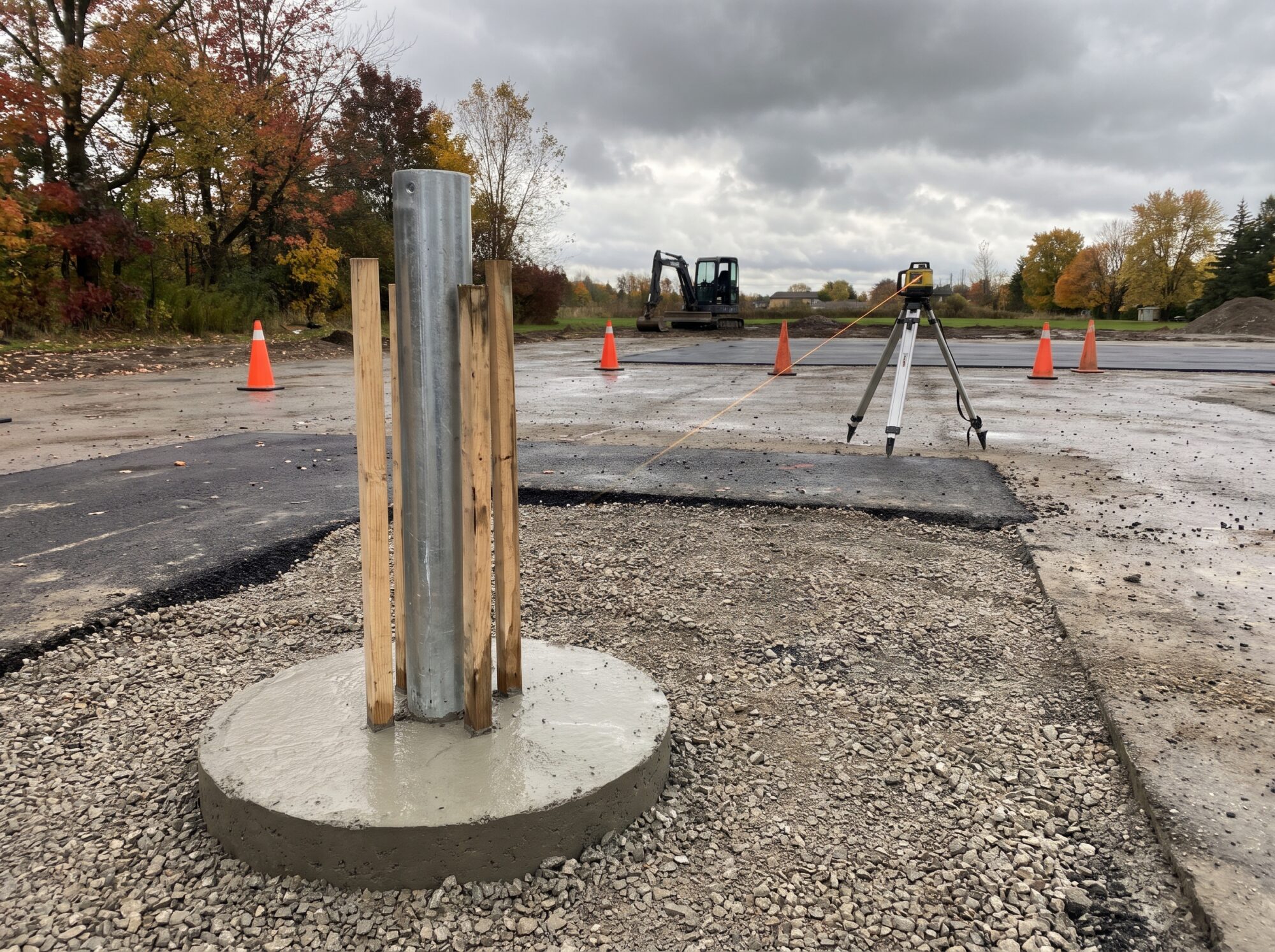
The sleeves are normally set while the base is open and before the pad goes down, which is why they come up so early in a project. Retrofitting a post into a finished court means cutting into the surface, so it is better to settle the net setup first. The same logic applies to fence posts, which is covered in our guide to tennis court fencing.
Why Grading and Slope Matter to Net Height
Net height is measured from the playing surface, so any slope or low spot under the net changes the number. A court has to shed water, which means it is not perfectly flat, and the grading plan decides how much fall there is and in which direction. The builder has to account for that fall when setting the posts, so the net reads correctly at both ends and at the centre. The details of slope and drainage are a design question for each site, and our articles on accurate grading for sports court drainage and tennis court drainage systems explain the principles. CrowAll’s laser guided grading page describes how precise grading is done.
Orientation
The Tennis Canada Tennis Court Design Standards state that outdoor courts must be built with a north-south orientation, and its court layouts are based on the ITF recommended measurements. That is a layout rule for the court, not a net rule, but it decides which way the net runs and which side faces the afternoon sun.
Net Height and Different Court Surfaces
The rule is the same on every surface, but the surface changes how you keep to it.
| Surface | What to watch | Practical note |
|---|---|---|
| Acrylic hard court | Coating layers add to the surface over time | Re-check net height after resurfacing |
| Soft asphalt or sealed asphalt | Settlement or cracking near posts | Inspect around sleeves each spring |
| Har-Tru or other clay | Loose material gets brushed, rolled and topped up | Measure from the compacted playing surface |
| Artificial turf | Pile and infill depth vary with wear | Measure at the same spot each time |
If you are weighing surfaces, our guides on the four types of tennis courts, ClayTech and Har-Tru and soft asphalt are good places to start. Whatever you choose, tell your builder how the net setup should be checked after the surface changes.
Common Net Height Problems and Likely Causes
| What you see | Likely cause | What to do |
|---|---|---|
| Centre reads above 36 in | Strap too short or anchor has moved | Adjust the strap, then re-measure |
| Centre reads below 36 in | Strap stretched or anchor loose | Replace or re-seat the strap |
| One post higher than the other | Footing movement, surface settlement or uneven cable setup | Measure both posts, then have the footing checked |
| Net sags between strap and post | Cable loose or worn | Tighten or replace the cable |
| Posts lean | Footing has shifted | Call a court builder before tightening further |
| Cracks radiating from a sleeve | Movement or water getting in around the post | See our guide to sport court crack repair |
A net that keeps drifting after you adjust it usually has a structural cause. Tightening a cable against a leaning post only hides the problem for a while.
Seasonal Care for Nets and Posts in Ontario
Ontario winters are hard on anything bolted to the ground. Water gets into sleeves, freezes and thaws, and posts can shift over a season. Many owners take the net down for winter to protect the cable and band, and our guides to winter court maintenance and seasonal tennis court upkeep cover the wider routine.
A simple spring check works well. Re-hang the net, measure the centre and both posts, look around each sleeve for cracks and standing water, and check the strap for wear. If the numbers are off after a hard winter, it is easier to deal with before the season starts than halfway through it. When a court has aged to the point where a post or surface keeps causing trouble, our article on maintenance vs replacement and the guide to when it is time to resurface will help you decide.
Choosing a Net Setup for Your Property Type
The height is the same for everyone. What changes is how the net is mounted, who adjusts it and how often.
Homeowners and Private Estates
A private court usually has light use and one or two people looking after it. A permanent post with a simple winch is normally enough, and the main decision is whether the net comes down for winter. If you are still deciding whether to build, our guides to building a tennis court for home use and tennis court costs in 2026 are useful starting points.
Clubs and Schools
Shared courts get adjusted by many people, so a clear centre strap and a measuring stick kept on site prevent drift. If singles and doubles are both played, plan where the singles sticks live. If a club is considering pickleball on the same pad, talk through post positions early, because the two sports use different posts.
Municipalities and Facility Managers
Public courts take more wear and more vandalism, and the net hardware is part of that. Choose posts and fittings that suit a maintenance schedule your team can actually follow, and write the spring net check into it. Before any work, confirm whether permits or utility locates are needed, which is covered in our guide on permits for sports courts. In Ontario, digging for footings requires locates through Ontario Dig Authority.
Developers, Landscape Architects and Contractors
If a court is part of a larger site, the net posts, fence posts and lighting poles all need footings, and it saves money to plan them together. Our guide to sport court lighting and CrowAll’s landscape design page show how those pieces fit around the court.
Planning a Tennis Court or Resurfacing With CrowAll
Net height is a small number with a long chain of decisions behind it. CrowAll builds and resurfaces tennis courts across Ontario, and our why choose us and company profile pages explain how we work. You can see finished work in the gallery, browse the surfaces and products, or read about our tennis court services and the areas we serve.
If you are a homeowner, a club, a school, a municipality or a developer planning a new court or a resurfacing, contact CrowAll to talk through your site conditions, your net and post options and your goals. Our website describes free consultations and quotes, and we are happy to go through the layout with you before anything is poured. If you are looking at timing, our guide to the best time of year to build a sports court is a good companion.
Frequently Asked Questions About Tennis Net Height
What is the height of a tennis net?
A tennis net is 3 feet 6 inches (1.07 m) high at the posts and 3 feet (0.914 m) high at the centre, measured from the playing surface to the top of the net. The centre is held down by a strap, which creates the six-inch dip.
What is the centre height of a tennis net?
The centre height is 3 feet, which is 36 inches or 0.914 metres. It is set by the centre strap, which has to be white and no wider than 2 inches (5 cm) under the ITF rules.
How high is a tennis net in inches?
The net is 42 inches high at the posts and 36 inches high at the centre. Those are the inch equivalents of the ITF figures of 3½ feet and 3 feet.
How high is a tennis net in centimetres and metres?
The ITF gives 1.07 m at the posts and 0.914 m at the centre. In centimetres that is about 107 cm and 91.4 cm.
Is the tennis net height the same for singles and doubles?
Yes. The heights are the same. What changes is where the net is supported. For singles on a doubles net, singles sticks are placed 3 feet outside the singles court so the net is held at the right height at the singles sidelines.
Why is a tennis net lower in the middle?
The rules call for 3 feet at the centre and 3 feet 6 inches at the posts, and a strap pins the centre at the lower figure. Without the strap, the centre would sit higher than the rule allows.
Is tennis net height the same as pickleball?
No. A pickleball net is 36 inches at the sidelines and 34 inches at the centre under the USA Pickleball rulebook, so it is six inches lower at the posts and two inches lower at the centre than a tennis net.
How far apart are tennis net posts?
On a doubles court the post centres sit 3 feet outside each doubles sideline. With a 36 foot wide court that works out to 42 feet between post centres.
How big can tennis net posts be?
The ITF says net posts must be no more than 6 inches (15 cm) square or in diameter. Singles sticks must be no more than 3 inches (7.5 cm).
How do you measure tennis net height?
Measure from the playing surface to the top of the white band at the centre strap first, then at each post. You should read 36 inches at the centre and 42 inches at each post. A rigid stick marked at those heights is faster than a tape.
How do you adjust tennis net height?
The centre is adjusted at the strap and the post ends by tightening or loosening the cable with the winch or crank on the post. Hardware varies, so follow the instructions for your system and re-check the centre after any post adjustment.
How wide is the net strap and band?
The centre strap can be no wider than 2 inches (5 cm), and the band along the top must be between 2 and 2½ inches (5 and 6.35 cm) deep on each side. Both have to be completely white.
How thick can the net cable be?
The ITF caps the cord or metal cable at 1/3 inch (0.8 cm) in diameter. Check this if you are replacing a cable on a permanent system.
Does net height change after a court is resurfaced?
It can. A new coating adds a thin layer to the surface, and the net is measured from the surface, so it is worth re-measuring the centre and both posts after resurfacing and adjusting if the numbers have moved.
Do net posts need footings in Ontario?
Permanent posts normally sit in sleeves set in concrete footings. The size and depth depend on the post, the soil and frost conditions on the site, so ask your builder to explain the design. Utility locates are needed before digging.
Does CrowAll build tennis courts with permanent net posts?
CrowAll builds and resurfaces tennis courts across Ontario, and its website describes free consultations and quotes. Contact the team to talk through your site, your net and post options and how the court will be used.