Sport Court Color Options in Ontario: Choosing the Right Acrylic Coating Colors
Every conversation CrowAll has about resurfacing a tennis court, building a new pickleball court, or coating a backyard basketball pad eventually gets to the same question: what color should it be? Most people assume the answer is purely cosmetic, a choice about what looks good against the house or the landscaping. It isn’t. Court color affects how well players track the ball, how hot the surface gets on a July afternoon, how a court reads from a distance, and how long a coating job looks fresh before it needs attention again.
This guide walks through how acrylic sport court coating colors actually work, the standard combinations used for tennis, pickleball, basketball, and multi-sport courts, the climate factors that matter specifically in Ontario, and how to think through a color decision without guessing. None of the figures here are invented. Where a specific claim needed a source beyond CrowAll’s own project experience, it is cited directly to the governing body or public agency that published it.
Why Court Color Is a Functional Decision, Not Just an Aesthetic One
Homeowners tend to start the color conversation the way they would pick a deck stain or a fence color, by browsing photos and picking what appeals to them. That instinct isn’t wrong, a court sits in a yard or a facility for a decade or more and it should look good. But three functional factors sit underneath the aesthetic choice, and skipping them is how people end up with a court that looks great in photos and plays worse than it should.
Ball Visibility and Contrast
The core function of court color is contrast against a moving ball. A tennis ball is optic yellow for a reason: it shows up clearly against green grass, blue hard court, and red clay alike. But the court surface still matters for depth perception and for tracking the ball’s bounce and spin against the background. A pickleball, which is smaller, lighter, and often a less saturated color than a tennis ball, is more sensitive to this. USA Pickleball’s own outdoor court construction guidance recommends choosing a ball color that sits opposite the court color on a color wheel, specifically because that relationship produces the strongest visual contrast between ball and surface. The same logic is why most pickleball courts pair a darker blue or green playing surface with a lighter, more neutral out-of-bounds area rather than choosing colors at random.
Surface Temperature and Heat Absorption
Darker acrylic coatings absorb more solar radiation and run hotter underfoot than lighter ones on the same sunny afternoon. This isn’t a small effect. A dark green or navy court surface can run noticeably hotter to the touch than a light gray or sand-toned surface finished the same week, purely because of how much light energy the pigment reflects versus absorbs. USA Pickleball’s construction guidance makes the same point directly, noting that lighter colors absorb less heat from the sun and keep the surface cooler, while darker colors absorb more. For a court that gets heavy midday use through an Ontario summer, that difference shows up as real player comfort, particularly for kids, older players, and anyone playing back-to-back matches.
Glare and Player Comfort
The flip side of a very light, low-heat-absorption color is glare. A pale surface under direct summer sun can be genuinely hard to look at for extended play, especially on courts oriented so players face into low afternoon light. This is one reason mid-tone colors, rather than the lightest or darkest options on a coating manufacturer’s chart, dominate most standard court color palettes. They balance heat absorption against glare rather than optimizing for only one of the two.
Standard Color Combinations by Sport
Every sport that CrowAll builds or resurfaces courts for in Ontario has its own set of conventional color pairings. None of these are strict rules the way net height or court dimensions are (see CrowAll’s guide to tennis court dimensions and pickleball court dimensions for the figures that are genuinely fixed), but they’ve become conventional for good reasons rooted in contrast, tradition, and glare management.
Tennis Court Color Combinations
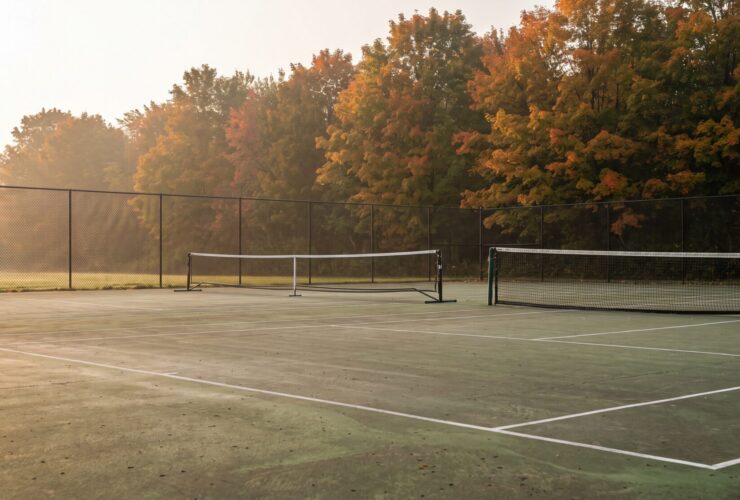
The most widely recognized modern tennis court scheme is a blue playing surface with a green surround, popularized on the professional tour and now common at clubs and private courts across North America. The blue improves contrast against the optic-yellow ball for players and spectators alike, and the green border visually separates the in-play area from the apron. A two-tone green court, playing surface and surround in different shades of the same color family, remains a classic look often chosen for private residential courts and older clubs that want a more traditional appearance. Where a court uses clay or a clay-look surface rather than an acrylic-coated hard court, the red-and-green pairing associated with European clay courts is the dominant convention instead.
Pickleball Court Colors and the Non-Volley Zone
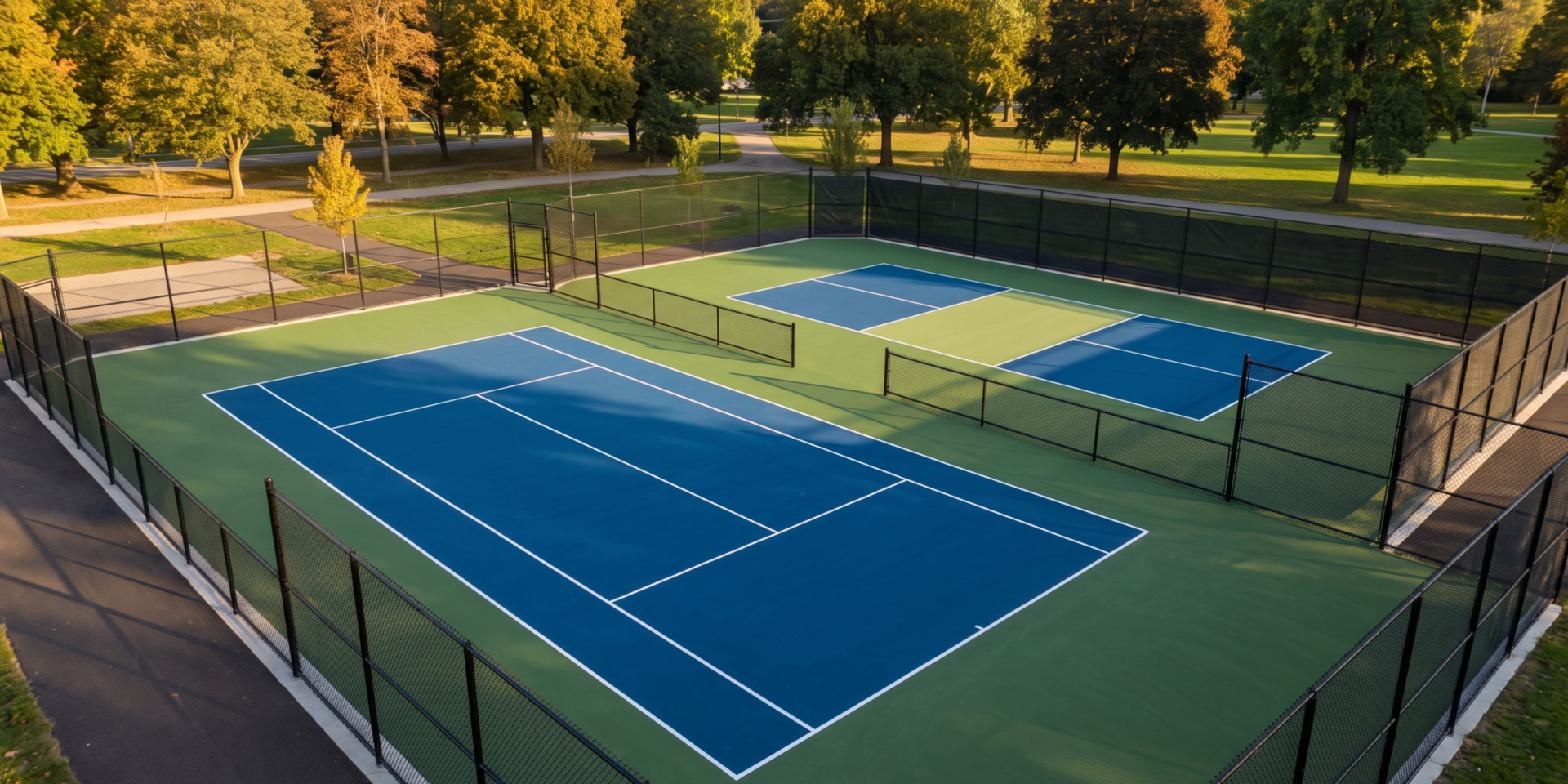
Pickleball color conventions are newer and less standardized than tennis, which is part of why so many owners ask about it specifically. There is no official rule mandating a specific court color. What has become common, largely following the lead of manufacturers and tournament organizers, is a darker playing-surface color (blue and green are both popular) paired with a visibly lighter shade marking the non-volley zone, commonly called the kitchen. That contrast helps players read, at a glance and mid-rally, whether they or an opponent are standing inside the zone, which matters because foot faults in the kitchen are one of the more commonly called rule violations in recreational and competitive play alike. Out-of-bounds areas are typically a third, more neutral tone, which is where the popular three-tone pickleball look comes from.
Basketball Court Color Schemes
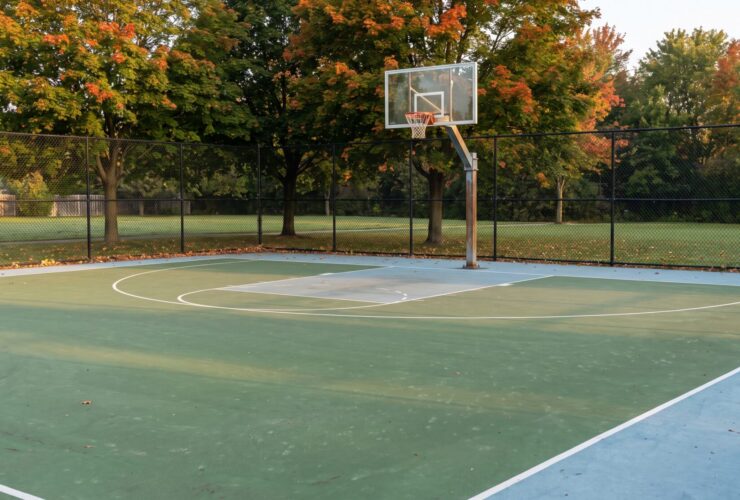
Outdoor basketball surfaces see far less color variation than tennis or pickleball. Green and blue remain the most common playing-surface colors for backyard basketball court installations and driveway conversions, generally paired with a contrasting key and free-throw lane so the scoring areas are easy to identify from any angle. CrowAll’s guide on choosing the right basketball court surface covers material selection in more depth; color choice on a basketball pad tends to follow whatever the household or facility already favors, since there’s no strong contrast argument pushing one color over another the way there is with a smaller, faster-moving ball like a pickleball.
Multi-Sport and Combination Courts
Courts built to host more than one sport on the same footprint, the subject of CrowAll’s multi-sport court construction guide, present a genuinely different color problem. Different sports use different court lines on the same surface, and color has to do double duty: distinguishing playing area from out-of-bounds while also keeping each sport’s lines visually distinct from the others. The usual solution is a neutral or single dominant base color with lines for each sport painted in a different, high-contrast color per sport (tennis lines in white, pickleball lines in yellow, basketball key markings in a third color, for example) rather than trying to zone the base coating itself by sport.
How Acrylic Coating Colors Actually Work
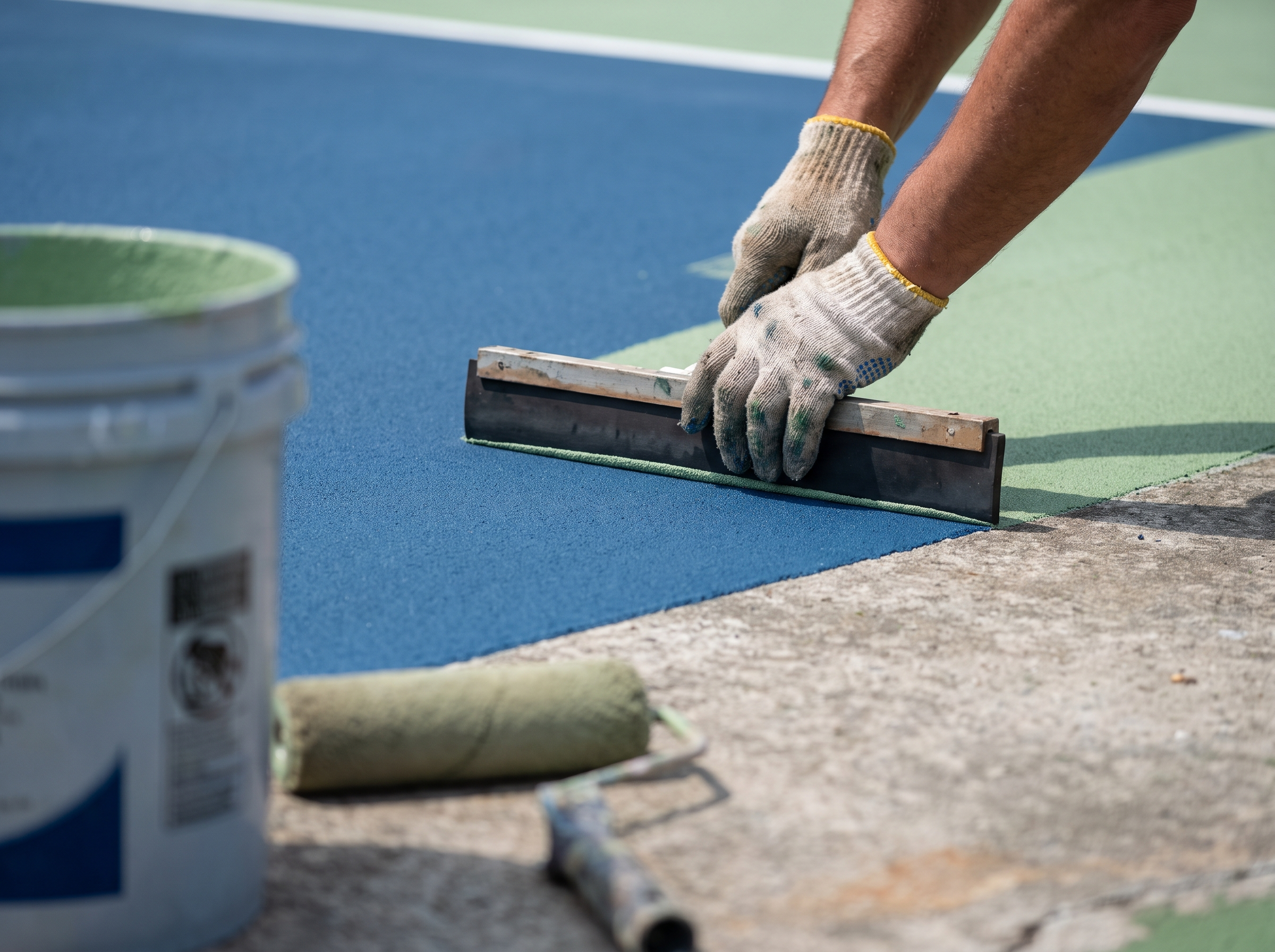
Color on a hard court isn’t paint in the way a wall or a fence is painted. CrowAll applies acrylic resurfacing systems, including Laykold’s NuSurf and ColorFlex product lines, which are built up in multiple layers rather than a single coat. Each layer serves a purpose: texture coats that build the cushioning and grip underfoot, and color coats applied on top that carry the actual pigment and UV-resistant finish. The color you see on a finished court is the top layer of that system, but the number and quality of the layers underneath it directly affects how long that color holds up.
Coating Systems and Color Application
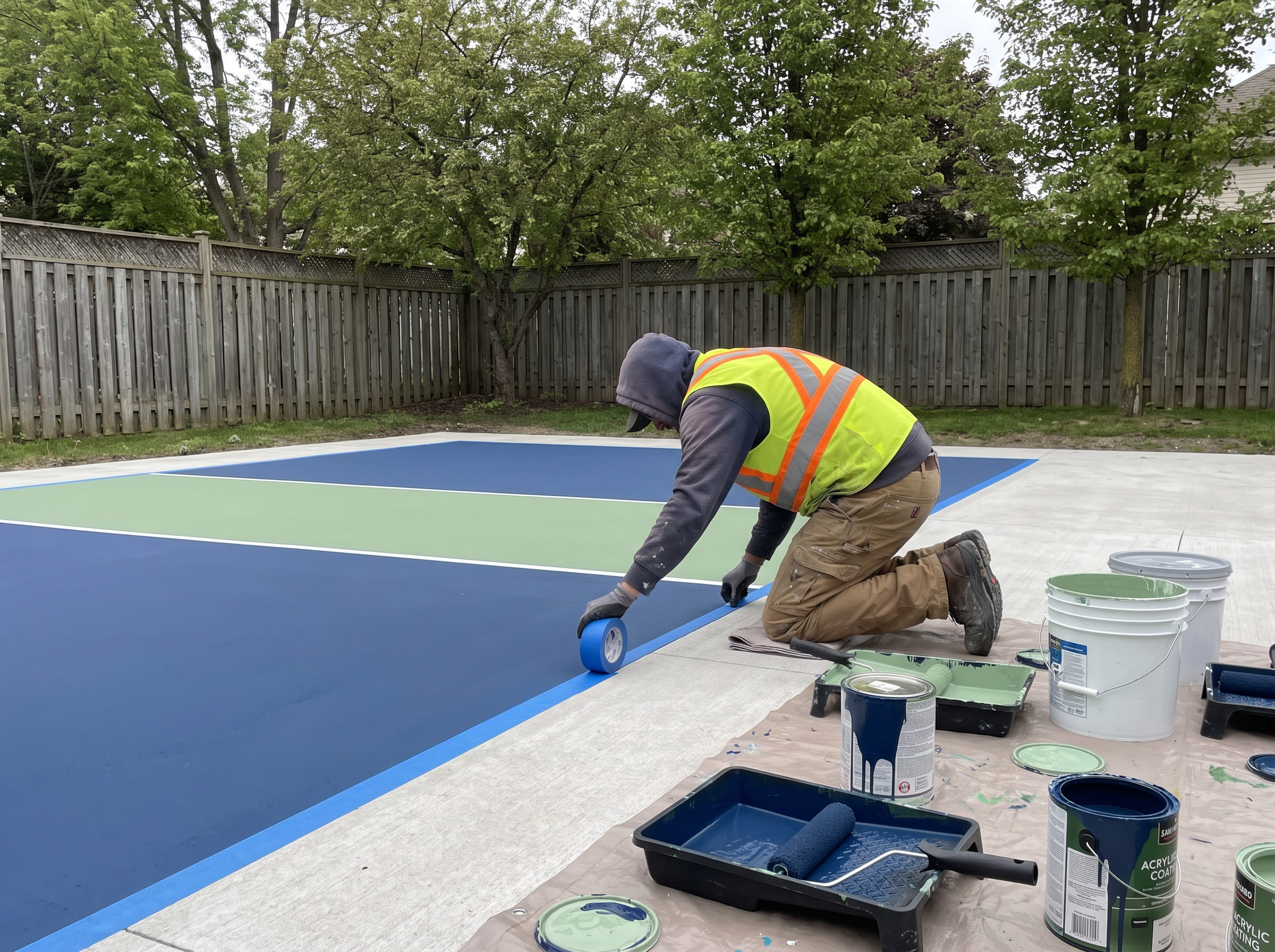
A typical acrylic resurfacing job for a hard court involves several distinct coats: a patch and leveling pass to correct any surface irregularities, one or more texture coats (often called cushion or acrylic resurfacer coats) that build the base texture and, on cushioned systems, the shock absorption, and finally two or more finish coats that carry the actual color. Manufacturers including Laykold offer standardized color charts, typically a mix of what CrowAll’s product catalogue describes as its “premium acrylic coating systems,” alongside custom-blend options for owners who want something outside the standard palette. Two-color designs require careful masking between coats so the color line stays crisp rather than bleeding, which is part of why a professional application, rather than a DIY roller job, produces a noticeably cleaner result on courts with a two-tone or three-tone design.
What Determines How a Color Holds Up
Color longevity comes down to coating thickness, UV exposure, and the quality of the base layers underneath. A thin, single finish coat over a poorly prepared surface fades and chalks faster than a properly built-up system with adequate finish coats, regardless of which color was chosen. This is one of several reasons CrowAll’s approach starts with laser-guided grading and a properly prepared base rather than jumping straight to color selection; a coating system only performs as well as what it’s applied over.
Two-Tone, Three-Tone, and Custom Color Designs
Most residential and club courts fall into one of three design categories, and the choice affects both the visual result and the complexity of the application.
A two-tone court uses one color for the in-play area and a second, usually complementary color for the surround or apron. This is the most common configuration for tennis and for basketball, and it’s the simplest to apply since it only requires masking a single boundary line between colors. A three-tone design adds a third color, typically used to mark a specific functional zone, the pickleball kitchen being the clearest example, or to add a decorative border or accent stripe. Three-tone jobs take longer to mask and coat correctly but are increasingly the default expectation on pickleball courts specifically, since the kitchen-zone contrast has become close to a design standard even without being an official rule.
Fully custom designs, matching a school’s team colors, a corporate campus’s branding, or simply a homeowner’s personal preference outside the standard color chart, are possible with most acrylic coating systems but typically involve a custom color match or blend rather than a stock chart color. That adds cost and lead time and is worth discussing early in the planning process rather than after a standard-color quote has already been prepared. CrowAll’s product catalogue outlines the acrylic coating options available as a starting point for that conversation.
Sheen, Texture, and Glare Reduction
Color isn’t the only optical property that matters in a finish coat. Acrylic sport surfacing is formulated with a matte, low-glare finish rather than the gloss sheen used on many other exterior coatings, and that texture plays into the same visibility conversation as the color itself. A glossy surface, even in a well-chosen color, would bounce direct sunlight back toward players at a low angle and create exactly the kind of glare that undermines the contrast benefit the color was chosen for in the first place. The fine aggregate texture built into most acrylic systems, on top of reducing glare, also improves footing and ball bounce consistency, which is part of why 100 percent acrylic coatings are the standard recommendation for outdoor pickleball and tennis surfacing rather than a smooth painted finish.
What to Confirm Before Committing to a Color
A short set of questions, asked before a color is locked in rather than after the first coat goes down, avoids most of the regrets owners run into later. Is the color being chosen from a manufacturer’s standard chart, or does it need a custom match, and if custom, what does that add to lead time and cost? Does the court’s primary use skew toward heavy midday summer play, where a lighter or mid-tone shade will matter for comfort, or is it lightly used and shaded enough that a darker, richer color is a reasonable trade-off? For pickleball specifically, is a distinct kitchen-zone color wanted, given how established that convention has become even without being an official rule? And for any court in a shared community, school, or municipal setting, have the relevant design guidelines or approval requirements actually been checked, rather than assumed?
Reviewing physical color chips or a small sample panel outdoors, in the same lighting the finished court will actually sit in, is worth the extra step before finalizing a choice from a printed or digital chart. Color can read noticeably different under overcast Ontario sky than it does in a manufacturer’s studio photo, and a sample panel is a cheap way to avoid a surprise on a surface that’s expensive to redo.
Ontario Climate Considerations for Court Color
Color decisions that make sense in a warmer, sunnier climate don’t automatically transfer to Ontario, where courts have to handle both intense summer sun and a real winter. A few climate-specific factors are worth weighing alongside the standard contrast and aesthetic considerations.
Summer surface temperature is the most immediate concern. On a hot, sunny July or August day, a dark-coated hard court can reach surface temperatures well above the surrounding air temperature, which matters for barefoot use around a backyard court and for player comfort during long matches or tournament play. Choosing a mid-tone rather than the darkest available shade, particularly for a residential court that sees heavy midday use in summer, is a straightforward way to reduce that effect without sacrificing contrast. CrowAll’s articles on signs a court needs resurfacing before the heat hits and on general seasonal court care cover related summer-condition issues in more detail.
Winter is a different consideration entirely. Acrylic coatings are UV-resistant but still experience thermal cycling as Ontario swings between summer heat and winter freeze-thaw conditions, and darker colors that absorb more heat can actually help snow and ice clear faster on a court used for off-season storage or shoulder-season play, an effect USA Pickleball’s own construction guidance notes as a secondary benefit of darker coatings in colder climates. For a court that pulls double duty, hosting a sport in the warmer months and getting flooded for backyard skating in winter (see CrowAll’s guide to backyard ice rink construction for how that conversion works), color choice can genuinely factor into how quickly the surface sheds snow between uses.
Choosing Colors for Different Settings
The right color choice depends heavily on where the court sits and who uses it, not just on the sport being played.
Residential Backyard Courts
For a private backyard court, personal preference legitimately drives most of the decision. Owners often want the court to complement the house, the landscaping, or a favorite color scheme, and there’s no rule requiring a specific palette on private property. The main practical guidance worth following is still the contrast and heat principles above, and coordinating with a landscaping design plan so the finished court reads as part of the property rather than a jarring addition to it.
HOA and Community Courts
Courts in a homeowners’ association or shared community setting sometimes come with color restrictions written into the community’s design guidelines, particularly for visibility from neighbouring properties or the street. It’s worth checking any applicable HOA rules or municipal guidelines before finalizing a color choice on a shared-amenity court, the same way it’s worth confirming permit requirements before construction begins.
Schools and Municipal Facilities
Institutional courts frequently use color to reinforce identity, a school’s team colors, a municipality’s branding, or simply a durable, high-visibility combination chosen for heavy public use. These projects are also the most likely to involve a genuinely custom color match rather than a stock palette, since matching an existing brand color precisely usually requires it.
Club and Tournament-Level Courts
Clubs hosting sanctioned tournament play sometimes follow whatever color convention their governing sport or league association recommends for televised or competitive visibility, which is part of why the blue-and-green tennis scheme and the darker-blue-with-lighter-kitchen pickleball scheme have become so dominant; they were adopted first at the competitive level and filtered down into general use.
Color and Player Visibility: An Accessibility Note
Strong color contrast between the playing surface, the lines, and any functional zones doesn’t just help competitive play, it genuinely helps players with low vision track the ball and read court boundaries more easily. Ontario’s accessibility framework under the Accessibility for Ontarians with Disabilities Act sets broader standards for accessible design in public spaces, and while it doesn’t dictate sport-court coating colors specifically, the same contrast principles that improve ball visibility for every player, high-contrast lines against a clearly differentiated background, also tend to make a court easier to navigate visually for players with limited vision. It’s a reasonable factor to weigh for any court intended for public, school, or community use rather than a strictly private backyard.
Cost Considerations for Custom and Multi-Color Courts
Color choice affects project cost mainly through complexity rather than through the pigment itself. A standard two-tone job in stock chart colors adds minimal cost over a single-color court, since it mainly requires one additional masking and coating pass. A three-tone design with a kitchen zone or accent border costs more in labor, since each additional color requires its own masking, coating, and cure time before the next color can go down. Fully custom color matches, especially anything matching a specific brand color or a shade outside a manufacturer’s standard chart, typically carry the highest premium, both in material cost and in the lead time needed to formulate and confirm the match before application.
None of CrowAll’s public project figures break out color as a separate line item, since it’s folded into the broader acrylic coating scope of a build or resurfacing job. For a general sense of what a full project costs before color-specific questions come into play, CrowAll’s cost breakdown guide and 2026 tennis court cost guide cover the major cost drivers, and sports court landscaping cost covers what typically surrounds the court itself. A free consultation is the most reliable way to get project-specific numbers once a color direction is chosen.
Resurfacing, Fading, and Color Renewal
Acrylic coating color doesn’t last forever, even with UV-resistant formulations. Sun exposure gradually fades and chalks the surface over years of play, and a court that once had strong, saturated color contrast slowly loses some of that visual separation between zones. CrowAll’s guides on when to replace a synthetic tennis court surface and on the broader role of acrylic coating in court durability and aesthetics cover the signs that a recoat is due.
Resurfacing is also an opportunity to change color entirely, not just refresh what’s already there. A court that was coated in a color the current owner doesn’t love, or one built before the current pickleball kitchen-zone convention became standard, can be recoated with a new scheme during a normal resurfacing cycle rather than requiring a separate project. This is worth raising directly during a resurfacing consultation, since it’s a straightforward addition to a job that’s already stripping and recoating the surface rather than a major scope change.
The CrowAll Color Selection and Application Process
CrowAll’s approach to color on a new build or resurfacing project follows a consistent sequence, regardless of which sport the court is built for.
The process starts with the same site work every court needs: laser-guided grading and base preparation, since color and coating quality both depend on a properly built substrate underneath. Once the base and any structural work is confirmed, color selection happens alongside surface planning, reviewing standard chart options against the sport, setting, and climate factors covered above. For two-tone or three-tone designs, the application sequence involves masking each zone in turn, applying and curing one color before moving to the next, which is why multi-color jobs take longer on-site than a single-color coat. A final walkthrough confirms the finished lines and zones read clearly before the court is handed back for play. Owners considering a project can review CrowAll’s project gallery for examples of finished color schemes, and CrowAll’s why choose us page and company profile cover the broader construction and resurfacing capability behind that process.
Common Color Mistakes to Avoid
A few mistakes come up repeatedly on projects CrowAll is called in to fix or advise on after the fact. Choosing the darkest available color purely for aesthetic contrast, without weighing the summer heat effect, is the most common one on residential courts that see heavy midday family use. Skipping the kitchen-zone contrast on a new pickleball court, then wishing it were there once players start complaining about foot faults being hard to judge, is a close second. Choosing a fully custom color match without confirming lead time and cost upfront, only to find it delays the broader project timeline, is a planning mistake more than a color mistake, but it’s avoidable with an early conversation. And on multi-sport courts specifically, trying to color-zone the base coating by sport rather than relying on differentiated line colors on a neutral base tends to produce a confusing, visually busy result rather than the clean multi-use surface most owners actually want.
Sport Court Color Reference Tables
| Sport | Common Playing-Area Color | Common Surround Color | Typical Line Color |
|---|---|---|---|
| Tennis (hard court) | Blue | Green | White |
| Tennis (traditional) | Dark green | Light green | White |
| Tennis (clay-look) | Red/terracotta | Dark green | White |
| Pickleball | Blue or green | Neutral gray or sand | White or yellow |
| Basketball | Green or blue | Contrasting key/lane color | White |
| Multi-sport | Single neutral base | N/A | Different color per sport’s lines |
| Zone | Typical Color Approach | Purpose |
|---|---|---|
| Baseline-to-kitchen playing area | Darker blue or green | Ball contrast for rally play |
| Non-volley zone (“kitchen”) | Lighter, contrasting shade | Instant visual identification of the zone |
| Out-of-bounds apron | Neutral gray, sand, or third accent color | Separates play area from surrounding space |
| Court lines | White (most common) or yellow | Maximum contrast against the base color for boundary calls |
| Shade Family | Relative Heat Absorption | Best Suited For |
|---|---|---|
| Light gray, sand, light blue | Lower | Heavy midday summer use, family courts |
| Mid-tone blue, mid-tone green | Moderate | Balanced glare and heat, most standard courts |
| Dark green, navy, dark red | Higher | Shaded courts, courts used for winter flooding, cooler-climate facilities |
| Design | Colors Used | Relative Complexity/Cost | Typical Use Case |
|---|---|---|---|
| Single color | 1 | Lowest | Basketball pads, budget-focused builds |
| Two-tone | 2 | Low to moderate | Standard tennis and basketball courts |
| Three-tone | 3 | Moderate | Pickleball courts with a kitchen zone, accent-border designs |
| Fully custom match | Varies | Highest | Team/brand color matching, schools, institutional facilities |
| Factor | Effect on Color Longevity |
|---|---|
| Number of finish coats applied | More coats generally hold color and texture longer than a thin single coat |
| Sun exposure / orientation | South-facing, unshaded courts fade faster than partially shaded ones |
| Color saturation | Deeply saturated darker colors can show fading and chalking more visibly than mid-tones as pigment breaks down |
| Base preparation quality | A properly graded, cracked-free base extends the life of the coating system as a whole, including color |
| Maintenance program | Regular cleaning and prompt crack/patch repair slows visible fading and staining |
| Setting | Primary Consideration |
|---|---|
| Private residential court | Personal preference, coordination with landscaping, heat comfort for family use |
| HOA / shared community court | Community design guidelines and neighbour visibility |
| School or municipal facility | Brand/team color matching, durability under heavy public use |
| Club or tournament-level court | Conformance with competitive-play visibility conventions |
Frequently Asked Questions About Sport Court Colors
What is the most common tennis court color combination?
Blue for the playing surface with green for the surround is the most widely used modern combination, popularized by professional tour courts. Two-tone green remains a common traditional alternative, especially for private and club courts that prefer a classic look over the tour-style scheme.
Why are so many tennis courts blue instead of green?
Blue creates strong visual contrast against a fluorescent yellow tennis ball, which helps players and spectators track the ball more easily. The shift toward blue courts on the professional tour in the mid-2000s popularized the look, and it has since become common at clubs and private courts as well.
Is there an official rule for pickleball court colors?
No. There is no official rule mandating a specific pickleball court color. USA Pickleball’s own construction guidance offers a recommendation, choosing a ball color opposite the court color on a color wheel for contrast, but color itself is a design choice rather than a regulated requirement.
Why do pickleball courts have a different colored kitchen zone?
Marking the non-volley zone, or kitchen, in a lighter contrasting color makes it instantly visible during fast rallies, helping players judge foot faults and positioning without having to look down at the line itself. It has become a strong design convention even though it isn’t an official rule.
Do darker court colors really get hotter?
Yes. Darker acrylic coatings absorb more solar radiation and run hotter to the touch on sunny days than lighter shades of the same coating system. This is a documented effect noted directly in USA Pickleball’s outdoor court construction guidance and is worth weighing for any court with heavy midday summer use.
What color basketball court is most common for backyard installs?
Green and blue are the two most common playing-surface colors for backyard and driveway basketball installations, usually paired with a contrasting key and free-throw lane. There’s no strong functional argument favoring one over the other, so most choices come down to preference.
Can I choose a custom color that isn’t on the standard chart?
Yes, most acrylic coating manufacturers including Laykold offer custom color matching beyond their standard chart. It typically adds cost and lead time since the color has to be formulated and confirmed before application, so it’s worth raising early in project planning rather than after a standard-color quote is already prepared.
How many colors should a multi-sport court use?
Most multi-sport courts use a single neutral base color and differentiate each sport by line color rather than zoning the base coating by sport. Trying to color-code the base surface itself for multiple sports tends to produce a visually confusing result rather than a clean, easy-to-read multi-use surface.
Does court color affect how visible the ball is?
Yes. Contrast between the ball color and the court surface color is one of the main functional reasons court colors were standardized in the first place, and it remains the main technical argument for choosing one combination over another beyond simple preference.
How long does an acrylic coating color last before it fades?
Fade timing depends on the number of finish coats applied, sun exposure and orientation, and how well the court is maintained, so there’s no single fixed number. A properly built-up coating system on a well-maintained court holds its color and texture meaningfully longer than a thin coat over a poorly prepared base.
Does color choice add much to the cost of a resurfacing project?
A standard two-tone job in stock chart colors adds relatively little over a single-color court. Three-tone designs and fully custom color matches add more, mainly through additional labor for masking and coating each color separately and, for custom matches, the cost of formulating the color itself.
Can I match my court color to my house or landscaping?
Yes, and many residential clients do exactly that. Coordinating the court’s color scheme with the surrounding landscaping design and the home’s exterior is a common part of planning a private backyard court.
Do HOAs or municipalities ever restrict court colors?
Some homeowners’ associations and municipal guidelines include design or visibility restrictions that can affect color choice on a shared or highly visible court. It’s worth checking any applicable rules and permit requirements before finalizing a color for a court in a regulated community.
Can an existing faded court be recoated in a completely different color?
Yes. A resurfacing project that strips and recoats a worn surface is a natural point to change the color scheme entirely, whether that means updating an older court to a current convention like a pickleball kitchen zone or simply choosing a different look than what was originally installed.
What’s the difference between a two-tone and three-tone court?
A two-tone court uses one color for the playing area and a second for the surround, the simplest and most common configuration. A three-tone court adds a third color, most often to mark a specific functional zone like a pickleball kitchen or to add a decorative accent, and takes more time and masking to apply correctly.
Does color contrast help players with low vision?
Strong contrast between the base color, lines, and functional zones can make a court meaningfully easier to read visually for players with limited vision, even though sport-court coatings aren’t directly governed by Ontario’s accessibility standards. It’s a reasonable factor to weigh for any court intended for public or community use.
What color are pickleball court lines usually painted?
White is the most common line color on pickleball courts, chosen for maximum contrast against both blue and green base coatings. Yellow lines are used on some courts as an alternative, again chosen primarily for contrast against the base color.
Should I choose color before or after deciding on the court’s base material?
Base material and structural decisions should come first. Color selection happens alongside surface planning once the base, grading, and material choice (acrylic-coated hard court, clay, turf, and so on) are settled, since not every base material carries the same range of standard color options.
Color, Lighting, and Night Play
nn
Color choice does not stop mattering once the sun goes down. Good LED court lighting depends on the same contrast principles as daytime color selection, since low color-rendering light can wash out a carefully chosen color scheme. CrowAll’s guide to sport court lighting in Ontario covers color temperature, CRI, and fixture layout for anyone planning to add lighting alongside a new color scheme.
nn
Getting Color Right the First Time
Color is one of the last decisions made on a court project and one of the first things anyone actually notices about the finished result. Getting it right means weighing contrast, heat, setting, and cost together rather than picking from a swatch chart in isolation. CrowAll works through that decision as part of every new build and resurfacing project, whether it’s a straightforward two-tone tennis court or a three-zone pickleball court built to current standards. Reach out through CrowAll’s contact page to book a free consultation and talk through color options alongside the rest of your project’s build or resurfacing plan.