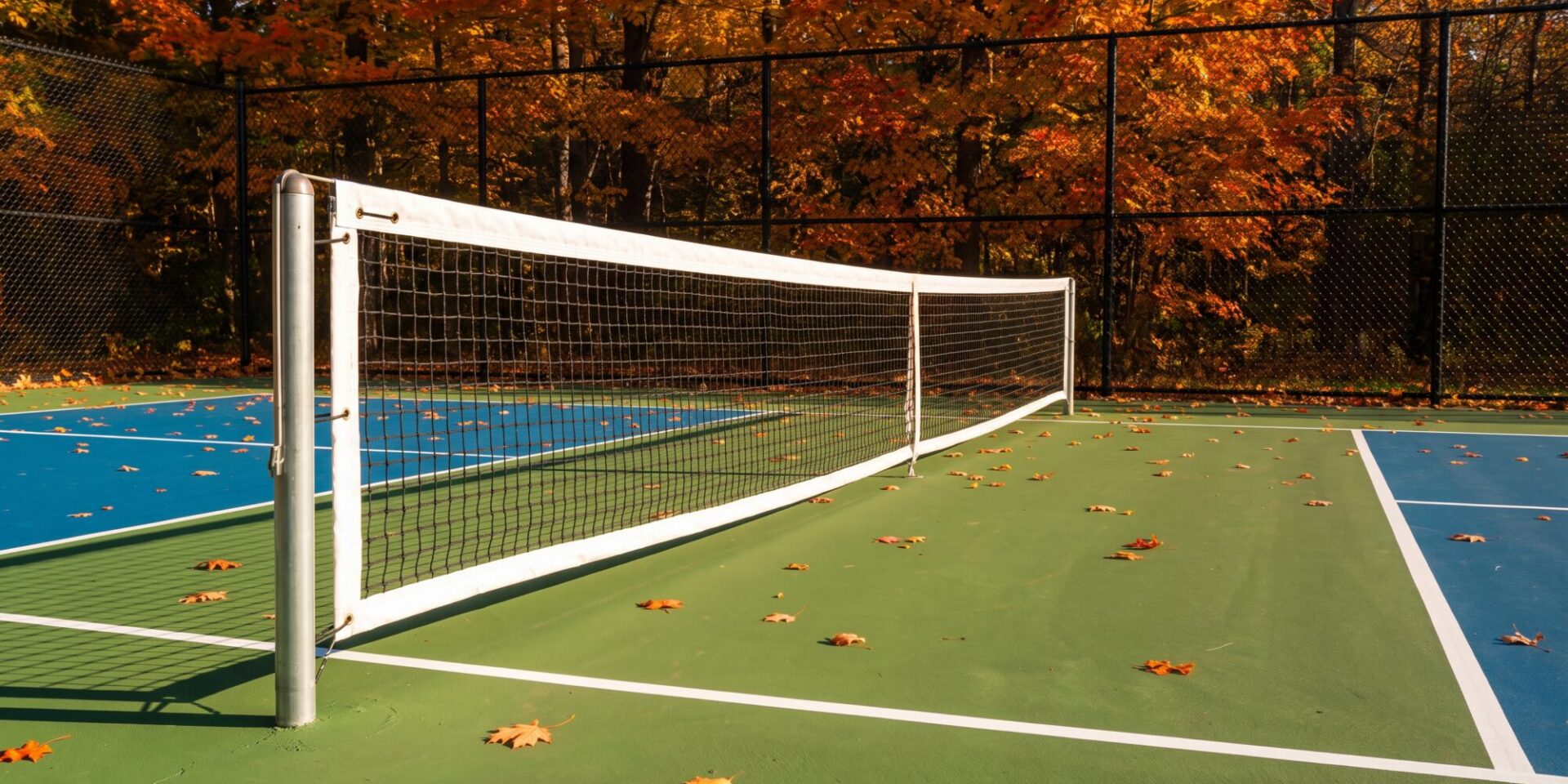
Pickleball Net Height: Official Measurements and Net Post Planning for Ontario Courts
Most people lift a tape measure to a pickleball net for the first time on a new court, and most of them are about two inches off. The net looks right, the posts look right, and then someone checks the middle and finds it sitting at tennis height. It is a small error that changes how the game plays, and on a permanent court it is also an error that is hard to fix once the posts are set in the ground.
This guide gives the official pickleball net height in inches and centimetres, shows where the numbers come from in the USA Pickleball rulebook, and explains how to measure them properly. It then goes further than most pages on the topic. If you are building or resurfacing a court in Ontario, the net is tied to post sleeves, footings, grading and line layout, and those decisions are made long before anyone hangs a net. Our full guide to pickleball court construction in Ontario covers the wider build, and this article focuses on the net and the posts that hold it.
The Short Answer: How High Is a Pickleball Net?
A pickleball net is 36 inches (91.4 cm) high at the sidelines and 34 inches (86.4 cm) high at the centre, measured from the playing surface to the top of the net. The USA Pickleball rulebook allows a tolerance of plus or minus a quarter of an inch at both points.
That is the whole rule in two numbers. The rest of this page is about getting those numbers right on a real court, with real posts, on a surface that is not always perfectly flat.
Pickleball Net Height at a Glance
| Measurement | Inches | Metric | Rule reference |
|---|---|---|---|
| Height at the sidelines | 36 plus or minus 0.25 | 91.44 cm | 2.C.5 |
| Height at the centre | 34 plus or minus 0.25 | 86.36 cm plus or minus 0.635 cm | 2.C.5 |
| Minimum net length | 21 ft 9 in | 6.63 m | 2.C.3 |
| Minimum net depth, bottom edge to top | 30 in | 76.2 cm | 2.C.3 |
| Post spacing, inside face to inside face | 22 ft plus or minus 1 in | 6.71 m plus or minus 2.54 cm | 2.C.2 |
| Maximum post diameter | 3 in | 7.62 cm | 2.C.2 |
| Top tape binding | 2 in white tape over a cord or cable | 5.08 cm | 2.C.4 |
These figures come from the rules published by USA Pickleball. If you are building for a sanctioned event or league, confirm which version of the rules it uses before you commit to a layout.
What the Rulebook Actually Says About the Net
Pages that repeat the 36 and 34 inch figures rarely tell you what else the rule covers. The net section of the USA Pickleball official rulebook is short, and every line of it matters when you are setting posts permanently.
Height at the Sidelines and at the Centre
Rule 2.C.5 sets the height at the point where the net crosses the sideline markers at 36 inches, and the height at the centre at 34 inches, each with a tolerance of a quarter of an inch. The centre point sits 10 feet from each sideline on a standard 20 foot wide court. If a centre strap is installed at that point, the net at the strap is held to the same 34 inch figure.
The two-inch drop is deliberate. A net held up by posts sags under its own weight, and the strap pulls the middle down to a fixed height so every court plays the same way. Without a strap, the centre height depends on how tight someone pulled the cable that day.
Net Length, Depth and Post Spacing
The rules call for a net at least 21 feet 9 inches long and at least 30 inches deep from bottom edge to top. Posts are placed 22 feet apart, measured from the inside face of one post to the inside face of the other, with a tolerance of one inch. Because a standard court is 20 feet wide, that spacing puts each post face about one foot outside the sideline.
Post diameter is capped at 3 inches. This catches people who try to reuse a heavy tennis post. A tennis post can be up to 6 inches square or round under the International Tennis Federation rules, so it may be too thick for pickleball play and too far from where a pickleball sideline sits.
Top Tape, Cord and Centre Strap
The top of the net is edged with 2 inch white tape binding over a cord or cable, and the binding has to rest on that cord. The net itself can be any mesh fabric that stops a ball from passing through. The rulebook does not name a material, which is why you see nylon, polyethylene and polyester nets in use. For a permanent outdoor court in Ontario, UV exposure and freeze-thaw cycling are good reasons to ask the net supplier what the mesh is made from and how it is rated for outdoor use.
Measured From the Playing Surface
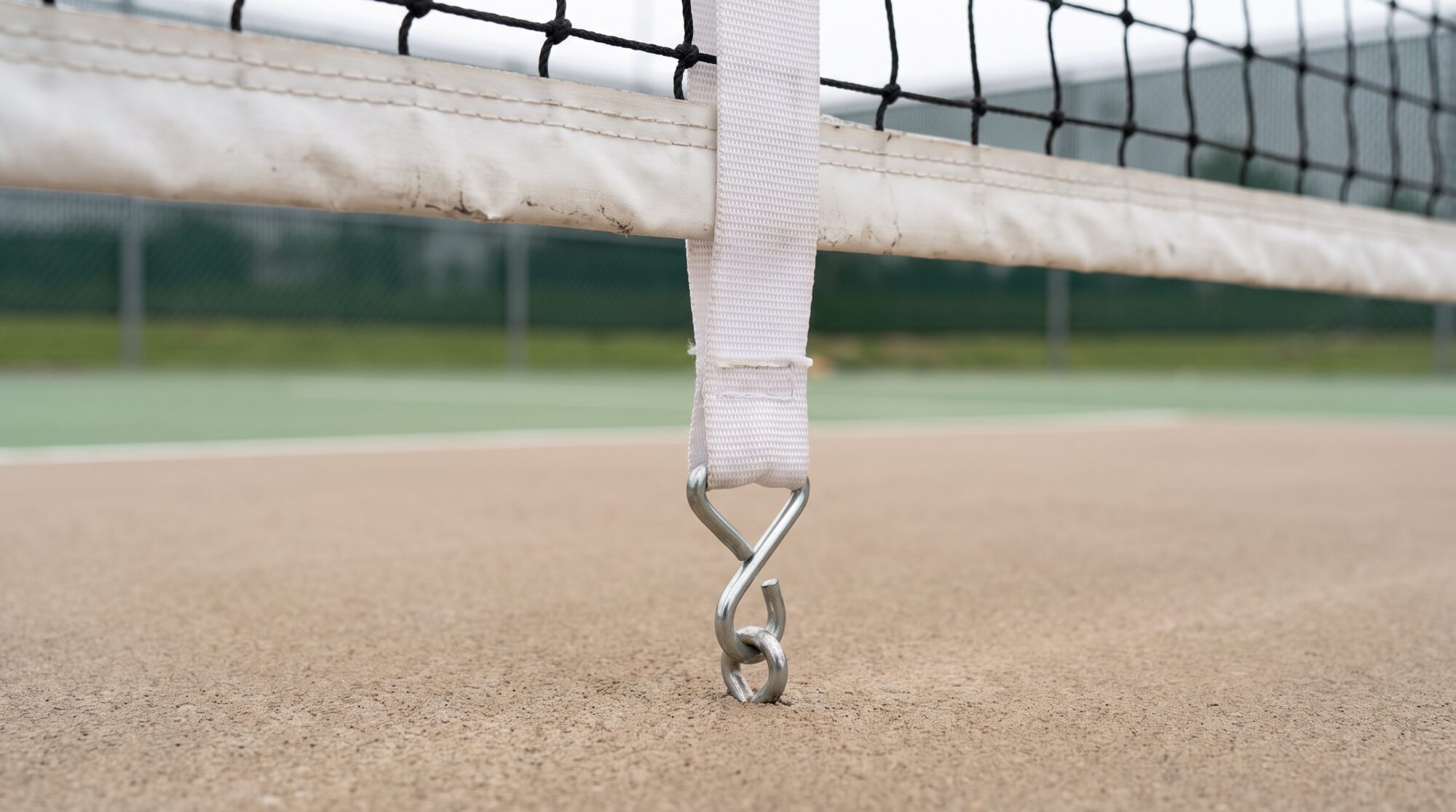
Height is measured from the playing surface to the top of the net. That sounds obvious until you consider what the playing surface is. On a well-built court it is a flat plane, so the measurement is the same everywhere. On a court with an uneven pad, a bird bath, or a post set on a slightly different grade than its twin, the height at one sideline can differ from the other even when both posts were cut to the same length. We come back to this in the section on posts and grading.
How to Measure Pickleball Net Height Properly
You need a tape measure with clear inch markings, a helper, and a few minutes. A rigid folding rule or a measuring stick cut to 34 and 36 inches is even better for repeat checks on a busy court.
A Simple Measuring Routine
- Pull the net tight and set the centre strap first, so the cable is carrying its load before you measure anything.
- Measure at the centre, 10 feet from either sideline, from the court surface to the top of the tape. Target 34 inches.
- Measure at each sideline where the net crosses the line. Target 36 inches at both posts.
- Check that the two sidelines read the same within the quarter-inch tolerance. If they do not, the cause is usually the post, the cable or the surface under it.
- Look along the length of the net from a low angle. The top should drop smoothly from post to centre with no kinks.
The Most Common Mistakes
| What you see | Likely cause | What to check |
|---|---|---|
| Centre sits at 36 inches or higher | No centre strap, or the strap is slack | Strap anchor point and strap length |
| One sideline reads higher than the other | Posts on different grades, or one post leaning | Surface level at each post, post plumb |
| Whole net reads about 6 inches too high | A tennis net or tennis post height was used | Post height, converter strap or portable net |
| Net droops between measurements | Cable stretched or loose at the post | Tension at the winch or tie-off |
| Height drifts through the season | Post footing has shifted | Post plumb, sleeve and footing condition |
If a post has moved, the fix is rarely just adjusting the cable. A leaning post on a permanent court usually means the footing was undersized, poorly compacted around, or sitting in water. That is a base-construction issue, and it ties back to drainage and grading decisions made before the pad went in.
Pickleball Net Height vs Tennis Net Height
Many Ontario pickleball courts start life as a tennis court, so the comparison matters in practice. The International Tennis Federation rules set the tennis net at 3 feet (0.914 m) at the centre and 3.5 feet (1.07 m) at the posts, as published in the ITF 2026 Rules of Tennis.
| Feature | Pickleball (USA Pickleball) | Tennis (ITF) |
|---|---|---|
| Height at the centre | 34 in (86.36 cm) | 36 in (0.914 m) |
| Height at the posts or sidelines | 36 in (91.44 cm) | 42 in (1.07 m) |
| Post position | 22 ft apart, inside face to inside face | Post centres 3 ft outside the doubles court |
| Maximum post size | 3 in diameter | 6 in square or round |
| Centre strap | Optional, holds net at 34 in | Required, no more than 2 in wide and white |
| Top band | 2 in white tape over cord or cable | 2 to 2.5 in on each side of the cord |
The centre difference is two inches and the post difference is six. That is why a tennis net on a pickleball court plays noticeably high at the sidelines, and why players who use one for a few games usually notice the ball catching the tape more often.
Can You Play Pickleball on a Tennis Net?
You can for casual play, but it is not the correct height. Net converter straps can pull a tennis net down toward pickleball height, and many shared courts use portable pickleball nets set in front of the tennis net. Our guide on pickleball court versus tennis court in Ontario covers the size and surface differences, and the walkthrough on how to convert a tennis court into a pickleball court explains what the full conversion involves, including permanent nets and line layout.
If you are considering a permanent pickleball net on an existing tennis court, the existing tennis posts are in the wrong place and are the wrong size for a pickleball net. A pickleball post sits roughly a foot outside a 20 foot sideline, while a tennis post sits 3 feet outside a doubles sideline. The two layouts do not share posts. Tennis Canada’s facilities approach to tennis and pickleball discusses shared-use options and portable nets for exactly this reason.
Net and Rim Heights Across Other Court Sports
Facility managers and schools often plan several sports on one pad or one property, so it helps to see how the heights compare. The figures below come from the governing rules we checked for our other dimension guides.
| Sport | Height | Source |
|---|---|---|
| Pickleball | 36 in at sidelines, 34 in at centre | USA Pickleball rulebook |
| Tennis | 42 in at posts, 36 in at centre | ITF Rules of Tennis |
| Volleyball, indoor, senior men | 2.43 m (about 7 ft 11.6 in) | FIVB rules 2025 to 2028 |
| Volleyball, indoor, senior women | 2.24 m (about 7 ft 4.2 in) | FIVB rules 2025 to 2028 |
| Basketball rim | 10 ft (3.05 m) | NBA Rule 1 |
If you are weighing a shared court, our guides to volleyball court dimensions and basketball court dimensions show how those sports fit on a pad, and our article on multi-sport court construction in Ontario explains how net sleeves, hoops and line colours are planned together so they do not fight for the same footprint.
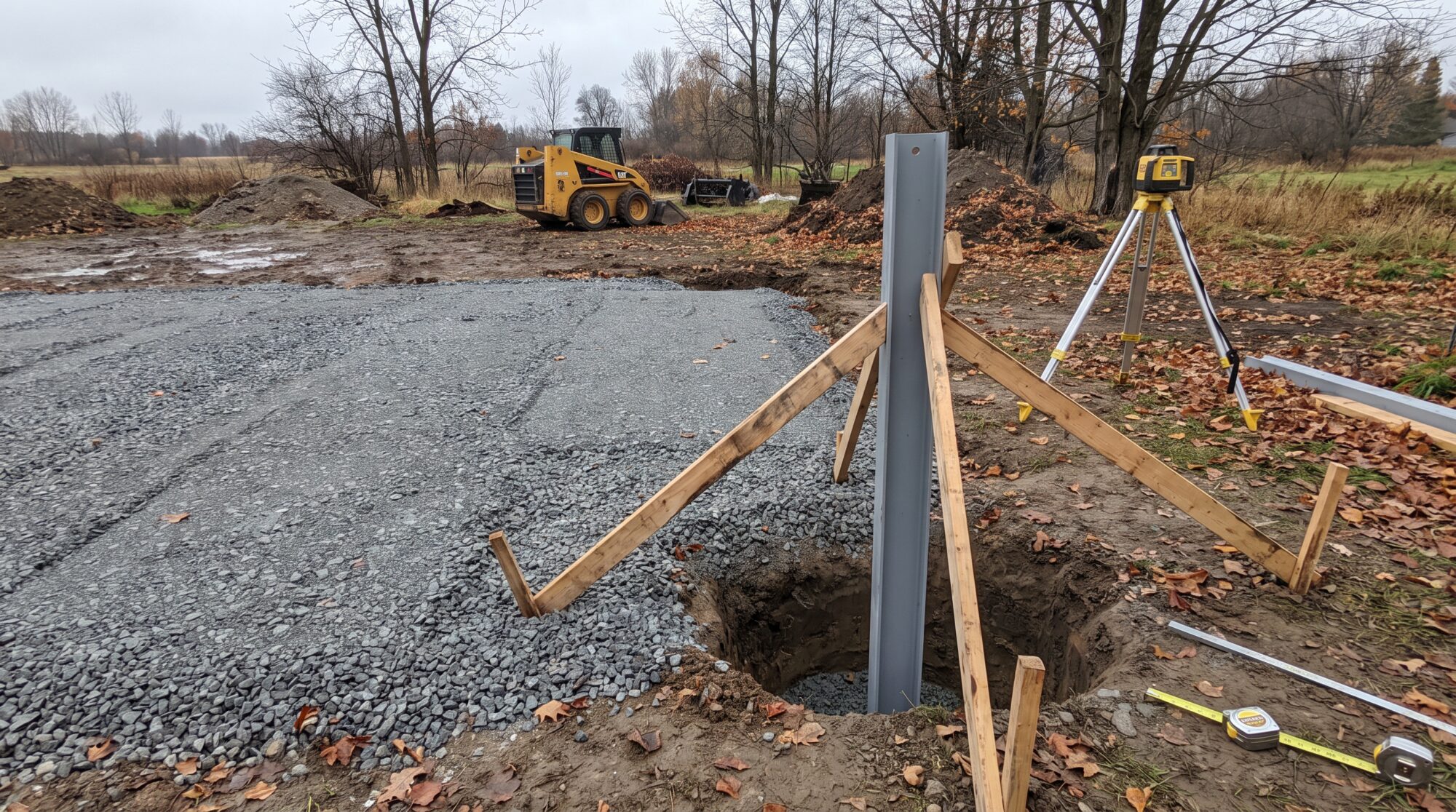
Net Posts on a Permanent Pickleball Court
A portable net can be nudged, shimmed and replaced. A permanent net depends on posts that were placed once, in the right spot, at the right time in the build. This is where a court builder spends most of the thinking about net height, because the number in the rulebook only holds if the posts do.
Where the Posts Go
On a standard 20 by 44 foot court, the rulebook puts the posts 22 feet apart, inside face to inside face. The court size in the rules is 20 by 44 feet, with a minimum playing area of 30 by 60 feet and a recommended 34 by 64 feet for new construction and tournament play. Our guide to pickleball court size and dimensions walks through that layout, including the non-volley zone lines the net sits beside.
Post position is set on the plan, not on the day. The net line has to sit at the centre of the court, perpendicular to the sidelines, and the posts have to land where the strap, the line marking and the fence gates all agree. That is why our site plans fix post positions at the same stage as fence lines and light poles.
Sleeves and Footings Belong in the Base
For a permanent build, net posts are normally set in ground sleeves held by concrete footings. Those footings are far easier to place while the site is open than to cut into a finished pad. Cutting through cured asphalt or concrete to add a sleeve later leaves a patch in the playing surface right at the centre of play, and it risks cracking around the opening.
Footing depth, diameter and reinforcement depend on the post, the soil, the local frost conditions and any engineering requirement, so they come from the post manufacturer and the project designer rather than from a rule of thumb in an article. What we can say from the build side is that the sleeve has to be plumb, square to the net line, and set at a height that lets the post cap sit flush with the finished surface. The photo above shows that stage: the sleeve is braced and the base is compacted, and neither the pad nor the acrylic has gone down yet. Our overview of the backyard sports court construction process shows where this fits in the sequence.
Grading and Levelness Affect Net Height
Because net height is measured from the playing surface, a court that is out of plane makes the rule hard to meet. If the two post sleeves sit on grades that differ by even a fraction of an inch, the sideline heights will differ with them. This is one of the practical reasons we care about accurate grading before any asphalt goes down. Our posts on accurate grading for sports court drainage and how laser-guided grading works explain the method, and our laser guided grading page describes the service.
A court also needs a gentle fall so water can leave it, and the amount depends on the design and the surface. The point for net planning is that the slope should be a deliberate, single plane across the whole court rather than a collection of local dips near the posts, where standing water also attacks footings.
Ontario Freeze-Thaw and Post Movement
Ontario winters move ground. Water that collects around a footing freezes, expands and can nudge a post out of plumb over several seasons. Good drainage around sleeves, well-compacted backfill and a footing that is sized for the post reduce the risk, but we would not promise that any particular footing will never move. If you are planning a court on clay soil or a wet site, ask your contractor how the post footings and the surrounding base are designed for that condition.
Call Before You Dig
Footing holes are excavation, and excavation in Ontario needs locates for buried utilities. The Ontario Dig Authority describes the locate process, and the request should be in well before work starts. Fencing posts, light poles and net sleeves all count.
| Build stage | Net post decision | Why it matters |
|---|---|---|
| Site plan | Net line, post positions and sleeve locations | Posts must agree with lines, fence gates and lighting |
| Locates and excavation | Utility locates before footing holes are dug | Protects buried services and the crew |
| Grading and base | Sleeve placement, footing design and compaction around them | Sleeves set in the base are not cut in later |
| Pad | Sleeve caps flush with finished grade | Avoids high spots and trip hazards at the net line |
| Surfacing and lines | Line marking set from the net centre line | Keeps the kitchen lines true to the net |
| Net installation | Set posts, strap and cable, then measure 36 and 34 inches | Confirms the court plays to the rulebook |
Portable vs Permanent Pickleball Nets in Ontario
Plenty of Ontario courts run portable nets, and for many owners that is the right answer. A portable net lets you move it off the surface for snow removal and storage, and it lets a tennis court switch between sports without any construction. A permanent net gives a more stable result and a tidier court, but it commits you to a layout.
| Factor | Portable net | Permanent net |
|---|---|---|
| Where it works best | Shared courts, trial courts, seasonal use | Dedicated pickleball courts with a settled layout |
| Net height consistency | Depends on the frame and on setup each time | Set once with posts and a centre strap |
| Winter in Ontario | Can be moved indoors and kept clear of the surface | Post caps and sleeve drainage need attention |
| Changes to the pad | None needed | Sleeves and footings built into the base |
| Flexibility | High, can be repositioned | Fixed once the footings cure |
For clubs and municipalities that run both sports, our post on tennis court net systems explains the tennis side of the hardware, and our tennis court fencing guide covers how fences, gates and net posts share the same perimeter.
How the Net Fits Into the Court Layout
The net is the centre of the court, so everything else is measured from it. The non-volley zone runs 7 feet out from the net on each side, the lines are 2 inches wide, and the dimensions in the rulebook are taken to the outside of the perimeter and non-volley lines. If the net line is off by a few inches, every kitchen line is off with it.
That is why line marking is done after the net position is fixed on the finished surface, and why colour choices should be made before the first coat. Our article on sport court colour options explains how contrast between the lines and the playing surface is planned, and the rulebook requires that lines clearly contrast with the surface.
Lights, Fences and Other Poles
A net post is one of several poles on a court. Light standards, fence posts and net sleeves each need footings, and their locations can conflict if they are decided separately. If you plan to play after dark, read our guide to sport court lighting in Ontario before you fix the net line, so light poles and sleeves are planned on the same drawing.
Noise and the Net
Net posts do not make much sound, but the court layout around them influences how noise travels toward neighbours. If you are placing a court close to a property line, our guide to pickleball court noise in Ontario explains how orientation and distance affect it.
Choosing a Net Setup for Your Property Type
| Property type | Common net approach | Planning notes |
|---|---|---|
| Homeowner, private court | Permanent posts on a dedicated court, or a portable net | Decide before the base is built; see our backyard pickleball court installation page |
| Pickleball club | Permanent posts on a dedicated bank of courts | Consistent net height across every court matters for league play |
| School or community centre | Portable nets on shared hard courts, or permanent posts on a dedicated pad | Storage, supervision and winter access drive the choice |
| Municipality or recreation department | Permanent posts on dedicated courts, portable on shared courts | Plan sleeves and footings during the initial build |
| Facility with tennis courts | Portable nets on lined tennis courts | Follow the shared-use guidance from Tennis Canada |
If your pickleball court is part of a larger project, such as a new tennis complex, our pages on pickleball court construction in Toronto and our service areas show where we work. Cost is part of the decision too, and our article on how much it costs to build a pickleball court explains what drives the price without guessing at figures. Permits and zoning are covered in our guide on whether you need a permit to build a sports court.
Seasonal Care for Nets and Posts in Ontario
A net that was perfect in June is not guaranteed to be perfect in October. Fabric stretches, straps loosen and posts can move. The best approach is to check the net on a few predictable occasions rather than on a fixed schedule we cannot verify.
| When | What to check |
|---|---|
| Start of the season | Measure 36 inches at both sidelines and 34 inches at the centre; check strap and cable |
| After a major storm or freeze-thaw swing | Check post plumb, sleeve condition and any water pooling at footings |
| Before a tournament or league night | Re-measure all three points |
| Before winter | Remove a portable net or secure and cap a permanent one; see our winter court maintenance tips |
| When resurfacing the court | Confirm sleeve caps and post bases are protected and flush with the new surface |
If your court is due for resurfacing, our guide on resurfacing a backyard pickleball court explains how the surface is renewed, and resurfacing is a sensible time to confirm that the net posts are still plumb and the sleeves are sound.
Plan Your Pickleball Court With CrowAll
Net height is a small number with a long chain of decisions behind it. CrowAll builds sports courts across Ontario, and our why choose us and company profile pages explain how we work. You can browse finished work in our gallery or look at the full range of surfaces and products.
If you are a homeowner, a club, a school, a municipality or a developer planning a pickleball court, contact CrowAll to talk through your site conditions, your net and post options and your project goals. Our website describes free consultations and quotes, and we are happy to go through the layout with you before anything is poured.
Frequently Asked Questions About Pickleball Net Height
What is the height of a pickleball net?
A pickleball net is 36 inches high at the sidelines and 34 inches high at the centre, with a tolerance of a quarter of an inch at each point. That is 91.44 cm at the sidelines and 86.36 cm at the centre, measured from the playing surface to the top of the net.
How high is a pickleball net in feet?
The sideline height is 3 feet and the centre height is about 2 feet 10 inches. The two-inch drop at the centre is intentional and is held in place by the net’s centre strap, so it is part of the rule, not a sag to be corrected.
How high is a pickleball net in centimetres?
The sideline height is 91.44 cm and the centre height is 86.36 cm, with a tolerance of 0.635 cm at the centre. Metric measuring sticks should be marked at both of those figures so you can check quickly.
Is a pickleball net lower than a tennis net?
Yes. A tennis net is 42 inches at the posts and 36 inches at the centre under the ITF rules, while a pickleball net is 36 inches at the sidelines and 34 inches at the centre. The difference is two inches in the middle and six inches at the posts.
Can you play pickleball with a tennis net?
You can for casual play, but the net is too high at the sidelines and slightly high at the centre. Converter straps and portable pickleball nets are common fixes on shared courts, and a permanent pickleball net is better for a dedicated court.
How wide is a pickleball net?
The rulebook calls for a net at least 21 feet 9 inches long, with posts 22 feet apart measured from inside face to inside face. On a standard 20 foot wide court, that puts each post about a foot outside the sideline.
How far apart are pickleball net posts?
Posts are 22 feet apart, plus or minus one inch, measured from the inside face of one post to the inside face of the other. The maximum post diameter is 3 inches under the USA Pickleball rules.
Does a pickleball net need a centre strap?
The rulebook describes a centre strap as an option, and where one is used the net height at the strap is 34 inches. In practice most permanent nets use one, because without it the centre height depends on how tight the cable was pulled.
Where is the centre of a pickleball net measured?
The centre height is measured 10 feet from each sideline, which is the middle of a 20 foot wide court. Measure from the playing surface to the top of the net tape, and check the strap if one is installed.
Should a pickleball net touch the ground?
The net should hang close to the playing surface at the posts and at the strap, but the rulebook specifies the top height, not the bottom clearance. It also requires a net at least 30 inches deep, so the bottom edge normally sits at or near the surface. If a ball hits a draping net on the ground, the rules call for a replay except on a serve.
Are pickleball net posts the same as tennis posts?
No. Tennis posts can be up to 6 inches in size and sit 3 feet outside a doubles court, while pickleball posts are 3 inches or less and sit about a foot outside the sideline. The two layouts do not share posts.
Can I install a permanent pickleball net on an existing tennis court?
It is possible, but it needs new sleeves and footings in the right spots, which means cutting into the surface or planning a resurfacing. A portable net is the simpler option for shared courts. Talk to a court builder before you cut into an existing pad.
How do you measure pickleball net height?
Use a tape measure or a marked stick from the playing surface to the top of the tape. Measure at the centre first, then at each sideline, and compare the sideline readings to each other. Both should read 36 inches within a quarter inch.
Why does my pickleball net sag?
A net that sags between the posts and the centre usually has a stretched or loose cable, or a slack strap. If the whole net is leaning or one side reads high, a post may have moved, which is a footing or drainage issue rather than a net issue.
Do I need a permit to install pickleball net posts in Ontario?
Whether net posts need a permit depends on your municipality, and the court itself may need one depending on the pad size, fencing and lighting. You also need utility locates before any digging. Check with your local building and zoning office before you start.
How much does it cost to install permanent pickleball net posts?
It depends on the post system, the footing design, the site and whether it is part of a new build or a retrofit, so a fair number needs a site visit. Our guide to pickleball court costs explains what drives the price.
Does CrowAll build pickleball courts with permanent net posts?
CrowAll builds pickleball courts across Ontario, and its website describes free consultations and quotes. Contact the team to talk through your site, your net and post options and the layout that suits how you want to play.