Sport Court Turf Infill in Ontario: Choosing the Right Fill for Artificial Turf Courts
If you have ever walked across an artificial turf sports court and wondered why some feel firm and springy while others feel hard as a parking lot, the answer usually has nothing to do with the turf itself. It comes down to what is packed between the blades. Infill is the part of a synthetic turf system that almost nobody asks about before installation and almost everybody notices the moment it is wrong.
For Ontario court owners adding a turf surface to a bocce court, a multi-sport area, or a backyard recreation space, infill choice affects how the court plays, how hot it gets in July, how well it drains after a downpour, and how much maintenance it needs over the next decade. This guide walks through the main infill types used on sports courts, how they compare on the things that actually matter for Ontario conditions, and how to think about the choice for different court types CrowAll builds and services.
What Infill Actually Does in an Artificial Turf Sports Court
Infill is not decoration. On a properly engineered synthetic turf system, it is doing several jobs at once, and skipping it or getting it wrong shows up in the court’s performance within a season or two.
First, infill holds the turf fibers upright. Without something weighting the base of each blade, synthetic fibers lie flat and matted instead of standing the way natural grass does, which changes both the look and the footing of the surface. Second, infill adds shock absorption. A bare turf backing over a compacted base is firm and unforgiving; infill introduces some give, which matters for anyone diving for a ball on a multi-sport turf court or running drills on a backyard practice area. Third, it acts as ballast. Turf that is not weighted down can shift, wrinkle, or lift at the seams as temperatures swing through an Ontario year, and a heavy, evenly distributed infill layer is what keeps the whole system anchored to the base below it.
Finally, infill affects drainage. Some materials let water pass straight through to the perforated backing and the graded aggregate base underneath, while others compact over time and slow that process down. On a court that gets played on year-round, that difference between a fast-draining infill and a compacted one is the difference between a playable surface twenty minutes after rain and a soggy one that stays wet for hours.
Why Infill Choice Matters More on a Sports Court Than a Residential Lawn
Most of what gets written about turf infill online is aimed at homeowners replacing a lawn, and a lot of that advice does not translate directly to a sports application. A decorative lawn infill only needs to look good and survive occasional foot traffic. A sports court infill has to survive repeated, concentrated impact in the same zones, game after game, season after season, without breaking down, compacting, or changing the way the ball or a player’s foot interacts with the surface.
Sports use also raises the stakes on heat. A synthetic surface with dark rubber infill can get uncomfortably hot on a sunny July afternoon in a way that matters a lot more when someone is actively playing on it than when a dog is lying on a residential lawn. And because a sports court is a defined, engineered system rather than a patch of decorative landscaping, the infill has to work correctly with the specific pile height, backing, and drainage design that CrowAll specifies for that particular court, not a generic one-size-fits-all recommendation from a lawn retailer.
Types of Artificial Turf Infill for Sports Courts
There is no single best infill for every situation. Each material trades off differently on cost, heat behavior, drainage, feel underfoot, and maintenance needs. Here is what actually gets used on sport court applications.
Silica Sand Infill
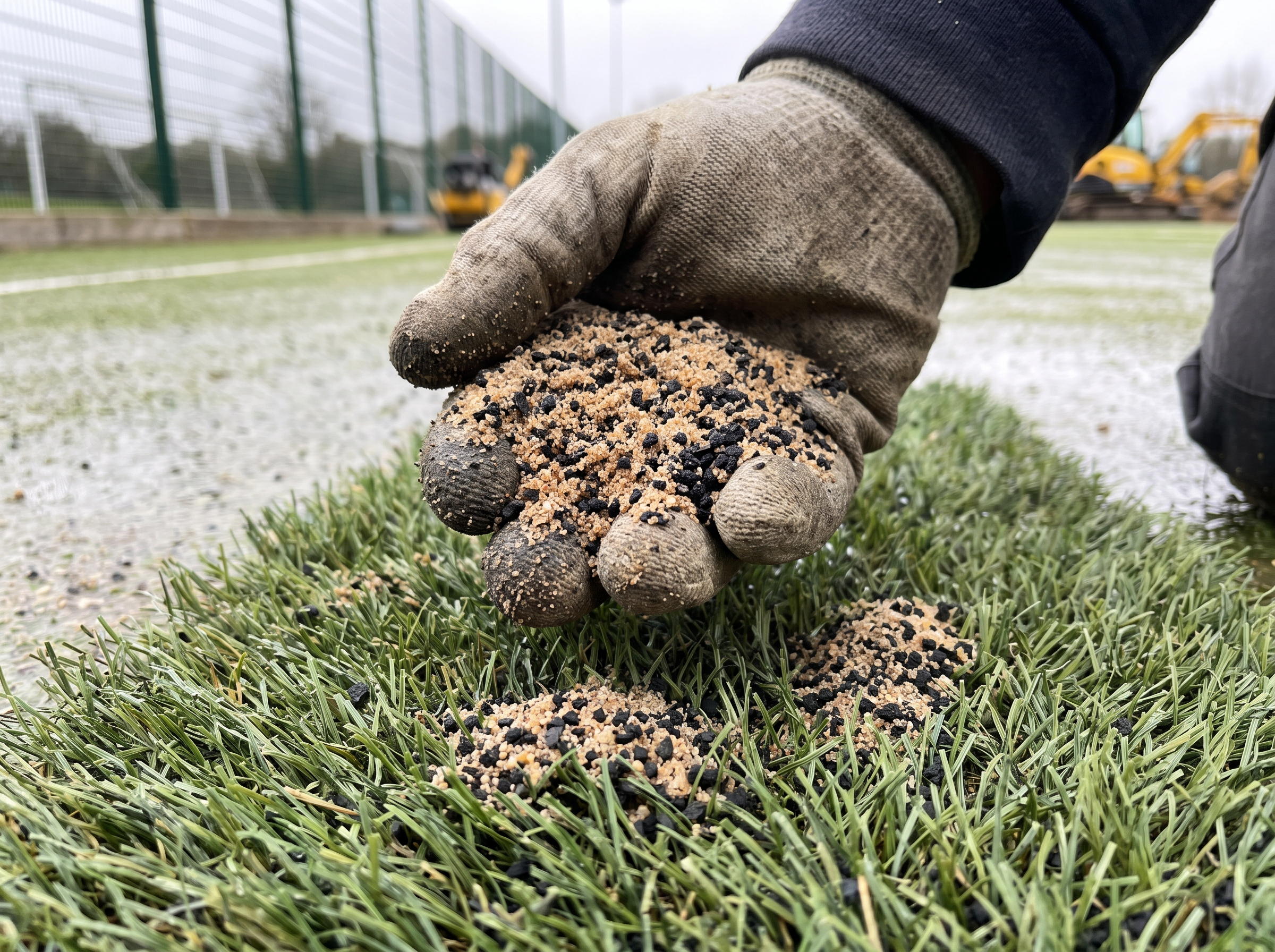
Silica sand is the baseline infill material most turf systems are built around. It is rounded, natural quartz sand that provides weight and fiber support at the lowest cost of any option. On its own, sand does very little for shock absorption or heat reduction, which is why it is more often used as a base layer under a cushioning infill than as the sole infill on a performance sports surface. It is reliable, widely available, and predictable, but it is not the material that gives a court its bounce.
Crumb Rubber Infill
Crumb rubber, made from recycled tire material, has been the standard sports turf infill for decades because it delivers real shock absorption and a springy, ball-responsive feel that plain sand cannot. It is relatively inexpensive per square foot and performs consistently under heavy, repeated use, which is part of why it remains common on multi-sport and athletic turf applications.
Its downsides are well documented. Crumb rubber absorbs heat quickly and can make a surface noticeably hotter than lighter-colored alternatives on a sunny day, it can transfer a faint rubber odor and dark residue onto clothing and footwear in warm weather, and some Ontario homeowners and facility managers prefer to avoid recycled tire material for pet areas or family-oriented courts for that reason.
Coated (Antimicrobial) Sand Infill
Coated sand infill starts as the same silica sand base but adds a polymer coating, usually with an antimicrobial additive, that rounds the particle edges, reduces compaction over time, and resists staining and odor buildup better than raw sand. It costs more than plain silica sand but less than premium organic options, and it has become a common middle-ground choice for courts that see mixed use from both sport and casual family activity, since it holds up well without the heat penalty of a fully dark rubber infill.
Zeolite Infill
Zeolite is a naturally occurring volcanic mineral infill known mainly for its odor-control properties, since its porous structure adsorbs ammonia and other odor-causing compounds. It is most relevant on courts that double as pet areas or see mixed recreational use rather than pure athletic play, and it is often layered underneath a top dressing of another infill rather than used alone across the full surface.
Organic Infill
Organic infills, made from ground cork, walnut shells, or coconut husk material, have grown in popularity as an alternative to rubber for anyone specifically looking to avoid recycled tire product on their court. They tend to run cooler underfoot than crumb rubber, are biodegradable, and provide a reasonably natural, springy feel. The tradeoffs are cost, since organic infill typically sits at the premium end of the pricing range, and consistency, since organic materials can compress or break down faster under heavy sustained athletic use than a synthetic alternative.
TPE and EPDM Infill
Thermoplastic elastomer (TPE) and EPDM rubber infill are manufactured, virgin-polymer alternatives to recycled crumb rubber. Because they are engineered rather than reclaimed, they can be produced in lighter colors that run cooler than black crumb rubber, they resist compaction well, and they hold up under heavy repeated use with minimal breakdown. They cost more than crumb rubber but are increasingly specified on school and institutional turf projects where heat management and consistent long-term performance are priorities.
| Infill Type | Relative Cost | Heat Behavior | Shock Absorption | Best Suited For |
|---|---|---|---|---|
| Silica sand | Lowest | Moderate | Low on its own | Base layer under another infill; light-use turf |
| Crumb rubber | Low to moderate | Runs hottest | High | Budget-conscious multi-sport and athletic turf |
| Coated sand | Moderate | Moderate | Moderate | Mixed-use family and recreational courts |
| Zeolite | Moderate | Moderate | Low to moderate | Pet-adjacent or mixed-use turf, usually as a base layer |
| Organic (cork, walnut, coconut) | Highest | Runs coolest | Moderate to good | Owners avoiding recycled rubber, moderate-use courts |
| TPE / EPDM | Highest | Cooler than crumb rubber | High | Institutional and school turf, heavy consistent use |
Infill by Sport: What CrowAll Sees Most Often on Ontario Courts
Turf is not a one-application material on a CrowAll job site. It shows up as the full playing surface on some court types and as a complementary surface on others, and the right infill depends heavily on which situation it is.
Bocce Courts
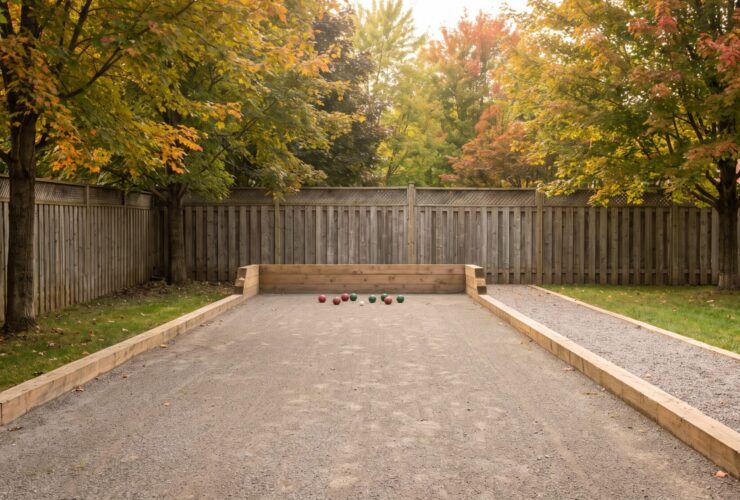
An artificial turf bocce court needs a surface that rolls true and consistently, which means infill depth and pile height have to be dialed in more precisely than on a general recreational lawn. Too much infill and the ball’s roll gets muted and unpredictable; too little and the turf fibers do not stay upright long enough to give a consistent surface. Bocce turf typically runs a shorter pile with a lighter, more tightly controlled infill depth than a multi-sport athletic area.
Multi-Sport Turf Areas
On a multi-sport court where turf covers all or part of the footprint, infill has to handle a wider range of impact than a single-sport surface, from running and cutting movements to balls bouncing and rolling across the surface. This is where crumb rubber or a coated sand and rubber blend tends to show up most often, since the priority is durability and shock absorption across varied use rather than the precise roll consistency a bocce court needs.
Backyard and Recreational Turf
For a family backyard court that sees a mix of casual play, kids, and sometimes pets, heat and comfort underfoot often outweigh pure athletic performance in the decision. This is where coated sand, zeolite, or an organic infill earns its higher price tag, since the household is trading some athletic-grade bounce for a cooler, lower-maintenance surface that is more pleasant to be barefoot on during an Ontario summer.
Putting Greens
A backyard putting green uses infill differently again. Putting surfaces are typically top-dressed with a fine, kiln-dried silica sand at a much shallower depth than a sport court, since the goal is a true, consistent roll for the ball rather than shock absorption for a player’s body. It is a good reminder that infill selection always follows the sport, not the other way around.
| Court Type | Typical Pile Height | Common Infill Approach | Priority |
|---|---|---|---|
| Bocce (turf) | Short | Light, tightly controlled sand or coated sand | Consistent, true roll |
| Multi-sport turf | Medium | Crumb rubber or coated sand/rubber blend | Durability and shock absorption |
| Backyard recreational turf | Medium | Coated sand, zeolite, or organic | Comfort, cooler surface, family use |
| Putting green | Very short | Fine kiln-dried sand top dressing | True, consistent ball roll |
How Infill Affects Playing Surface Temperature
Anyone who has stepped barefoot onto a dark synthetic surface on a hot July afternoon in Ontario already knows that artificial turf can get significantly hotter than the surrounding air temperature, and infill color and material are a big part of why. Darker materials, especially black crumb rubber, absorb more solar radiation and hold that heat longer than lighter sand, coated sand, or organic alternatives.
Researchers at institutions like Pennsylvania State University’s Center for Sports Surface Research have spent years studying how synthetic surface composition, including infill type and color, affects playing surface temperature and player comfort, and that body of independent research is part of why many sports turf specifiers have shifted away from dark, all-rubber infill systems toward lighter or blended alternatives on projects where summer heat is a real concern. For an Ontario backyard court that gets used through the hottest weeks of summer, this is a legitimate factor to weigh against crumb rubber’s lower upfront cost.
Shade, court orientation, and how often the surface gets rinsed with water also affect surface temperature, so infill choice is one lever among several rather than the only one. But for anyone comparing two otherwise similar turf systems, infill color is often the single biggest variable in how the court feels on the hottest days of the year.
Infill and Drainage in Ontario’s Climate
Ontario’s mix of heavy spring runoff, summer downpours, and a long freeze-thaw season puts real demands on how a turf system handles water. Properly graded aggregate base does most of the heavy lifting for drainage, but infill plays a supporting role that is easy to overlook. A porous, well-maintained sand or coated sand infill continues to let water pass through to the backing and base below even after years of use. Compacted or degraded infill, especially older crumb rubber that has broken down into finer particles, can start to slow drainage and hold moisture at the surface, which becomes a bigger problem once winter freeze-thaw cycles get involved.
This is one of the reasons drainage planning and infill maintenance are connected rather than separate concerns. A court with excellent underlying drainage design can still develop puddling and playability problems at the surface if the infill layer above it has compacted and stopped doing its job.
How Much Infill Does a Sports Court Actually Need
Infill depth is specified by the turf manufacturer based on pile height, backing type, and intended use, and it is not something to guess at or apply uniformly across every project. As a general guideline, sports turf systems commonly apply infill somewhere in the range of one to three pounds per square foot, with shorter-pile applications like bocce and putting surfaces sitting toward the lower end of that range and taller-pile, higher-impact multi-sport turf sitting toward the higher end. The manufacturer’s specification sheet for the specific turf product being installed is always the actual source of truth, since underfilling leaves fibers matted and unsupported while overfilling can make a surface feel dead and reduce drainage performance.
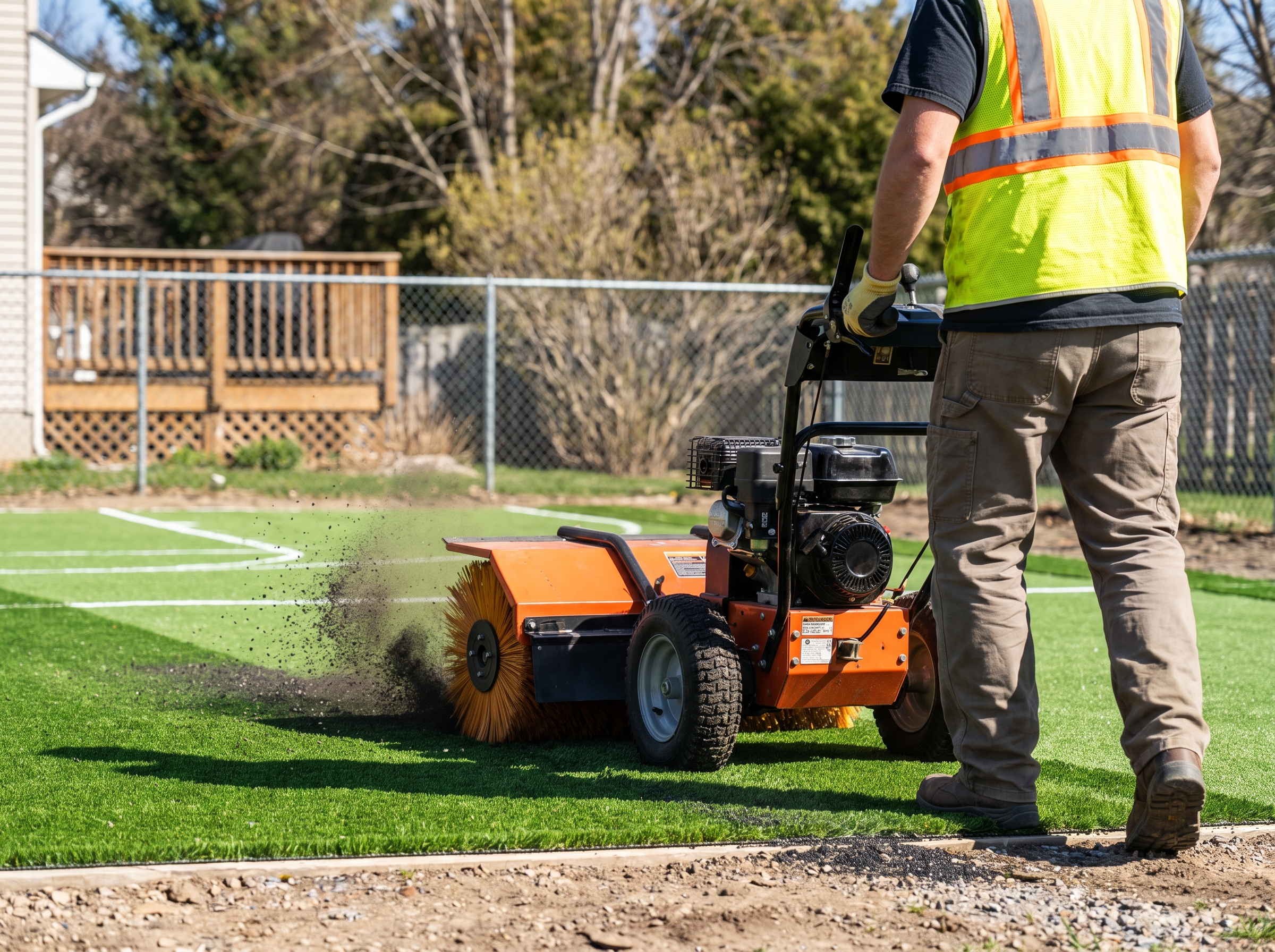
Maintaining Turf Infill Over Time
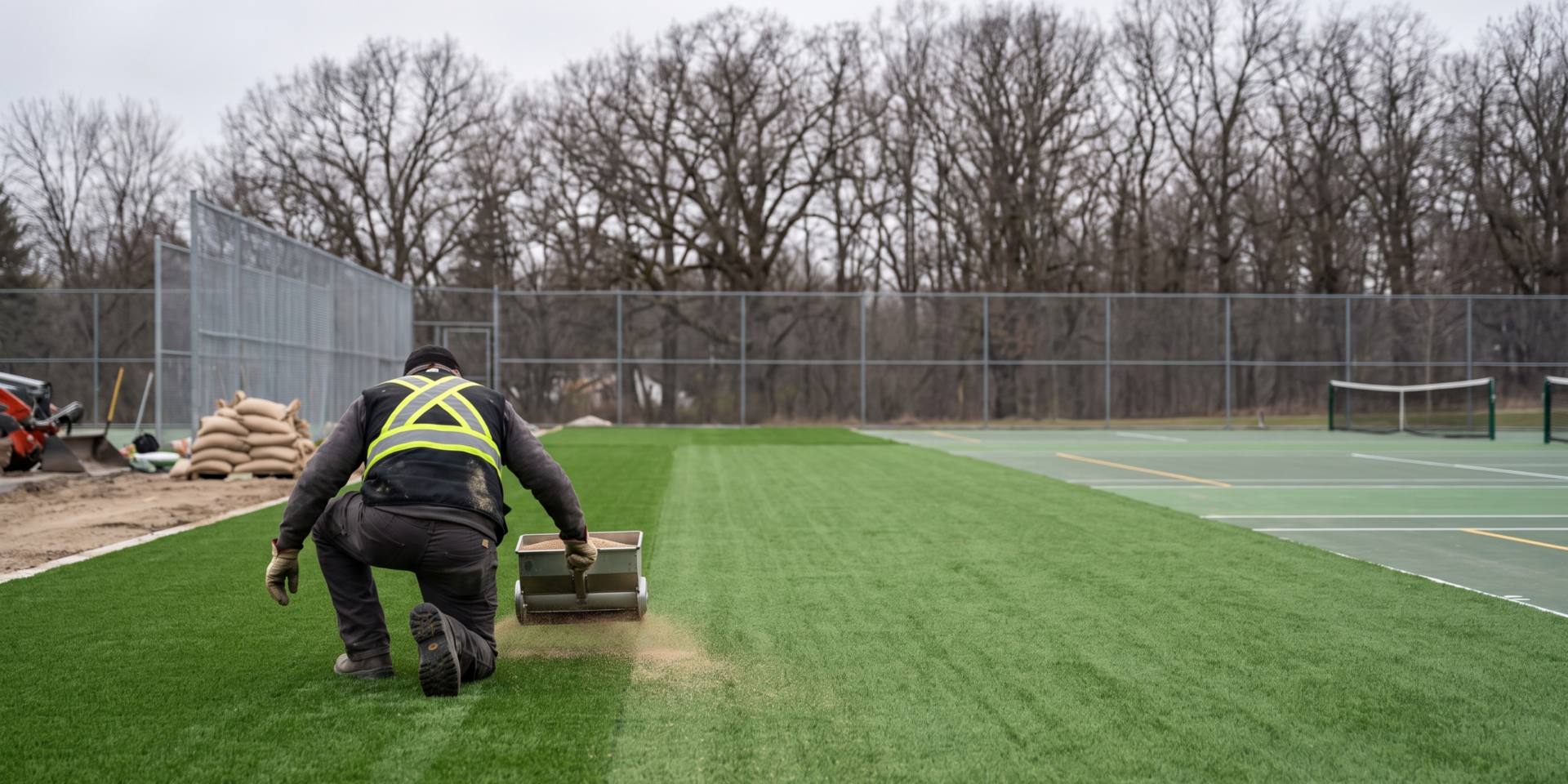
Infill is not a one-and-done installation step. It settles, compacts, and migrates over years of use and weather exposure, and a maintenance routine that accounts for this is what keeps a turf court playing the way it did on day one.
| Task | Frequency | Why It Matters |
|---|---|---|
| Groom / brush turf fibers | Monthly during active season | Redistributes compacted infill and keeps fibers standing upright |
| Debris removal (leaves, organic matter) | Weekly to biweekly in fall | Prevents organic buildup that clogs drainage and feeds weed growth |
| Infill level check and top-up | Annually | Compensates for gradual settling and migration over a playing season |
| Deep decompaction / deep clean | Every 2 to 3 years, more often on heavy-use courts | Restores drainage performance and cushioning that gradual compaction reduces |
| Full infill replacement | Typically at turf resurfacing, or sooner if drainage or compaction issues persist | Old, degraded infill cannot be fully restored by cleaning alone |
Skipping this maintenance is one of the more common ways a turf court’s performance quietly declines over several seasons without an obvious single cause. A regular maintenance routine that includes infill grooming and periodic top-ups is far cheaper than the alternative, which is a court that plays poorly for a year or two before anyone traces the problem back to compacted infill.
Environmental and Safety Considerations
Infill choice increasingly comes up in conversations about environmental impact alongside on-court performance. Peer-reviewed environmental research has examined how crumb rubber particles from synthetic turf can migrate off the playing surface into surrounding soil and waterways over time, which is one of the reasons some school boards, municipalities, and environmentally conscious homeowners have moved toward mineral or organic infill alternatives on newer installations. This is a genuinely evolving area, and CrowAll does not present any single infill material as risk-free or as definitively settled science, since that is not an accurate representation of where the research currently stands.
What is more settled is the accessibility angle. Consistent, well-maintained infill depth matters for anyone using a mobility aid on or around a court, since an uneven or compacted surface can create rolling resistance or trip hazards that a properly maintained one does not. Ontario’s own accessibility laws apply most directly to public and commercial facilities, but the underlying principle, a level and predictable playing surface, is good practice on any court regardless of who owns it.
Cost Drivers for Turf Infill
Infill is only one line item in a turf installation, but it is a meaningful one, and the material chosen affects both upfront and lifetime cost. For a full breakdown of what goes into a turf sport court budget beyond infill alone, CrowAll’s cost breakdown guide and landscaping cost guide cover the fuller picture.
| Cost Driver | Effect |
|---|---|
| Infill material selected | Silica sand is the least expensive; organic and virgin-polymer options run considerably higher per square foot |
| Court size and total area | Infill is priced and applied by square footage, so larger courts scale cost proportionally |
| Pile height and required depth | Taller pile turf generally needs a deeper infill fill, increasing material volume |
| Blended systems | Using two materials (for example a sand base layer under a rubber or organic top layer) adds labor and material cost over a single-material fill |
| Long-term maintenance and top-up needs | Lower-cost infills that compact or migrate faster can cost more over a decade once top-ups are factored in |
Turf Infill Versus Hard-Surface Coatings: When Turf Is the Right Call
Infill selection only matters once turf is the right surface choice in the first place, and it is worth stepping back to confirm that before getting deep into infill specifics. CrowAll’s guides on artificial turf versus natural grass and artificial turf versus hard court surfaces for tennis cover that comparison in more depth. In general, turf tends to win out for bocce, some multi-sport applications, and situations where a softer, more forgiving surface underfoot is a priority, while acrylic-coated hard surfaces remain the standard for tennis, pickleball, and basketball where consistent ball bounce and line precision matter more than cushioning.
For an existing synthetic surface reaching the end of its service life, infill condition is often part of what determines whether a court needs a full turf replacement or can get by with a deep clean and infill top-up for another season or two. CrowAll’s synthetic versus acrylic comparison guide covers that decision from a broader performance and cost angle.
Common Mistakes with Turf Infill Selection and Installation
A few patterns come up repeatedly on courts CrowAll gets called to assess or resurface. Choosing infill based on price alone without factoring in how the court will actually be used is probably the most common one, since a bocce court filled like an athletic field, or an athletic court filled like a decorative lawn, both underperform for their intended purpose. Skipping the manufacturer’s specified depth, either underfilling to save on material or overfilling because “more must be better,” is another frequent issue, and both directions cause real playability problems.
Neglecting maintenance is the third common mistake, and probably the most avoidable one. Many owners assume synthetic turf is maintenance-free simply because it does not need mowing or watering, but infill grooming and periodic top-ups are exactly the kind of upkeep that gets skipped when nobody explains it is needed. This pattern shows up across sport court types generally. Turf infill is a particularly easy thing to forget about, since the consequences of neglecting it show up gradually rather than all at once.
Finally, working with an installer who treats infill as an afterthought rather than an engineered part of the system is a mistake that is hard to fix after the fact. Getting infill selection, depth, and blend right at installation is far easier and cheaper than correcting it on a finished court.
Getting Infill Right From the Start
Turf infill is one of those details that is invisible when it is done correctly and obvious the moment it is not. For anyone planning a new turf sports court, converting part of an existing court to turf, or troubleshooting a surface that is not playing the way it used to, matching the infill to the sport, the climate, and the household or facility’s actual priorities is what separates a court that plays well for fifteen years from one that needs constant attention after three.
If you are weighing infill options for a new turf installation, or trying to figure out whether an existing court’s playability problems trace back to its infill, reach out to CrowAll for a consultation. Our team can walk through the options for your specific sport, court size, and budget, and you can see examples of finished turf courts in our project gallery. Learn more about why Ontario court owners choose CrowAll and read about our company profile for more on how we approach every build.
FAQ
What is turf infill?
Infill is the granular material, sand, rubber, or organic matter, packed between the fibers of artificial turf. It supports the fibers upright, adds shock absorption, weighs the turf down, and helps water drain through to the base below.
Does all artificial turf need infill?
Most sports and athletic turf applications need infill to perform correctly, though some low-traffic decorative turf products are engineered to stand upright without it. For any turf getting regular sport or recreational use, infill is standard practice.
What is the best infill for a sports court?
There is no single best option. Crumb rubber offers the strongest shock absorption at a lower cost but runs hottest. Organic and coated sand infills run cooler and are often preferred for family or mixed-use courts. The right choice depends on the sport, expected use, and budget.
Why does artificial turf get so hot in summer?
Dark synthetic fibers and infill, especially black crumb rubber, absorb solar radiation efficiently and hold that heat. Lighter-colored infill materials and shaded court orientation both reduce peak surface temperature meaningfully.
Can I mix different infill types on the same court?
Yes. Many turf systems use a layered approach, for example a sand base layer topped with rubber or organic infill, to balance cost, performance, and comfort rather than relying on a single material throughout.
How often does turf infill need to be topped up?
A general guideline is an annual check with top-ups as needed, since infill gradually settles and migrates with use and weather. Heavier-use courts may need attention more often.
Is crumb rubber infill safe?
This remains an area of ongoing research rather than a fully settled question. Peer-reviewed studies have looked at how rubber particles can migrate into surrounding soil and water over time, and that research is part of why some owners choose mineral or organic alternatives. CrowAll does not present any infill material as definitively risk-free.
What is zeolite infill used for?
Zeolite is a natural mineral valued for odor control, since its porous structure adsorbs ammonia and similar compounds. It shows up most often on courts with pet exposure or mixed recreational use, frequently as a layer beneath another top infill.
How deep should turf infill be applied?
Depth depends on the specific turf product’s pile height and manufacturer specification, but sports applications commonly fall somewhere between one and three pounds of infill per square foot. Always follow the manufacturer’s spec sheet for the actual product being installed.
Does infill affect how a ball bounces or rolls?
Yes, significantly. Infill depth and type change ball response more than almost any other variable in a turf system, which is why bocce turf, for example, uses a much more tightly controlled infill depth than a general multi-sport surface.
Can turf infill go bad or wear out?
Yes. Infill compacts, breaks down, and migrates over years of use and weather exposure. Compacted or degraded infill reduces both shock absorption and drainage performance, which is why periodic maintenance and eventual replacement are part of a turf court’s normal lifecycle.
Is organic infill worth the extra cost?
For owners specifically prioritizing a cooler surface temperature and avoiding recycled rubber material, many find it worthwhile despite the higher price. For a strictly budget-driven athletic application seeing heavy consistent use, crumb rubber or a coated sand blend often remains the more practical choice.
Does infill choice affect drainage?
Yes. Porous, well-maintained infill continues letting water pass through the turf backing to the base below. Compacted or degraded infill, particularly older breakdown crumb rubber, can slow this process and contribute to surface puddling.
Can I change my court’s infill without replacing the whole turf?
In many cases, yes. Existing infill can be removed and replaced with a different material as part of a deep clean or turf maintenance service, provided the turf fibers themselves are still in good condition.
Does CrowAll install turf on courts other than bocce?
CrowAll installs artificial turf across several sport and recreational applications, including bocce, multi-sport areas, backyard recreational courts, and putting greens, each specified with the infill approach appropriate to that surface’s use.
What is the difference between infill for a sports court and infill for a residential lawn?
A sports court sees concentrated, repeated athletic impact in defined zones and needs infill engineered for that specific pile height and use, while residential lawn infill mainly needs to support fibers and look presentable under light, general foot traffic.