Sport Court Crack Repair in Ontario: How Professionals Fix and Prevent Cracking
A crack in a sport court rarely shows up on its own schedule. It shows up after the first hard freeze of the year, or after a wet fall followed by a cold snap, and by the time anyone notices it, it’s already wider than it was in August. For a lot of Ontario court owners, the question isn’t whether a court will ever crack. Asphalt and concrete both move with temperature, and a court built outdoors in this climate is going to develop some cracking over its life. What matters is figuring out what kind of crack it is, whether it’s still a cosmetic problem or already a structural one, and what a professional actually does to fix it properly instead of just hiding it for a season.
This guide walks through why tennis, pickleball, basketball, and multi-sport courts crack in the first place, the difference between a hairline crack you can leave alone for now and a structural one that needs immediate attention, and the actual repair methods professionals use, from routing and sealing to full-depth patching and fabric interlayer systems. It also covers when repair is the right call versus when a court has crossed the line into needing resurfacing or a rebuild, because that’s the decision most court owners actually need help making.
Why Sport Courts Crack in the First Place
Cracking is almost never caused by one single thing. It’s usually two or three factors working together over several years until a weak point finally gives. Understanding the actual causes matters because it changes the repair plan. Filling a crack without addressing what caused it is a short-term fix at best.
Temperature movement is the biggest driver on outdoor courts in Ontario. Asphalt and concrete both expand and contract as temperatures swing through the year, and that movement concentrates stress at any existing weak point, an old construction joint, a spot where the base is thinner, or a seam between two pours. Base movement is the second major cause. If the granular base under a court wasn’t compacted evenly, or if water has been getting underneath the surface and softening it, the surface above will settle unevenly and crack along the line of that movement. Tree roots do the same thing from a different direction, pushing up from below rather than settling down. Age plays a role too. Asphalt loses flexibility as it oxidizes over the years, so an older court is more prone to cracking under the same temperature swings that a newer surface would absorb without issue. Poor original construction, a base that was never properly graded or compacted, shows up as cracking years down the road even though the surface looked fine when it was new.
Drainage failures deserve their own mention because they’re one of the more preventable causes. Water that pools on a court instead of running off will find its way into any existing crack or seam, and once it’s underneath the surface it accelerates every other failure mode on this list. Accurate grading during construction is what prevents this in the first place, which is why so many crack problems on older courts trace back to a base that was never properly sloped.
Ontario’s Freeze-Thaw Cycle and Why It Matters Here
Ontario’s climate is harder on outdoor pavement than most of the material science behind crack sealing was originally written for warmer regions. A federally supported infrastructure guideline on sealing and filling cracks in asphalt pavement, developed through the Federation of Canadian Municipalities’ InfraGuide program and archived through the National Research Council of Canada, notes that active cracks can widen 15 to 100 percent more in winter than their summer width, with total annual crack movement ranging from about 5 to 25 millimetres depending on the pavement and climate, and with the widest opening typically occurring in February. That guideline was written for municipal roadways, but the underlying material science, asphalt’s response to temperature cycling, applies just as directly to an asphalt-based sport court.
What that means practically is that a crack that looks manageable in September can be visibly wider by February, not because anything new happened to it, but because the same crack opens and closes every year as temperatures swing. Left untreated, that repeated movement works the crack edges loose, lets water in during the shoulder seasons, and that water then freezes and expands, widening the crack further. It’s a compounding cycle, and it’s the single biggest reason crack repair timing matters as much as the repair method itself, which is covered further down in this guide.
Types of Cracks and What Each One Actually Means
Not every crack calls for the same response, and knowing which category a crack falls into is most of what a professional assessment is actually doing.
Hairline cracks are thin, usually under an eighth of an inch, and shallow. They’re cosmetic on their own but worth sealing before they widen, since a hairline crack today is often a wider one in two winters if it’s ignored. Structural cracks are wider, typically a quarter inch or more, and extend deeper into the surface and sometimes into the base itself. These indicate an underlying issue, base movement, settlement, or a drainage problem, rather than simple surface wear, and they need more than a bead of filler. Alligator or spider-web cracking is an interconnected network of cracks that resembles the texture it’s named for, and it’s almost always a sign of base failure or long-term water infiltration rather than a single crack that spread. Expansion joint cracks form along the intentional joints built into concrete courts to allow for movement, and some cracking along these lines is normal and expected rather than a defect. Birdbathing, a low spot where water pools after rain instead of draining, isn’t technically a crack but it’s closely related. It’s often what happens after settlement has occurred near a crack, and standing water in that low spot will accelerate whatever cracking is already present.
| Crack Type | Typical Width/Depth | Likely Cause | Usual Response |
|---|---|---|---|
| Hairline | Under 1/8 inch, shallow | Surface aging, minor temperature movement | Rout and seal before next winter |
| Structural | 1/4 inch or more, deep | Base movement, settlement, drainage failure | Full-depth patch or base repair |
| Alligator/spider-web | Interconnected network | Base failure, prolonged water infiltration | Section removal and base rebuild |
| Expansion joint | Along intentional joint lines | Normal thermal movement (concrete) | Joint sealant renewal |
| Birdbathing | Localized low spot, not a crack itself | Settlement or original grading error | Patch and re-level, review drainage |
Crack Sealing Versus Crack Filling: They Aren’t the Same Thing
These two terms get used interchangeably by homeowners, but the FCM/NRC guideline draws a clear line between them, and the distinction matters for how long a repair actually holds. Filling is the right call for a crack under about 3 millimetres wide that’s less than a year old and shows little ongoing movement. Sealing is for active cracks, ones that visibly open and close with the seasons, and it requires routing the crack to a specific shape before the sealant goes in, rather than just pouring material over the surface crack as it sits.
The routing detail is one that a lot of DIY crack repair skips entirely, and it’s a big part of why store-bought crack filler often fails within a season or two while a properly routed repair lasts for years. The guideline specifies a width-to-depth ratio at or above 1, giving examples of rout dimensions like 30 by 15, 25 by 12, and 12 by 12 millimetres (width by depth) that have shown good field performance. A rout that’s too deep relative to its width creates a bond geometry that’s more likely to fail as the crack opens and closes, since the sealant can’t stretch the way it needs to without debonding from one side.
| Material | Application | Typical Durability | Best Used For |
|---|---|---|---|
| Hot-pour thermoplastic sealant | Melted and applied at roughly 175 to 200°C | Multiple years with proper routing | Active cracks needing a flexible, long-term seal |
| Cold-pour emulsion | Applied without heating, simpler equipment | Often fails after one or two winters | Minor, inactive cracks or temporary measures |
| Acrylic crack patch (trowel grade) | Troweled into the crack by hand | Good for shallow, narrow cracks under a coating system | Cracks up to about an inch wide before recoating |
| Fabric or fiberglass interlayer system | Mesh embedded under a new coating layer | Slows crack reflection through to the surface | Active or recurring cracks ahead of a full recoat |
How Professional Crack Routing and Sealing Actually Works
A proper crack repair follows a specific sequence, and skipping steps is the most common reason a repair reopens within a year. The crack first gets cleaned out completely, loose material, dirt, and any old failed filler removed with a wire brush, compressed air, or both. Vegetation growing in a crack has to come out roots and all. Trimming it at the surface leaves the root structure in place, and it will push the crack back open within a season.
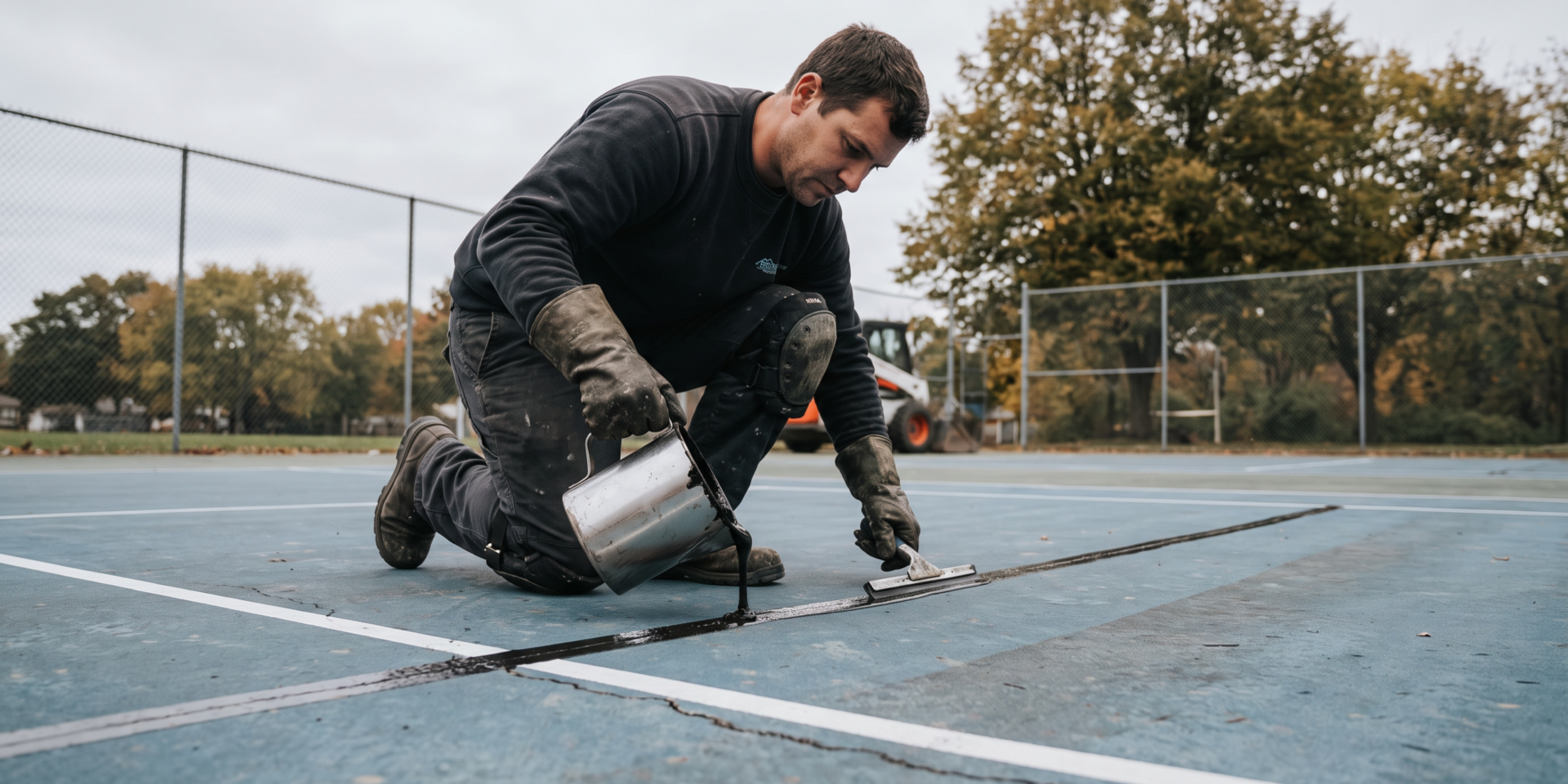
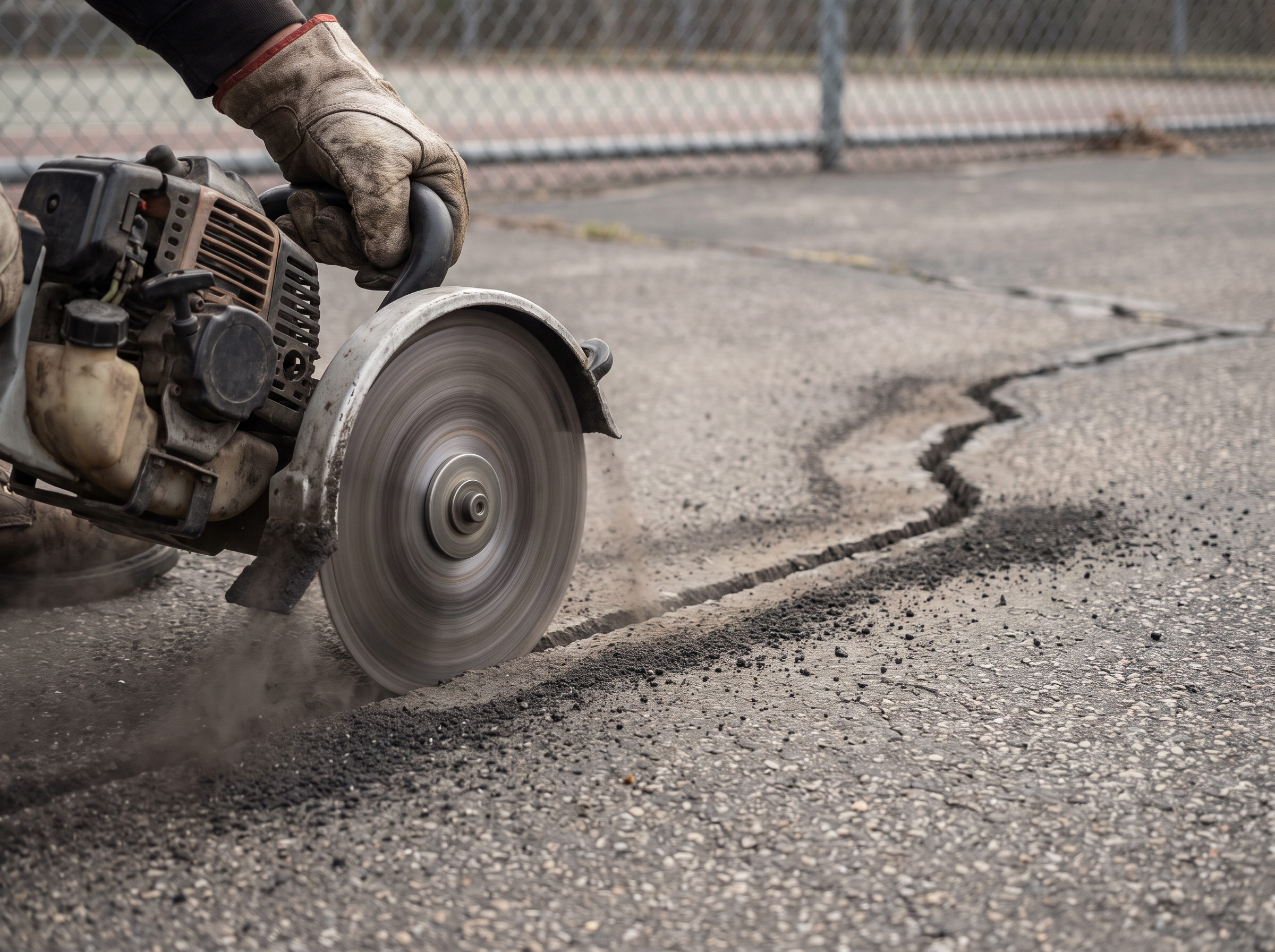
For an active crack that’s getting sealed rather than simply filled, a router cuts a clean, consistent groove along the crack to the width-to-depth ratio described above. This isn’t cosmetic. It gives the sealant a consistent bond surface on both sides of the crack instead of an irregular natural crack edge that the sealant can’t grip evenly. Hot-pour sealant then gets heated to the manufacturer’s specified temperature and applied with a pour pot or wand, typically slightly overfilled and then tooled level with the surrounding surface using a squeegee. Backer rod, a foam rope inserted into the bottom of a wider crack, is sometimes used first to control how deep the sealant sits and to keep it from disappearing into a crack that’s deeper than it is wide.
Timing matters more than most people expect. The same FCM/NRC guideline recommends late summer through mid-fall as the best window for routing and sealing, since cracks are neither at their widest winter opening nor at their narrowest summer closing at that point, giving the sealant room to flex both ways through the coming year. Late spring can also work once surface moisture from snowmelt has cleared. A minimum ambient temperature of roughly 5 to 7°C and rising is generally required for proper sealant adhesion and cure, and morning dew or fog needs to clear first since a cool, damp surface can cause hot-pour sealant to cool and gel too quickly to bond properly.
Full-Depth Patching and Fabric Interlayer Systems: When Sealing Isn’t Enough
Routing and sealing works well for active cracks that are otherwise structurally sound. It doesn’t fix a crack caused by a failed base underneath it, and applying sealant over a structural problem just delays the point where it shows up again, usually as the same crack reopening within a season or two.
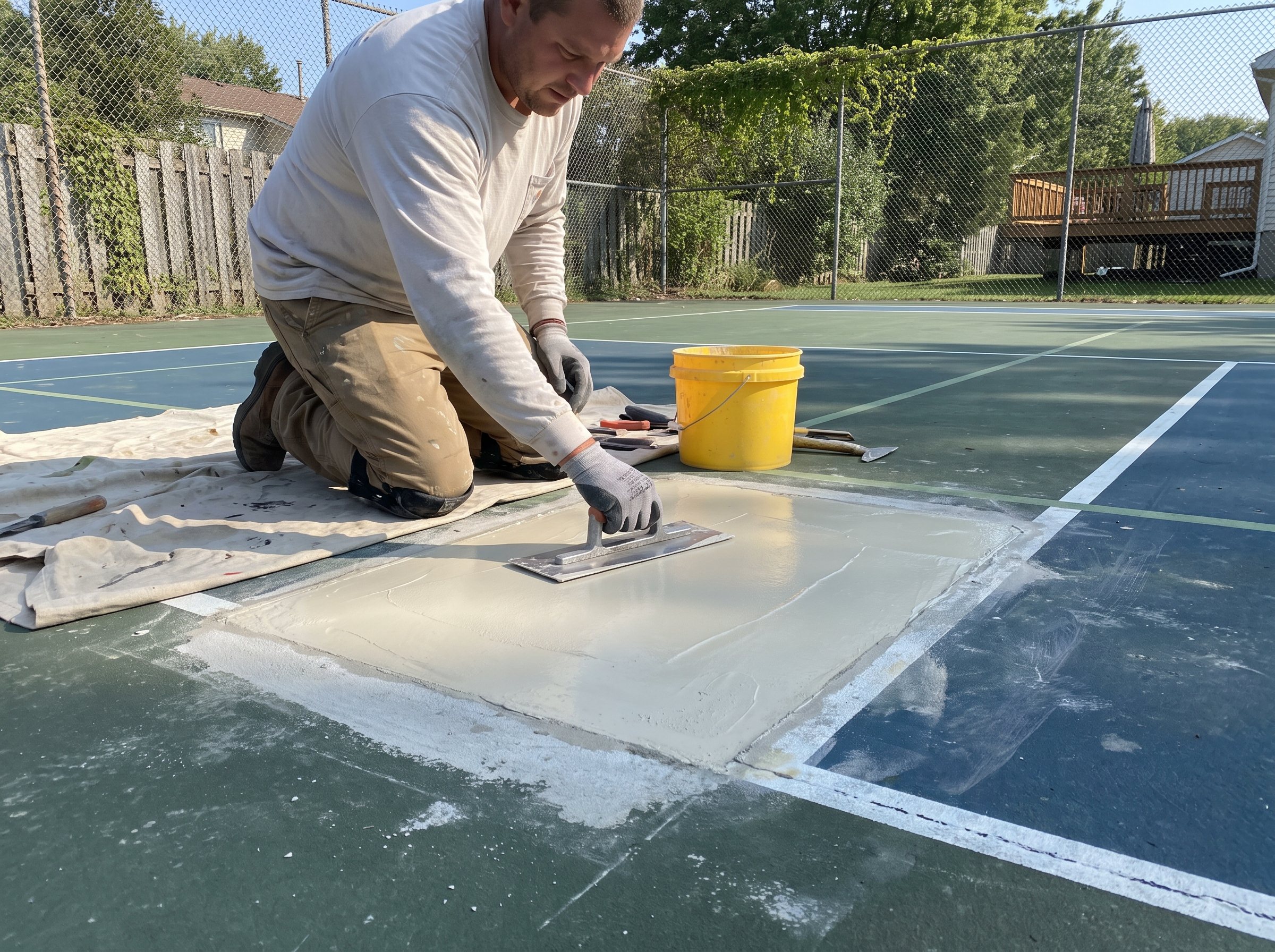
Structural cracks and alligator cracking generally call for full-depth patching: cutting out the damaged section down to and sometimes into the base, rebuilding the base if it’s compromised, and repouring or repatching the surface material in that section before recoating over the repair to blend it in. This is more involved and more expensive than a simple rout-and-seal, but it’s the only approach that actually addresses base-level failure rather than papering over it.
For courts that get a full acrylic resurfacing after crack repair, a fabric or fiberglass mesh interlayer is sometimes embedded into the patched area before the new coating goes on. The mesh doesn’t stop a crack from ever reappearing, nothing fully does on an outdoor asphalt court in this climate, but it slows what’s called crack reflection, the tendency of an underlying crack to telegraph back up through a fresh coating within a season or two. It’s a reasonable middle ground between a basic patch and a full base reconstruction on a court where the base is mostly sound but has one or two recurring problem areas.
When Repair Makes Sense Versus When It’s Time to Resurface or Rebuild
This is the question most court owners actually need answered, and it doesn’t have a one-size-fits-all response. A single hairline crack on an otherwise sound court is a straightforward repair. Widespread alligator cracking across large sections of the court is a different conversation entirely, one that’s more honestly had by looking at resurfacing versus repair as the real decision rather than treating every crack the same way.
As a general framework, isolated cracks, even structural ones, in a court that’s otherwise flat, well-drained, and reasonably recent usually justify targeted repair. Cracking that’s widespread, recurring in the same areas after previous repairs, or accompanied by other symptoms like fading, peeling, or ball bounce inconsistency is a signal that the whole surface coating has reached the end of its useful life, which points toward resurfacing instead. Full reconstruction, removing the surface and rebuilding the base, becomes the right call when the base itself has failed: significant settlement, extensive alligator cracking across most of the court, or a drainage problem that’s been left unaddressed long enough to undermine large sections of the sub-base. Our guide on how often a court needs resurfacing or repair goes deeper into the timeline side of this decision, and how to tell when it’s time to resurface covers the visual and performance signs to watch for beyond cracking alone.
| What You’re Seeing | Likely Next Step |
|---|---|
| One or two isolated hairline or structural cracks | Targeted rout-and-seal or patch repair |
| Several cracks plus fading, peeling, or dull traction | Full resurfacing over patched cracks |
| Cracks reopening in the same spot after prior repair | Investigate the base before repairing again |
| Widespread alligator cracking or visible settlement | Base evaluation, likely partial or full reconstruction |
| Standing water plus nearby cracking | Drainage and grading review before any surface repair |
Crack and Seam Issues by Surface Type
Not every court surface fails the same way, and the repair conversation looks different depending on what the court is built from.
Asphalt courts, the most common base for tennis, pickleball, and multi-sport courts across Ontario, are the surfaces most of this guide has been describing: prone to thermal cracking, generally repairable through routing, sealing, and patching, and recoatable with an acrylic system once cracks are addressed. Concrete courts, more common under basketball courts, crack differently. Concrete’s control and expansion joints are designed to crack in a controlled way rather than randomly across the slab, and joint sealant renewal, rather than crack routing, is usually the maintenance task that matters most. Unplanned cracking outside those joints on a concrete court is more often a sign of base or reinforcement issues than simple thermal movement. Soft asphalt (asphalt penetration) systems behave somewhat differently again, since their layered stone-and-sand construction with a liquid asphalt binder is more forgiving of minor base movement than a standard hard asphalt lift, though they aren’t immune to cracking under severe base failure.
Synthetic turf and artificial surfaces don’t crack in the traditional sense, but they have an equivalent failure mode: seam separation, where the adhesive or stitched bond between turf sections lets go, usually starting at a high-wear area like a baseline or key. Our comparison of synthetic versus acrylic court systems and our guide on when to replace a synthetic surface cover that failure mode in more detail, since the repair approach for a lifted seam is a different job entirely from patching an asphalt crack.
Crack Repair Considerations by Sport
The sport being played on a court changes how urgently a crack needs attention, even when the crack itself is identical in size and type.
On a tennis court, a crack running across a baseline or service line area affects ball bounce in a way players notice immediately, since a true, consistent bounce is central to the sport. Pickleball’s smaller court footprint means players are closer to any given surface defect at all times, and the non-volley zone in particular sees enough short, quick footwork that a crack there is both a bounce issue and a trip hazard sooner than the same crack would be on a larger court. On a basketball court, cracking in the key or along the three-point line affects dribbling consistency more than a crack near the baseline would, since that’s where the ball contacts the surface most often during play. Multi-sport courts add a wrinkle: a crack that’s a minor annoyance for one sport sharing the footprint might be a real problem for another, so repair priority on a shared court should generally follow whichever sport has the least tolerance for surface irregularity.
Preventing Cracks Before They Start
Prevention is cheaper than any repair method described above, and most of it comes down to decisions made during original construction rather than anything a court owner does afterward.
Laser-guided grading at the base stage is the single biggest factor in long-term crack resistance, since a properly and consistently sloped base prevents the water pooling that drives so much of the drainage-related cracking described earlier. Proper drainage systems around the court perimeter keep water moving away from the base rather than sitting against it. Tree root barriers, installed during construction or retrofitted around an existing court, protect against a cause of cracking that has nothing to do with the court’s own material or workmanship. On the maintenance side, our article on the top mistakes that damage sports courts covers several habits, harsh cleaning chemicals, dragging equipment across the surface, ignoring small cracks, that accelerate problems this guide has already touched on. Landscaping choices near a court also matter more than most owners expect; our guide to sport court landscaping and site design covers how grading, plantings, and drainage around the court perimeter tie into the surface’s long-term condition.
Timing Crack Repair Around Ontario’s Seasons
Getting the season right matters almost as much as getting the repair method right. As covered above, late summer through mid-fall is generally the best window for routing and sealing, since it avoids both winter’s maximum crack width and summer’s fully closed state. Our broader guide to the best time of year to build or repair a sports court and our seasonal comparison of summer versus fall timing in Canada cover this in more depth for anyone planning a larger project alongside crack repair.
Winter repair is generally not advisable for hot-pour sealant work, since the ambient and surface temperatures needed for proper adhesion and cure simply aren’t reliably available. A crack noticed in January is one to monitor and plan for, not necessarily one to rush a repair crew out for immediately, unless it’s created an acute safety hazard that needs a temporary fix in the meantime.
DIY Crack Filler Kits Versus Professional Repair
Store-bought crack filler products have a place, and it would be dishonest to suggest every crack needs a professional crew. A single hairline crack on a private backyard court, caught early and filled with a quality acrylic crack patch product before it has a chance to widen, is a reasonable DIY project for an owner comfortable with basic surface work.
Where DIY reaches its limit is on anything wider than a hairline crack, anything showing signs of being an active crack that moves noticeably through the seasons, and anything near or connected to alligator cracking or visible settlement. Routing equipment, proper hot-pour sealant application at the correct temperature, and base-level diagnosis all require equipment and judgment that go beyond what a homeowner kit is designed for. A repair that looks fine going into winter but wasn’t properly routed or sealed at the right temperature often fails by spring, at which point the same crack has to be redone anyway, this time potentially with additional damage from a winter of water infiltration through the failed repair.
Cost Considerations for Sport Court Crack Repair
CrowAll doesn’t publish a fixed price list for crack repair since the right approach and its cost depend heavily on what’s actually found once a crack is assessed. That said, several factors consistently drive cost up or down across most projects, and knowing them helps set expectations before a quote comes in.
| Factor | Why It Matters |
|---|---|
| Total crack length and count | More linear footage means more routing, material, and labour time |
| Crack depth and whether the base is involved | Base-level repair costs considerably more than surface-only sealing |
| Surface material (asphalt, concrete, soft asphalt) | Different materials need different tools, sealants, and patch compounds |
| Whether recoating is needed after the repair | A patch that needs to blend into a color coating adds a resurfacing step |
| Site access and court size | Equipment access and larger courts both affect labour and setup time |
For a full picture of what a larger project costs beyond crack repair alone, our cost breakdown for installing a sports court covers the construction side, while a free consultation with CrowAll is the most reliable way to get numbers specific to your court’s actual condition.
Cracks Are a Safety and Accessibility Issue
A crack that looks like a cosmetic problem can carry real safety weight. A crack wide enough to catch a shoe edge or a wheel is a genuine trip and fall risk, especially on a pickleball or multi-sport court where quick lateral footwork is part of normal play. For courts used by schools, clubs, municipalities, or any facility open to the public, this crosses from a playability concern into an accessibility and liability one. Ontario’s accessibility laws, enforced under the Accessibility for Ontarians with Disabilities Act, require public and many private facilities to maintain accessible paths of travel, and a chronically cracked or uneven playing surface can undermine that requirement even when the court itself isn’t classed as a formal path of travel. Anyone maintaining a court used by the public is worth reviewing Ontario’s accessibility laws against, separate from whatever playability standard a private backyard court is held to.
A Maintenance Schedule to Catch Cracks Early
Most of the crack repair described in this guide is easier, cheaper, and less disruptive the earlier it happens. A simple inspection routine catches most problems while they’re still a rout-and-seal job rather than a full-depth patch.
| Timing | What to Check |
|---|---|
| Spring (after snowmelt) | New cracks from winter movement, standing meltwater, heaved sections |
| Early summer | Whether spring cracks need sealing before the court sees heavy summer use |
| Late summer to early fall | Best window to schedule routing and sealing work before winter |
| Before winter | Confirm all known cracks are sealed; clear debris from drainage points |
| Annually | Professional inspection for base movement, recurring cracks, drainage issues |
A professional maintenance contract is one practical way to keep this schedule from slipping, since it puts the inspection and early crack repair on a calendar rather than something that only happens after a problem is already visible.
The CrowAll Approach to Crack Repair
CrowAll treats crack repair as a diagnostic job first and a repair job second. Every crack repair project starts with an assessment of what’s actually causing the cracking, surface aging, base movement, drainage, or something else, rather than jumping straight to filling whatever’s visible on top. That assessment determines whether the right answer is a targeted rout-and-seal, a full-depth patch, a fabric interlayer ahead of resurfacing, or a recommendation that the court has reached the point where resurfacing or reconstruction makes more sense than continued repair.
Our full product catalogue and our page on why clients choose CrowAll cover the broader construction and resurfacing services that crack repair often connects to. For larger projects involving base reconstruction, it’s also worth checking whether permits are required before work begins, since a full rebuild can trigger requirements that a simple crack repair wouldn’t. You can see examples of past resurfacing and repair work in our project gallery, and learn more about the team behind the work on our company profile page.
Sport Court Crack Repair FAQ
Why do sport courts crack in Ontario specifically?
Ontario’s freeze-thaw cycle is harder on outdoor pavement than milder climates. Cracks can open 15 to 100 percent wider in winter than summer, and repeated freezing and thawing of water inside a crack works the edges loose over time, which is why cracking here often progresses faster than in warmer regions.
What’s the difference between crack sealing and crack filling?
Filling suits narrow, inactive cracks under about 3 millimetres wide with little ongoing movement. Sealing is for active cracks that visibly widen and narrow with the seasons, and it requires routing the crack to a specific width-to-depth ratio first so the sealant bonds and flexes properly.
Can a crack be repaired without resurfacing the whole court?
Yes, in most cases. Isolated cracks on an otherwise sound court are typically handled with targeted routing, sealing, or patching. Resurfacing becomes the better option when cracking is widespread or paired with fading, peeling, or drainage problems across the surface.
What is a full-depth patch, and when is it needed?
A full-depth patch removes the damaged surface material down to, and sometimes into, the base before rebuilding that section and repouring the surface. It’s needed for structural cracks and alligator cracking where the problem originates below the surface rather than at the surface itself.
How wide does a crack need to be before it’s a structural concern?
Cracks a quarter inch or wider, especially ones extending deep into the surface, generally indicate an underlying structural cause rather than simple surface aging. Anything narrower is typically treated as a routine hairline crack.
Is DIY crack filler a reasonable option?
For a single hairline crack caught early on a private court, yes. Wider or active cracks, and anything connected to alligator cracking or visible settlement, need professional routing equipment and base-level diagnosis that go beyond a homeowner filler kit.
What temperature does crack sealing need to be done at?
Most guidance recommends a minimum ambient temperature of roughly 5 to 7°C and rising, with no morning dew or fog present, since a cool or damp surface can cause hot-pour sealant to cool and bond improperly.
When is the best time of year to repair court cracks in Ontario?
Late summer through mid-fall is generally best, since cracks are at neither their widest winter opening nor their narrowest summer closing, giving new sealant room to move both ways through the coming year. Late spring, once surface moisture has cleared, is a reasonable second option.
Why does my repaired crack keep coming back?
A crack that reopens after repair is often a sign the original repair only addressed the surface symptom, not an underlying base or drainage issue. Recurring cracking in the same spot is worth a professional assessment before repairing it the same way again.
Does a crack affect ball bounce?
Yes, particularly on tennis and pickleball courts where consistent bounce matters most. A crack running through a baseline, service line, or non-volley zone area is worth prioritizing for repair even if it’s not yet a structural concern.
Are concrete court cracks the same as asphalt court cracks?
Not exactly. Concrete courts have intentional expansion and control joints designed to manage movement in a controlled way, so joint sealant renewal is usually the main maintenance task. Cracking outside those joints on concrete more often points to base or reinforcement issues than simple thermal movement.
What causes birdbathing on a court surface?
Birdbathing is a low spot where water pools after rain, usually from settlement or an original grading error rather than play-related wear. It’s not a crack itself, but standing water in that spot accelerates any nearby cracking.
Can tree roots really crack a sport court?
Yes. Roots growing under a court exert upward pressure that shows up as cracking or heaving on the surface above, often years after a tree was planted nearby. Root barriers installed during construction or retrofitted around an existing court help prevent this.
How often should a court be inspected for cracks?
At minimum once a year, ideally in spring after snowmelt when new winter cracking is easiest to spot. Courts under heavy use or with a history of cracking benefit from a second check in late summer, ahead of the fall repair window.
Is a cracked court an accessibility or safety issue?
It can be. A crack wide enough to catch a shoe or create an uneven step is a trip hazard, and for public or club facilities this can intersect with accessibility requirements under Ontario law, separate from the playability concerns that apply to any court.
Does CrowAll repair cracks on courts it didn’t originally build?
Yes. Crack assessment and repair are offered independent of who built or last resurfaced the court, since diagnosing the cause of cracking doesn’t depend on having built the original surface.
Will a patched crack be visible after repair?
A rout-and-seal repair on bare asphalt is usually visible as a sealed line. On an acrylic-coated court, patched sections are typically recoated to blend into the surrounding color, though a very close inspection can sometimes still show a faint patch outline depending on the coating’s age and color match.
Cracking is one of the most predictable problems an outdoor sport court will face in Ontario, and it’s also one of the most manageable when it’s caught early and repaired the right way. Whether that means a straightforward rout-and-seal on a single hairline crack or a full assessment of a court that’s showing its age across multiple sections, getting a professional opinion before the next freeze-thaw cycle does more damage is almost always the cheaper path in the long run. Reach out to CrowAll for a free consultation on crack repair, resurfacing, or a full assessment of your court’s condition.