How to Convert a Tennis Court Into a Pickleball Court in Ontario
Pickleball has moved faster than most Ontario recreation departments could plan for. Clubs with one or two tennis courts are suddenly fielding a waiting list for pickleball, and a lot of them are looking at the asphalt they already own and asking the obvious question: can we just use this?
The short answer is yes, in most cases. A tennis court can become one, two, or four pickleball courts without a full rebuild, provided the base is sound and the layout gets planned properly. This guide walks through how the conversion actually works, from court dimensions and line marking to net height, drainage, and the Ontario-specific details that get missed when a project is copied from a warm-climate playbook.
Why So Many Tennis Courts Are Becoming Pickleball Courts
Pickleball participation in Canada has grown fast enough that municipal parks departments, tennis clubs, schools, and homeowners associations are all fielding the same request: more courts, sooner, without buying more land. An existing tennis court is close to ideal raw material. It already has a compacted base, drainage built in, fencing, and often lighting. That infrastructure is the expensive part of any court project, and a conversion reuses almost all of it.
There’s also a practical fit between the two sports. A regulation pickleball court is roughly a quarter of the footprint of a tennis court, so a single tennis court can typically host two full pickleball courts side by side, or up to four smaller layouts when courts share lines. For a club or municipality trying to stretch a limited footprint across more players, that math is hard to ignore.
Who Is Actually Doing These Conversions
The requests we hear come from a fairly consistent group: tennis clubs adding pickleball as a membership draw, schools and community centres responding to demand from families and older adults, condo and HOA boards converting an underused court, and homeowners with a private backyard tennis court who want more variety. Each group has slightly different priorities. Clubs tend to want permanent, tournament-ready lines. Homeowners often start with a temporary layout to see how much the court gets used before committing to a full resurface.
Can You Actually Play Pickleball on a Tennis Court?
Yes. A standard tennis court can support pickleball with a lowered or adjusted net and painted or taped boundary lines. No structural changes are required for casual play, though a permanent conversion for club or public use typically involves professional line striping, net system adjustments, and sometimes a fresh acrylic coat for better traction and color contrast between the two sets of lines.
What Changes and What Stays the Same
The base, fencing, and general footprint of the court stay exactly as they are. What changes is the net height at the center, the addition of pickleball boundary and kitchen lines in a contrasting colour, and in some cases the surface texture if the existing coating has worn thin. Everything below the surface, the aggregate base, the slope, the drainage system, does the same job it always did. That’s why a court with a failing base is a poor conversion candidate no matter how good the new lines look.
Tennis Court vs. Pickleball Court: Dimensions and Layout
Before marking anything, it helps to see how the two courts actually compare on paper. A doubles tennis court is 78 feet long and 36 feet wide, while a regulation pickleball court measures 44 feet long and 20 feet wide, including a 7-foot non-volley zone (the “kitchen”) on each side of the net, a dimension confirmed in the official pickleball rules summary. For a wider side-by-side look at pad size, nets, surfaces and cost drivers, see our guide to pickleball court vs tennis court differences in Ontario.
| Measurement | Tennis Court (Doubles) | Pickleball Court |
|---|---|---|
| Length | 78 ft | 44 ft |
| Width | 36 ft | 20 ft |
| Net height (posts) | 42 in | 36 in |
| Net height (center) | 36 in | 34 in |
| Non-volley zone | Not applicable | 7 ft from net, both sides |
Why the Size Difference Matters for Layout Planning
Because a pickleball court is so much smaller, the leftover space around it inside the tennis court boundary isn’t wasted, it becomes the buffer zone players need to move safely and to keep balls from one court out of another. Rushing the layout to fit an extra court often backfires, since tight buffer zones lead to collisions and constant ball interruptions between games.
How Many Pickleball Courts Fit on One Tennis Court?
Most tennis courts can hold two full-size pickleball courts side by side, oriented across the width of the tennis court. Some facilities push to four smaller courts by running two rows of two, which works for casual or youth play but leaves tighter buffer zones between games. The right number depends on expected traffic, whether the court still needs to host tennis some of the time, and how much space is available outside the existing fence line for spectators or overflow.
| Layout | Best For | Trade-off |
|---|---|---|
| Single pickleball court, tennis lines kept | Homes and clubs that still play tennis regularly | Fewer players accommodated at once |
| Two full courts, side by side | Clubs, schools, and municipal parks | Tennis play on that court usually stops |
| Four smaller courts, two rows | High-demand public courts, tournaments, youth clinics | Tighter buffer zones, more line marking to maintain |
Step 1: Assess the Existing Court Before You Convert It
A conversion is only as good as the surface underneath it. Before any lines get painted, the court needs a real inspection, not just a walk-through.
Surface and Structural Checks
Look for cracking, especially long cracks that run through what will become the new playing area, along with soft or spongy spots, raised seams, and areas where the coating has worn down to bare asphalt. Isolated cracks can usually be routed and sealed as part of the conversion. Widespread cracking, sinking sections, or a base that’s visibly failing is a sign the court needs repair or resurfacing before any line work, not after.
Drainage and Slope
A court that already holds water after rain will hold water in exactly the same spots once it becomes a pickleball court, and standing water on a smaller playing surface causes more disruption because there’s less room to work around it. If puddling is a known issue, it’s worth addressing the grading before investing in new coatings and lines. Laser-guided grading is the method we rely on to correct slope issues without tearing out a court that’s otherwise sound, and it’s worth reading about the process in our article on what to expect from laser-guided grading.
Fencing and Access
Existing tennis court fencing is usually tall enough to contain pickleball play, since pickleballs travel with less force than tennis balls, but gates, wind screens, and any interior dividers between new courts should be checked for condition and placement. If the plan is to run two courts inside one fence line, a center divider net or fence section helps keep balls from crossing between games. For a closer look at fencing options and upkeep, see our guide to tennis court fencing materials and maintenance.
Step 2: Choose Temporary or Permanent Line Marking
This is usually the first real decision a club or homeowner has to make, and it shapes the budget and timeline more than anything else in the project.
Temporary Marking
Chalk, removable court tape, or a portable line kit let a facility test demand before committing to a permanent layout. It’s a reasonable way to run a trial season, especially where the court still needs to serve tennis players part of the week. The downside is upkeep. Tape lifts, chalk washes out in rain, and neither holds up well through an Ontario winter.
Permanent Marking
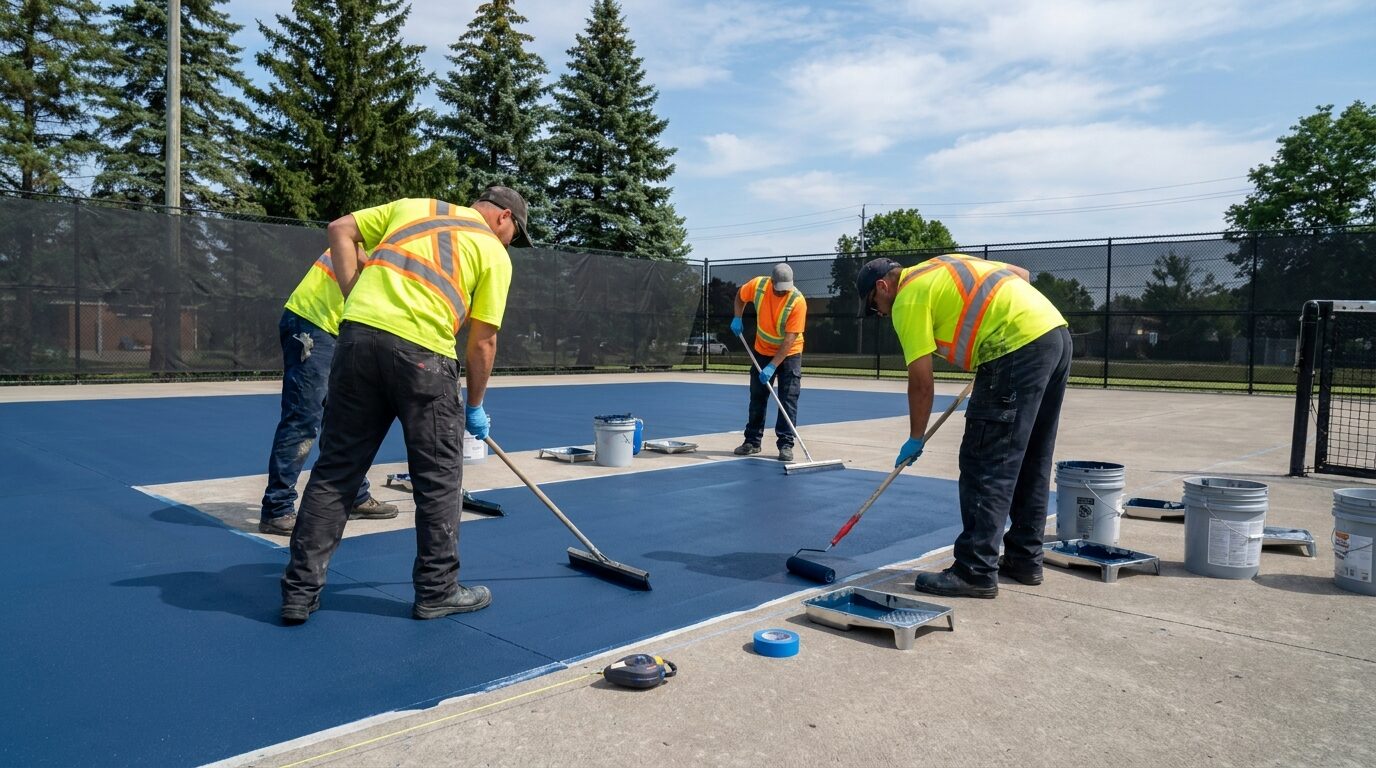
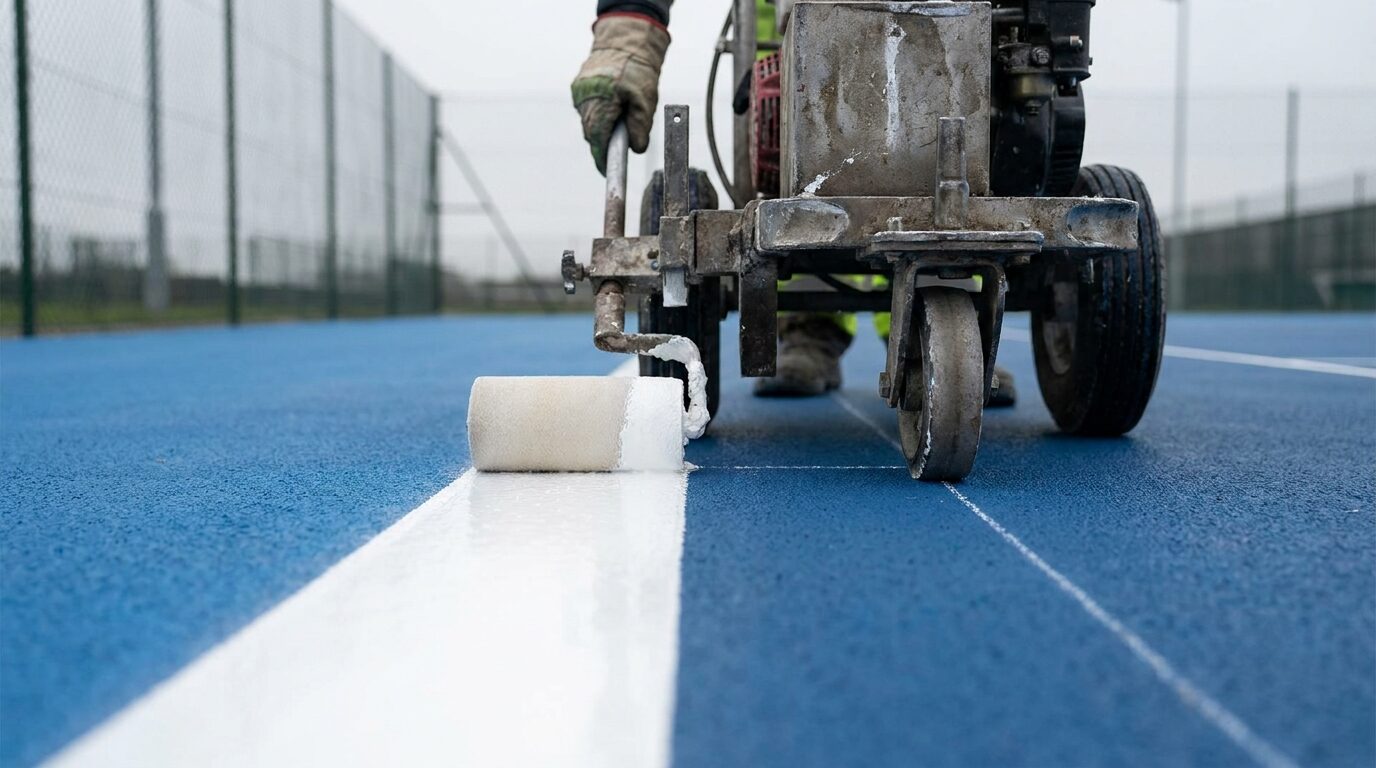
Painted or coated lines in a contrasting colour from the tennis lines give a cleaner, more durable result and are the standard choice for clubs, schools, and municipal courts expecting regular pickleball play. Permanent lines are typically applied as part of a resurfacing pass, since new acrylic coating provides a clean surface for accurate striping and better long-term adhesion than painting directly over aged, oxidized asphalt.
| Factor | Temporary (Tape or Chalk) | Permanent (Painted/Coated) |
|---|---|---|
| Durability | Weeks to a season | Multiple years with normal wear |
| Best suited for | Trial periods, shared-use courts | Dedicated or high-traffic courts |
| Winter performance in Ontario | Poor, needs reapplication each season | Holds up when applied over a sound, well-cured coating |
| Reversibility | Fully reversible | Permanent, though tennis lines can be retained alongside |
Step 3: Adjust or Install the Right Net System
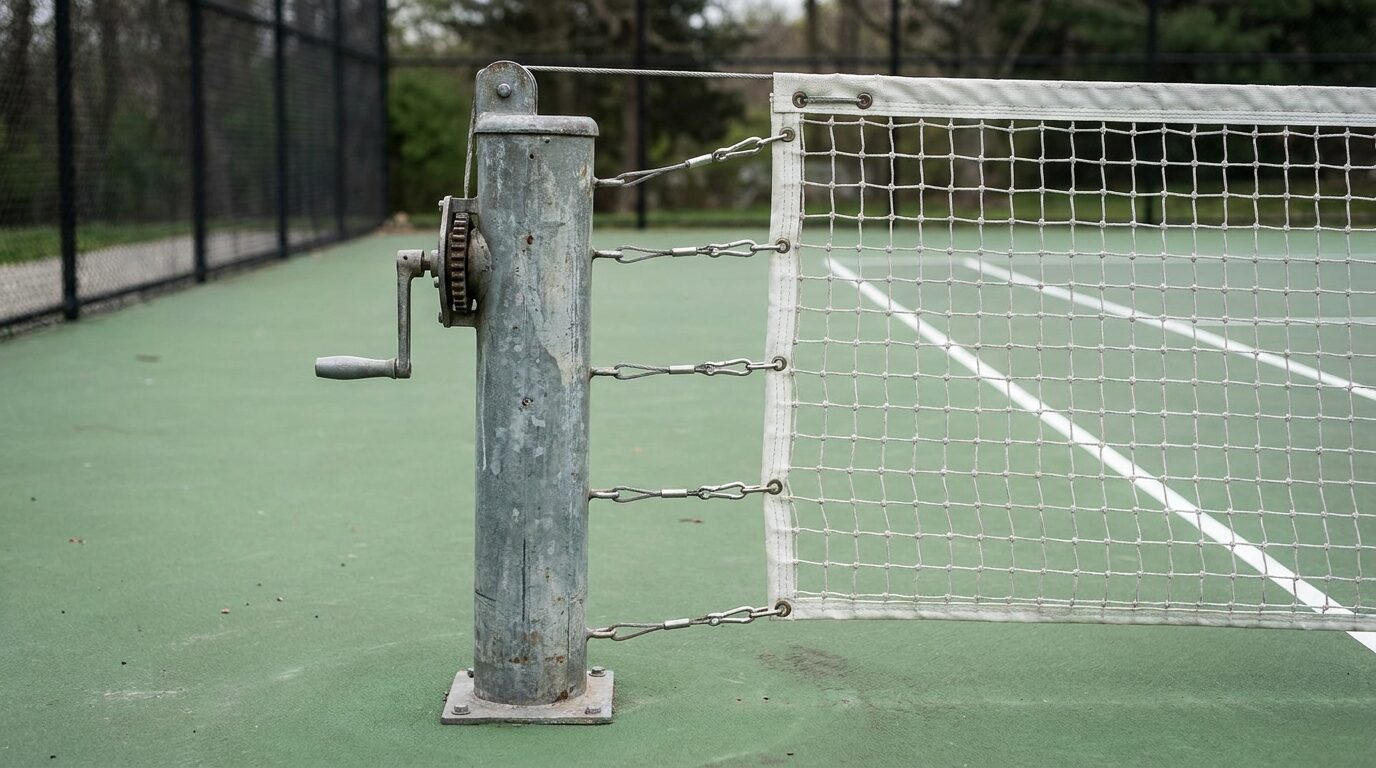
Net height is one of the most overlooked details in a DIY conversion. A pickleball net sits lower than a tennis net, at 36 inches at the posts and 34 inches at the center, compared with a tennis net’s 42 inches at the posts and 36 inches at the center.
Working With an Existing Tennis Net
For courts that need to serve both sports, a center strap can bring a tennis net down to pickleball height for a match, then be released afterward. It’s a workable short-term fix but not something clubs running regular pickleball programming want to manage every session.
Dedicated Pickleball Net Systems
A permanent or semi-permanent pickleball net system, with its own posts set at the correct width and height, is the more practical option for courts converting fully or mostly to pickleball. Portable net systems are also common on shared courts, since they can be set up and stored without altering the tennis net posts at all. For more detail on how net systems get chosen and installed, see our article on tennis court net systems, installation, and maintenance.
Step 4: Resurfacing and Coating for Multi-Sport Play
Not every conversion needs a full resurface, but many benefit from one, especially on courts that are a few years past their last coating.
Why Coating Condition Matters More on a Shared Court
A worn coating already affects traction and ball response on a tennis court, and those same issues carry over to pickleball, where quick lateral movement near the kitchen line puts real demand on grip. A fresh acrylic sports court coating restores texture and gives the new lines a clean surface to bond to, which matters for how long the striping actually lasts.
Color Contrast Between Tennis and Pickleball Lines
When both sets of lines stay on the court, colour contrast is what keeps players from confusing them mid-point. A common approach uses the existing tennis line colour and a clearly different colour, often yellow or blue, for the pickleball boundaries and kitchen lines. This is a detail worth deciding before any paint goes down, since redoing a colour scheme later means recoating.
Step 5: Fencing, Ball Containment, and Player Safety Between Courts
Running two or four pickleball games at once inside one tennis court fence line raises a practical issue: balls crossing between games. Interior dividers, whether netting, low fencing, or simply enough buffer space, reduce interruptions and the risk of a player backing into an adjacent game. Gate placement and any wind screens should also be reviewed, since a layout that made sense for tennis doesn’t always put gates in a convenient spot for four smaller courts.
Step 6: Drainage, Grading, and Ontario Climate Considerations
Ontario’s freeze-thaw cycle is hard on any outdoor court, and it doesn’t treat a converted court any differently than it treats a tennis court. Water that gets into a crack in November and freezes in December will widen that crack regardless of what sport gets played on top of it in July.
Freeze-Thaw and Base Stability
A stable, well-drained base is what allows a resurfaced or newly striped court to survive an Ontario winter without the coating lifting or cracking prematurely. This is why we always recommend addressing drainage and grading issues before a conversion, rather than treating new lines as a cosmetic fix on top of a base that’s already struggling. Our article on the importance of accurate grading for sports court drainage covers this in more depth.
Seasonal Timing for the Work
Line marking and light resurfacing generally need dry, mild conditions to cure properly, which puts most conversion projects in late spring through early fall in Ontario. Trying to rush acrylic coating or paint into a narrow cold-weather window usually shows up later as peeling or uneven adhesion.
Full Conversion vs. Shared-Use Multi-Sport Courts
Not every property needs to choose one sport over the other. A shared-use court, with both tennis and pickleball lines in contrasting colours, lets a facility keep tennis available while adding pickleball capacity. A full conversion removes that flexibility but produces a cleaner playing surface with less visual clutter for pickleball, which some clubs and schools prefer for programming and coaching.
| Consideration | Full Conversion | Shared-Use Court |
|---|---|---|
| Tennis still playable | No | Yes |
| Visual clarity for players | High | Lower, more lines to read |
| Best fit | Dedicated pickleball clubs, high-demand public courts | Mixed-use clubs, schools, private homes |
Many of our clients start with a shared-use layout and revisit a full conversion once they see how the demand actually splits between the two sports. If you’re weighing a brand-new build instead of a conversion, our overview of tennis court construction and resurfacing services covers both paths.
Permits, Accessibility, and Municipal Considerations in Ontario
Line marking and net adjustments on an existing private court rarely trigger a permit, but resurfacing, fencing changes, or lighting additions might, depending on the municipality. Public and municipal courts usually go through a parks or facilities review before any conversion work starts. It’s worth checking early rather than scheduling contractors first.
Accessibility for Schools and Municipal Facilities
For schools, community centres, and municipal parks, accessible routes to and around the court matter as much as the playing surface itself. Ontario’s accessibility framework addresses accessible public spaces, including paths of travel, and it’s worth reviewing the province’s accessibility laws overview alongside your municipality’s own requirements when planning a public-facing conversion. If permitting is unfamiliar territory, our article on whether you need permits to build a sports court is a useful starting point.
What Affects the Cost of a Tennis-to-Pickleball Conversion
Every conversion project is different, so a single number rarely tells the real story. What actually drives cost is a combination of the factors below.
| Cost Driver | Why It Matters |
|---|---|
| Number of pickleball courts | More courts mean more line marking, nets, and layout planning |
| Temporary vs. permanent lines | Permanent striping usually requires resurfacing first |
| Current surface condition | Cracked or worn courts need repair before new lines are applied |
| Drainage or grading issues | Correcting slope adds scope but protects the new work |
| Net system choice | Portable, semi-permanent, and permanent systems vary in cost and labour |
| Fencing or divider changes | Multi-court layouts sometimes need interior dividers or gate changes |
Because every court’s starting condition is different, the most reliable way to understand cost for a specific property is a site assessment. If you’d like CrowAll to take a look at your court, we can walk through which of these factors apply before any work is scheduled.
Maintenance After Conversion: Keeping a Multi-Sport Court in Shape
A converted court has the same maintenance needs as any acrylic-coated surface, with a bit more attention paid to line visibility since there are now two sets to track.
| Season | Task |
|---|---|
| Spring | Inspect for winter cracking, clear debris, check net height and tension |
| Summer | Clean surface regularly, check line visibility, monitor for surface heat damage |
| Fall | Clear leaves promptly, inspect drainage before freeze-up, store portable nets |
| Winter | Avoid parking equipment on the surface, follow surface-safe snow removal practices |
Routine care goes a long way toward protecting the investment in new lines and coating. For a broader look at what a maintenance plan should include, see our guide on the cost-benefit of professional sport court maintenance.
Signs Your Tennis Court Is a Good (or Poor) Candidate for Conversion
A good candidate has a stable base, manageable or repairable cracking, working drainage, and fencing in decent condition. A poor candidate is showing the kind of wear we cover in our article on signs you need tennis court resurfacing, including spreading cracks, standing water, or a coating that’s peeling and bubbling. In that case, resurfacing needs to happen first, with the pickleball conversion planned as part of that same project rather than layered on top of a failing surface.
When a Full Rebuild Makes More Sense
If the base itself has settled unevenly or the court has structural issues beyond the coating, a conversion isn’t the right fix. At that point it’s worth comparing conversion against building a new court from scratch, since a rebuild resets the clock on the base as well as the surface.
Multi-Sport Courts: Adding More Than Just Pickleball
Once a tennis court is already being reworked for pickleball, some clients ask about going a step further and adding basketball lines to the same surface. It’s a reasonable question, since acrylic coating and line striping work the same way for basketball as they do for pickleball, and the extra lines add negligible cost once a resurfacing crew is already on site.
What a Three-Sport Layout Looks Like in Practice
A true multi-sport court usually keeps the tennis boundary as the outer reference, adds pickleball lines in one colour, and basketball key and three-point lines in a third colour, sized to fit within the available width. It works best on courts with enough clear space around the perimeter, since basketball hoops and their footings need their own clearance from the pickleball buffer zones. For background on how surface choice affects this kind of layout, our comparison of basketball court surface options is a useful companion read.
When to Keep It Simple Instead
Three sets of lines on one court can get visually busy fast, and for smaller courts or ones serving mostly younger players, a two-sport layout (tennis and pickleball, or pickleball and basketball) is often easier to read and maintain. The right call depends on how the space actually gets used week to week, which is part of what a site visit is meant to sort out before any coating goes down.
Working With a Professional Contractor vs. a DIY Layout
A temporary DIY layout with tape and a portable net is a reasonable way to test interest in pickleball on a private court. For clubs, schools, and municipal facilities, or for any permanent line marking and resurfacing work, a professional contractor brings court-layout accuracy, proper surface preparation, and coating experience that a weekend project can’t match. Mis-measured lines or a rushed coating job are difficult and expensive to correct once players are used to the layout.
Our team at CrowAll Surface Contractors works with tennis clubs, schools, municipalities, and homeowners across Ontario on exactly this kind of project, from a straightforward line-marking pass to a full resurface with multiple new pickleball courts. If your community is also exploring dedicated pickleball construction rather than a conversion, our pickleball court construction services in the Toronto area and our article on what a new pickleball court costs are good next steps to review. For clubs thinking about the business side of adding pickleball, our piece on the basics of running a pickleball club covers some of the planning questions that come up alongside the construction side.
Frequently Asked Questions
Can you really turn a tennis court into a pickleball court?
Yes. A standard tennis court can host one, two, or four pickleball courts once the net is adjusted and pickleball lines are added in a contrasting colour. No structural rebuild is needed if the existing base and drainage are in good condition.
How many pickleball courts fit on one tennis court?
Most tennis courts comfortably fit two full-size pickleball courts side by side. Some facilities fit four smaller courts in two rows, though that layout leaves tighter buffer zones between games and works best for casual or youth play rather than competitive matches.
What is the official size of a pickleball court?
A regulation pickleball court measures 44 feet long by 20 feet wide, with a 7-foot non-volley zone, or “kitchen,” extending from the net on each side, as outlined in the official pickleball rules.
Do I need a new net, or can I use my tennis net?
A tennis net can be adjusted with a center strap to reach pickleball height for casual play, but a dedicated pickleball net system, set at 36 inches at the posts and 34 inches at the center, is the better long-term option for regular or club-level play.
Is it cheaper to convert a tennis court than build a new pickleball court?
Generally yes, since a conversion reuses the existing base, drainage, and fencing rather than building them from scratch. The exact savings depend on the court’s current condition and how many pickleball courts are planned.
Do I need permits to convert a tennis court to pickleball?
Temporary line marking on a private court usually doesn’t require a permit, but resurfacing, fencing changes, or lighting work might, depending on your municipality. Public and municipal courts typically go through a parks or facilities review before conversion work begins.
Can pickleball and tennis share the same court?
Yes, with both sets of lines painted in contrasting colours. This shared-use approach keeps tennis available while adding pickleball capacity, though it adds visual clutter compared with a full conversion.
What color should pickleball lines be on a shared court?
There’s no single mandated colour, but choosing a shade that clearly contrasts with the existing tennis lines, often yellow or blue against a green or blue court, helps players tell the two layouts apart during fast-paced play.
Does the court need to be resurfaced before adding pickleball lines?
Not always. A court in good condition can often have lines added directly. A court with a worn, oxidized, or cracked coating should be resurfaced first so the new lines bond properly and last.
How does Ontario winter weather affect a converted court?
Freeze-thaw cycles stress cracks and drainage weak points the same way on a converted court as on any tennis court. A stable, well-graded base is what allows new coating and line work to survive an Ontario winter without premature cracking or lifting.
Can a backyard tennis court be converted for pickleball?
Yes. Backyard tennis courts are common conversion candidates, often starting with temporary tape lines and a portable net before homeowners commit to permanent striping and a dedicated net system.
How long does a tennis-to-pickleball conversion take?
A simple line-marking project can often be completed in a day or two. A full conversion involving resurfacing, new lines, and net system installation takes longer and depends on court condition, weather, and coating cure time.
What is the best time of year in Ontario to convert a court?
Late spring through early fall offers the dry, mild conditions that acrylic coatings and paint need to cure properly. Projects rushed into cold or wet weather are more likely to show adhesion problems later.
Will converting my tennis court affect its resale or property value?
A well-executed multi-sport conversion can add appeal for buyers interested in either sport, particularly as pickleball demand grows, though the impact on value depends on the local market and the quality of the work.
Can I still play tennis after converting part of my court to pickleball?
Yes, if you choose a shared-use layout that keeps tennis lines alongside the new pickleball lines, or if you convert only one section while leaving a full tennis layout elsewhere on the property.
What is the non-volley zone and why does it matter for conversions?
The non-volley zone, or kitchen, is the 7-foot area on each side of the pickleball net where players can’t volley the ball. Accurate placement during line marking is essential, since it directly affects legal play and safety near the net.
Should the kitchen zone be a different color than the rest of the court?
Most pickleball courts built today mark the kitchen in a visibly lighter, contrasting color rather than leaving it the same shade as the rest of the playing surface, since that contrast helps players judge foot faults at a glance during fast rallies. CrowAll’s sport court color options guide covers this and other color decisions in more detail.
Plan Your Tennis-to-Pickleball Conversion With CrowAll
A tennis-to-pickleball conversion works best when it starts with an honest look at the court you already have. From there, the plan comes together around your budget, your player mix, and how permanent you want the new lines to be. Book a consultation with CrowAll Surface Contractors to review your court’s condition and talk through layout options, or explore our why choose us page to see how we approach court conversions across Ontario. If a third sport, like basketball, is part of the plan, our guide to multi-sport court construction in Ontario covers how to combine it with tennis and pickleball on one court. Clubs looking beyond tennis and pickleball are also increasingly asking about padel, and our guide to padel court construction in Ontario covers what that structural build actually involves.
Before you add pickleball lines, think about who lives nearby. Several pickleball courts on a former tennis court produce far more paddle strikes than the original two players did, and our guide to pickleball court noise in Ontario explains how court count, hours and barriers affect the neighbours.