Bocce Court Dimensions: Official Sizes and Backyard Layouts for Ontario Courts
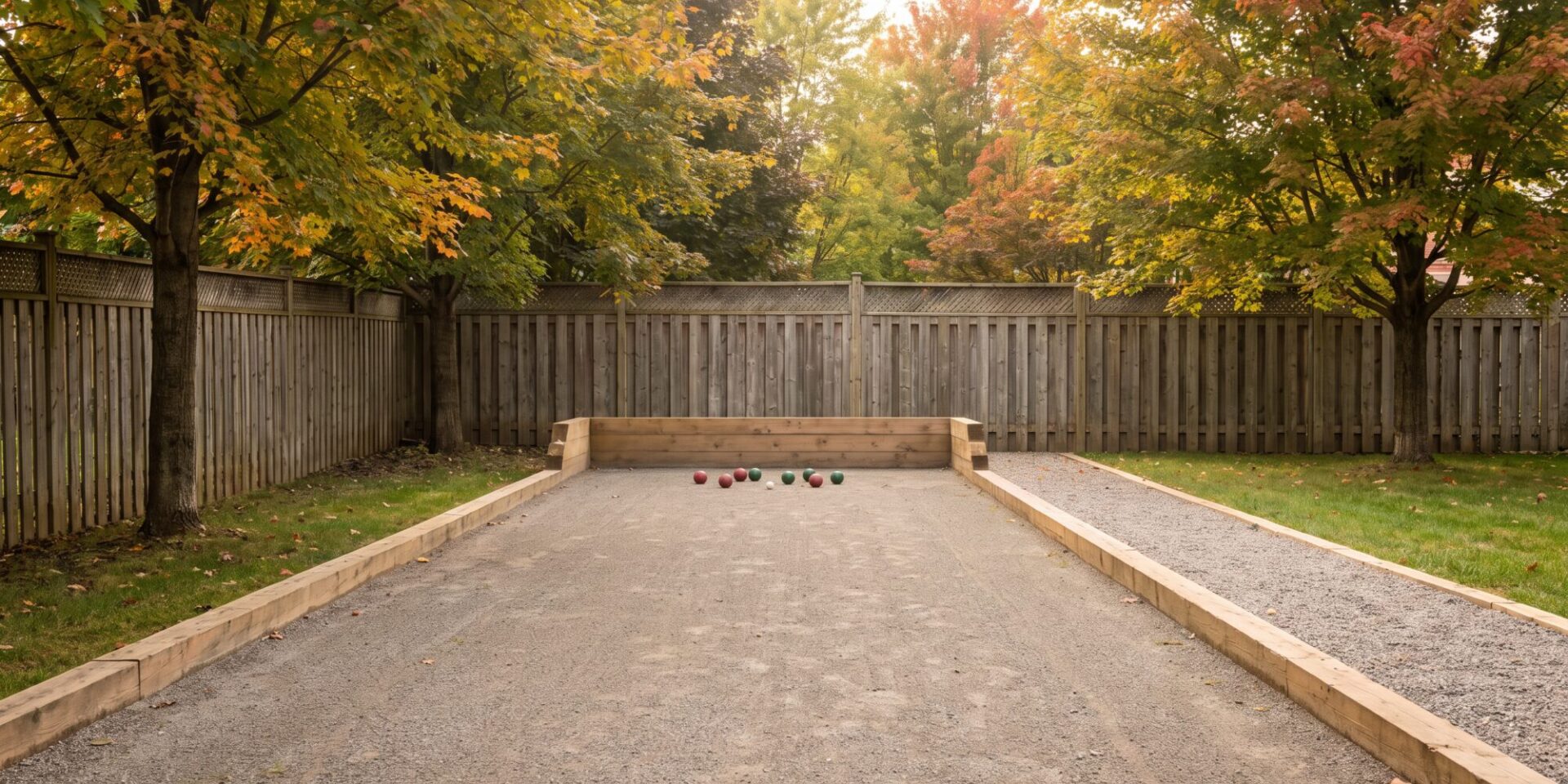
A bocce court looks simple on paper. It is a long strip of flat ground with a board at each end and a few balls rolling down the middle. Then someone lays a tape measure across the backyard and finds that the “regulation” size depends on which rule book they pick up, and that one of the most commonly quoted figures online does not match any of the primary sources at all.
This guide sets out the official bocce court dimensions in feet and metres, based on the rules published by the United States Bocce Federation, Special Olympics Canada and the international technical rules for Raffa and Volo. It then turns those numbers into the footprint you actually need on an Ontario property, including the room around the court, the boards, the lines and the slope question. Where a figure comes from a published rule, we name the source. Where it depends on your lot, your league or your surface, we say that too. If you are weighing a full build rather than just checking a number, our guide to bocce court construction in Ontario covers the base, drainage and surface decisions in more detail.
The Short Answer: How Big Is a Bocce Court?
A regulation bocce court under international-style rules is about 26.5 metres long and 4 metres wide, roughly 86.9 by 13.1 feet. Special Olympics Canada uses 18.29 by 3.66 metres, or 60 by 12 feet. Backyard courts are often shorter, since the game plays well at many lengths.
That covers most searches. The harder part is that no single number is the bocce court size. Federations write their rules for different kinds of play, and a backyard court only has to satisfy the people who use it.
Bocce Court Dimensions at a Glance
| Source | Metres (length by width) | Feet (length by width) | Notes |
|---|---|---|---|
| United States Bocce Federation Open Rules | About 26.5 by 4.0 | 86.92 by 13.12 | Described as the official court. Unofficial courts may be smaller. |
| International technical rules (Raffa and Volo) | 26.50 by 4.00 to 4.50 | About 86.9 by 13.1 to 14.8 | Lengths of 24.50 to 28.00 m and a 3.80 m width need prior authorisation under the rules. |
| Special Olympics Canada | 18.29 by 3.66 | 60 by 12 | Walls are optional and the rules note that backyard bocce courts are commonly used. |
| Government of Western Australia sports dimensions guide | Up to 26.5 by up to 4.0 | Up to about 86.9 by 13.1 | Gives maximums for a regulation court, with a raised barrier up to 20 cm high. |
If you want to see how that footprint compares with the other courts we build, our guides to volleyball court dimensions, basketball court dimensions and pickleball court dimensions take the same approach, official numbers first and then the real pad you need.
Why the Numbers Differ Between Sources
The sources are not contradicting each other so much as describing different games. The United States Bocce Federation and the international technical rules describe a long lane for competition, which is why both land on the same 26.5 metre length. Special Olympics Canada sets a shorter, narrower court that works in gyms, school yards and community spaces, and it says plainly that walls are optional. The Western Australia guide gives maximum figures for a regulation court rather than a single required size.
For a homeowner this is good news. There is no inspector measuring your backyard court against a federation drawing, so the decision comes down to how much space you have, who will play and whether you ever want to host league or tournament play.
Bocce Court Dimensions in Feet and Metres
Bocce rules are written in metres in most of the world and in feet in North America, so the same court shows up with slightly different numbers depending on where you look. A short conversion table saves a lot of confusion when a drawing is in one unit and your survey is in the other.
| Measurement | Metric | Imperial | Source |
|---|---|---|---|
| Official court length | 26.5 m | 86.92 ft | USBF Open Rules, international technical rules |
| Official court width | 4.0 m | 13.12 ft | USBF Open Rules, international technical rules |
| Upper width in the international rules | 4.5 m | About 14.8 ft | International technical rules |
| Special Olympics Canada length | 18.29 m | 60 ft | Special Olympics Canada bocce rules |
| Special Olympics Canada width | 3.66 m | 12 ft | Special Olympics Canada bocce rules |
| Raised barrier maximum | 20 cm | About 7.9 in | Western Australia sports dimensions guide |
| Side siding height, international rules | 25 cm, plus or minus 2 cm | About 9.8 in | International technical rules |
The Full-Length Court
The United States Bocce Federation states in its Open Rules that official courts are 86.92 feet long and 13.12 feet wide. Those numbers are the metric 26.5 by 4 metre lane converted to feet and rounded, which is why they look so oddly precise. The international technical rules for Raffa and Volo describe the same standard lane length of 26.50 metres, with a width between 4.00 and 4.50 metres.
If you are building for league play, this is the size to start from. It is a big footprint, close to 107 square metres, or about 1,140 square feet, before you add any room around it.
The Special Olympics Canada Court
The Special Olympics Canada bocce rules describe a court 3.66 metres wide by 18.29 metres long, which is 12 by 60 feet. The rules allow the surface to be stone dust, dirt, clay, grass or an artificial surface, and they state that court walls are optional. For schools, community centres and municipal programs that serve athletes of different abilities, this is a practical size that fits on a much smaller site than a full-length lane.
Why You May See 91 by 13 Feet
Many contractor and retailer pages in search results quote a regulation court of 91 feet by 13 feet. We could not find that figure in any of the federation or government documents above, which point to about 87 feet. It may come from an older convention or from rounding, and a court built to it would simply be a little longer than the published standard. If a league or club tells you to build to 91 feet, build to that. Otherwise, the published rule books are the better reference.
Boards, Lines and Markings
A bocce court is more than a rectangle of flat ground. The boards that enclose it, the lines painted across it and the way those lines are measured all affect how much space you need and how the court plays.
| Feature | What the source says | Source |
|---|---|---|
| End walls | At least 304 mm (12 in) high, made of a rigid material such as wood or Plexiglas | Special Olympics Canada |
| Side walls | At least as high as the bocce balls | Special Olympics Canada |
| Walls overall | Optional, and backyard courts are commonly used | Special Olympics Canada |
| Raised barrier | Up to 20 cm high on a regulation court | Western Australia guide |
| Sidings | Non-metallic, such as wooden planks, 25 cm high with a tolerance of 2 cm | International technical rules |
| Line width | 50 mm (2 in) wide | Special Olympics Canada |
| Line width, international | Maximum 1.5 cm | International technical rules |
| Foul line | 3.05 m (10 ft) from the backboards in Special Olympics Canada rules, and a recommended 13 ft from the back wall in the USBF rules | Special Olympics Canada, USBF |
| Half-court marker | The 30-foot line, drawn sideboard to sideboard with the 10-foot line | Special Olympics Canada |
End Boards and Side Boards
The boards do two jobs. They keep balls on the court, and in many games they are part of play, because the Special Olympics Canada rules say the side or end walls may be used for bank shots or rebound shots. That is why the height matters. A side board that is lower than the ball will not contain it, and an end board that is too short lets a hard throw leave the court.
The published figures run from about 12 inches for end walls up to the 25 centimetre siding in the international rules. A backyard court has more freedom than a sanctioned one, so the board height is often decided by how the court looks next to the patio, fence or garden. Timber, composite and stone borders are all used, and the choice affects maintenance more than play.
Foul Lines and the Half-Court Marker
The foul line is the line players must stay behind when throwing, and rule books place it differently. Special Olympics Canada puts it 3.05 metres (10 feet) from the backboards, while the USBF recommends a single line at 13 feet from the back wall for pointing and shooting. For a backyard court, this is something to decide with the people who will actually play, then mark clearly on the boards and the surface.
The Special Olympics Canada rules also use a half-court marker at the 30-foot line, and a pallina that stops closer than that line makes the frame dead. Both the 10-foot and 30-foot lines are drawn from sideboard to sideboard. Lines are part of the surface design, so they are better planned before the court is finished than added afterward.
Line Width and How Lines Are Measured
The line width is a small number that causes real problems. Special Olympics Canada specifies 50 millimetres, about 2 inches, while the international rules cap line width at 1.5 centimetres. The two documents are written for different competitions, so the width you choose should follow the league you expect to play in. On an acrylic or turf surface, line width and colour are also part of the finish, which our guide to sport court colour options covers in more detail.
Raffa, Volo and Punto: Does the Format Change the Court?
Bocce is played in a few forms, and the international technical rules treat them separately. Punto is the pointing throw, raffa is a rolling hit on a called ball and volo is a thrown hit. The court dimensions in the technical rules apply to all of them, but the lines inside the lane change what a player is allowed to do.
What the International Rules Add
The international technical rules for Raffa and Volo describe lines labelled A through E, with distances measured from the lane heads and the same in every lane. One line limits where a player can stand for punto and raffa, another limits the volo throw, and a further line sets the minimum landing distance for a raffa. A volo has to land within 40 centimetres of the called ball. The text of the rules does not give numeric distances for these lines. Those appear only in a drawing, so if you are building to the international format, work from the drawing in the current rules rather than from a summary.
What This Means for a Backyard Court
Most backyard and community courts are played in a relaxed punto style and never need the full set of competition lines. A single foul line and a half-court marker, as in the Special Olympics Canada rules, is usually plenty. If a club in your area plays Raffa or Volo and you hope to host them, ask the club for the line layout before the surface is finished, because adding lines later means touching a finished surface.
How Much Space You Need Around the Court
The published dimensions describe the playing lane. They do not describe the walkway, the fence line, the flower bed or the patio next to it. Real sites need all of that, and this is where most backyard plans run short.
Clearance Around the Playing Surface
Our bocce court construction guide suggests planning roughly 3 to 5 feet of clearance around the perimeter so players can stand, retrieve balls and move without stepping into a fence line or garden bed. That is a CrowAll planning allowance, not a rule from a federation, so adjust it for your property, your neighbours and the way the court will be used. Clubs building more than one court side by side should leave a similar buffer between courts so each court can be maintained on its own.
Footprint Arithmetic for Common Sizes
| Court size | Court area | Overall footprint with 3 ft allowance each side | Overall footprint with 5 ft allowance each side |
|---|---|---|---|
| Official lane, 86.92 by 13.12 ft | About 1,140 sq ft | About 93 by 19 ft | About 97 by 23 ft |
| Special Olympics Canada, 60 by 12 ft | 720 sq ft | 66 by 18 ft | 70 by 22 ft |
| Recreational court, 50 by 10 ft | 500 sq ft | 56 by 16 ft | 60 by 20 ft |
| Compact court, 40 by 8 ft | 320 sq ft | 46 by 14 ft | 50 by 18 ft |
The footprints in the table are simple arithmetic, adding the allowance to both ends and both sides of each court. They are meant to help you check a site, not to define a standard. The recreational and compact courts are example sizes within the ranges described in our own bocce guide, and a federation does not set them.
Orientation and Sun
Long, narrow courts are more sensitive to the sun than square ones. A court that runs straight into low afternoon light makes it hard to judge a throw. Our bocce guide suggests running the long axis north to south where the site allows it, which keeps the sun off the line of play for much of the day and helps snow melt more evenly in spring. Trees and fences cast long shadows across a strip this narrow, so look at the shade pattern in more than one season before you fix the position.
Choosing a Bocce Court Size for an Ontario Property
The right size is the longest court that fits comfortably on the site, with room around it and without squeezing out the rest of the yard. Length is what makes the game feel like bocce, since players need room for a ball to travel, curve and stop. Width is more forgiving, but a court that is too narrow gets awkward when two players stand at one end.
Short Courts and What Changes
A shorter court changes the character of the game rather than breaking it. Throws are shorter, there is less room for a ball to curve or bank, and the pallina has fewer places to go. For casual family play, that is often fine. For players who want something that feels like a club court, every extra metre of length helps. If your lot is tight, a 40 foot court that is well built will be used far more than a 60 foot court that never fit comfortably.
Narrow Side Yards and Tight Lots
Narrow side yards are a common place for bocce in the Greater Toronto Area, because they are long, flat and otherwise unused. The challenge is access. Excavation and base installation need machinery, and a side yard with a 1 metre gate may not allow it. Check how equipment will get to the site, where the excavated material will go and whether fences, utilities or roots sit inside the footprint. Our guide to the construction process for a backyard sports court explains the sequence a site goes through.
Table: Matching the Court to the Space
| Situation | Court format to consider | What to check first |
|---|---|---|
| Family backyard with room for a long strip | Recreational court of 50 to 60 ft | Sun direction, fence line, access for equipment |
| Narrow side yard | Compact court of 30 to 40 ft | Gate width, utilities, drainage off the roof and neighbours’ lots |
| Condo, restaurant or community amenity space | Special Olympics Canada size of 60 by 12 ft | Surface rules, boards, lighting, accessibility |
| Club planning league play | Full lane of about 26.5 by 4 m | League rules for lines, boards and surface |
| School or municipal program | 60 by 12 ft, with optional walls | Supervision, storage, line layout for the programs offered |
Matching the Court to the People Who Will Use It
A court gets used for years, so the people matter as much as the dimensions. The same strip of ground can be a family court, a club venue or a community amenity, and each use points to a different layout.
Homeowners and Private Estates
Residential owners usually want a court that looks as good as it plays. That points to boards and borders that match the house, a surface that holds its grade through winter and a position close enough to the patio for people to move between the two. Space is the limit, and the earlier you measure, the more options you keep. Our guide to sport court landscaping covers how to tie a court into planting, paths and seating.
Clubs and Community Centres
Clubs usually prioritise a full-length lane and consistent play. Community centres and condo developments care more about low maintenance, durability under heavy use and the ability to host different groups. A club that expects tournament play should confirm the format and the line layout with its governing body first, and plan lighting from the start. Our guide to sport court lighting in Ontario explains how lighting choices affect evening use.
Schools, Municipalities and Accessibility
Schools and recreation departments often work to the Special Olympics Canada format because it fits more sites and is designed around inclusive programs. Walls are optional under those rules, which makes it easier to design for access, but the surface still has to be free of obstructions in the ball’s path. If the court will be part of an accessible program, involve the people who will use it in the layout and surface decisions. Accessibility requirements for a public facility depend on the project and the municipality, so confirm them with your building department.
How Surface Choice Affects Court Size and Build
The rule books list many acceptable surfaces. The USBF Open Rules mention carpet, crushed stone, dirt, oyster shells, clay and synthetic carpets or poured liquid, and the Special Olympics Canada rules list stone dust, dirt, clay, grass or an artificial surface. Dimensions do not change with the surface, but the depth of the build, the edging and the maintenance routine do.
| Surface | Where it appears | Planning notes |
|---|---|---|
| Crushed stone, stone dust, oyster shell | USBF Open Rules, Special Olympics Canada, Western Australia guide | Traditional feel. Needs a well-compacted base and regular raking, watering and rolling to stay true. |
| Clay or dirt | USBF Open Rules, Special Olympics Canada | Plays softer and slower. Moisture management matters through the season. |
| Grass | Special Olympics Canada | Needs mowing and watering and is harder to keep level on a narrow strip. |
| Artificial turf | Special Olympics Canada, USBF (synthetic carpet) | Holds grade well through freeze-thaw. Infill and pile choice affect ball speed. |
| Poured or coated surface | USBF (poured liquid) | Fast and low maintenance, with a different feel from granular surfaces. |
Crushed Stone and Oyster Shell
This is the traditional surface, and it is the one most people picture. It rewards careful base construction and regular upkeep. Because the playing layer is loose, a hard freeze-thaw cycle can disturb it where the base underneath is poorly drained or poorly compacted. Edge detail matters too, since a loose surface wants a firm border to keep it in place.
Artificial Turf
Turf has become a common choice in Ontario because it keeps its grade through winter far better than a loose aggregate. A short, dense pile with the right infill gives consistent speed without raking. Our guide to building a bocce ball court with artificial turf covers installation, and the article on turf infill for sport courts explains how infill affects the way a surface plays. For a wider look at the tradeoffs, see artificial turf versus natural grass.
Clay, Asphalt and Acrylic-Coated Bases
Clay and ClayTech make sense where an existing clay area already sets the look. A paved or acrylic-coated base is the lowest-maintenance option and suits busy commercial sites, though the ball rolls faster and truer than on granular material. If an acrylic finish is on the table, our article on the role of acrylic sports court coating explains what the coating does and where it fits.
Level, Slope and Drainage on a Narrow Court
Bocce is a precision game played over a long throw, and a narrow court leaves nowhere for a flaw to hide. A half inch of unevenness that nobody would notice on a basketball pad shows up on the first throw down a bocce lane.
What the Rules Say About Flatness
The international technical rules ask for a flat and perfectly levelled surface, and the Special Olympics Canada rules ask that the surface be free of obstructions in the ball’s path. Neither document tells you how to drain an outdoor court in Ontario, because they are written for the game rather than for the site. That part is a design decision.
Drainage Is a Site Decision
An outdoor court has to shed water, and in Ontario it also has to survive freeze-thaw cycles. Our bocce construction guide describes a very slight and consistent cross-slope, typically around 1 percent, as a common way to move water off a court evenly rather than letting it collect in one corner. The actual slope, drainage layers and outlet for your court depend on your soil, your lot and the surface you choose, so they should be set by the person designing the build. Our articles on accurate grading for sports court drainage and the importance of drainage in sports surface construction explain why.
Grading to a Tight Tolerance
On a long, narrow court, laser-guided grading is what establishes the finished elevation along the full length before any base material goes down. Our laser-guided grading page describes the service, and the article on what to expect from laser-guided grading walks through the process.
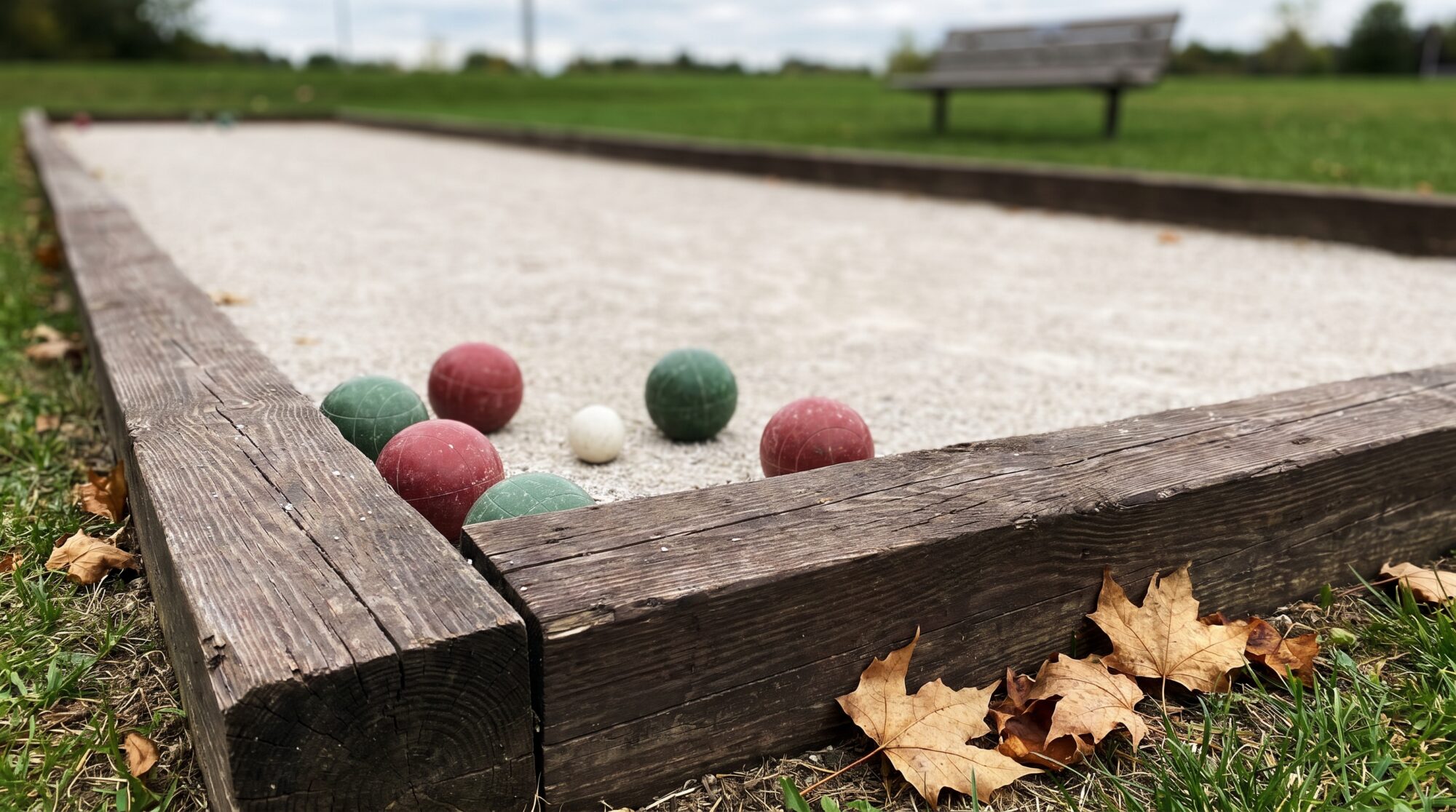
Laying Out a Bocce Court on the Ground
A court that is a few inches off square or out of parallel is hard to fix once the base is in. Layout is cheap to get right on day one and expensive to correct later.
A Practical Layout Sequence
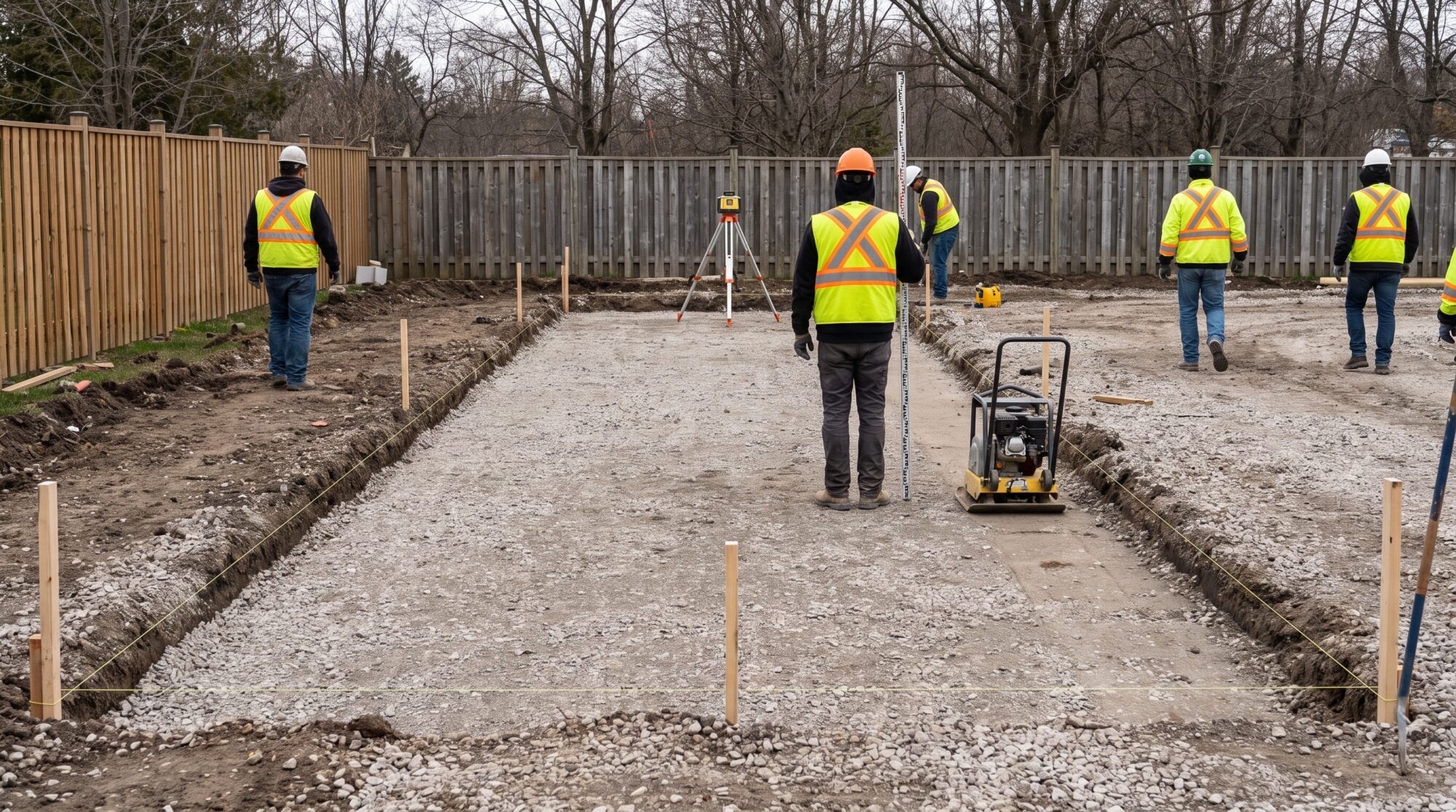
The sequence below is common construction practice and not a federation requirement. Your builder may adjust it to suit the site.
- Confirm the finished dimensions, including boards, and decide which unit the drawings and the survey will use.
- Mark the four corners and check the diagonals. In a true rectangle both diagonals are the same length.
- Set string lines on stakes at the finished edges, offset enough that digging does not disturb them.
- Establish the finished grade with a laser level, along the full length and across the width.
- Locate the foul line, the half-court marker and any other lines, and decide how they will be made on the finished surface.
If you want a closer look at how a site is prepared, our guide to the best time of year to start building sports courts and the article on how long sports court construction takes help with scheduling.
Common Measuring Mistakes
| Mistake | What happens | How to avoid it |
|---|---|---|
| Measuring the court but not the boards | The finished court ends up narrower or shorter than planned | Decide whether stated dimensions are inside the boards or outside them before layout |
| Mixing feet and metres | A 13.12 ft width becomes 13 ft, then 12 ft, on different drawings | Pick one unit and convert once, with the source number written beside it |
| Skipping the diagonals | The court is a parallelogram that looks fine until the boards go in | Check both diagonals at the string line stage |
| Forgetting clearance | Players stand in a flower bed or against a fence | Add a perimeter allowance to the site plan as well as the court |
| Marking lines after the surface is finished | Lines look added on, and paint or inlay can fail at the edges | Plan the line layout with the surface design |
| Ignoring drainage outlets | Water collects at one end after rain | Design the outlet and the slope direction with the grading plan |
Digging Safely and Permits in Ontario
Before a shovel or an excavator goes into the ground, you need to know what is under it. Ontario Dig Authority, which now operates in place of Ontario One Call, says locate requests should be made at least five business days before you dig and that locates are required for any project that breaks ground, whatever the size or depth. Request a new locate if the project changes. Your contractor will usually handle this, but it is worth asking who is responsible.
Permit and zoning rules vary by municipality. A bocce court may need a grading, fence or accessory-structure permit depending on its height, boards, lighting and distance from lot lines, and a court in a public or club setting can raise other requirements. Our guide to permits for building a sports court explains what to ask your local office.
Bocce Beside Other Courts
Bocce is a good partner for other sports because its footprint is long and thin. A strip along the side of a multi-sport pad or beside a tennis or pickleball court can turn unused edge space into a second activity. The table shows how the playing area compares, using dimensions already verified in our other guides.
| Court | Playing dimensions | Approximate playing area |
|---|---|---|
| Bocce, official lane | 26.5 by 4 m | About 106 sq m |
| Bocce, Special Olympics Canada | 18.29 by 3.66 m | About 67 sq m |
| Pickleball | 20 by 44 ft | About 82 sq m (880 sq ft) |
| Volleyball, standard | 18 by 9 m | 162 sq m |
| Basketball, FIBA | 28 by 15 m | 420 sq m |
The areas are for the playing court only. Once you add run-off, fencing and clearance, the real footprints are larger. Our guide to multi-sport court construction in Ontario covers how to combine sports on one pad, and the articles on shuffleboard court construction and padel court construction show how other narrow or enclosed formats are planned. For a quiet corner of the yard, a backyard putting green is another way to use a small, flat area.
Frequently Asked Questions About Bocce Court Dimensions
What are the dimensions of a bocce court?
An official bocce court is about 26.5 metres long and 4 metres wide, or 86.92 by 13.12 feet, according to the USBF Open Rules and the international technical rules. Special Olympics Canada uses 18.29 by 3.66 metres, or 60 by 12 feet. Backyard courts are usually shorter.
How long is a bocce court?
The standard lane is 26.5 metres, about 86.9 feet. The international rules allow 24.5 to 28 metres with prior authorisation, and Special Olympics Canada uses 18.29 metres, or 60 feet. A backyard court can be any length that fits the site.
How wide is a bocce court?
The international rules set the width between 4.0 and 4.5 metres, about 13.1 to 14.8 feet. The USBF lists 13.12 feet and Special Olympics Canada lists 3.66 metres, or 12 feet. Backyard courts are commonly 8 to 12 feet wide.
What are bocce court dimensions in feet?
The USBF Open Rules give official courts as 86.92 feet long and 13.12 feet wide. Special Olympics Canada uses 60 by 12 feet. Many recreational courts are narrower and shorter, such as 50 by 10 feet or 40 by 8 feet.
What are bocce court dimensions in metres?
The standard lane is 26.50 metres long, with a width of 4.00 to 4.50 metres under the international technical rules. Special Olympics Canada uses 18.29 by 3.66 metres. The Western Australia guide gives maximums of 26.5 by 4 metres.
What is the Special Olympics bocce court size?
Special Olympics Canada describes a court 3.66 metres wide by 18.29 metres long, which is 12 by 60 feet. Walls are optional, lines are 50 millimetres wide and the foul line sits 3.05 metres from the backboards.
Is a regulation bocce court 91 by 13 feet?
Many retailer and contractor pages say so, but the federation and government documents we checked point to about 86.9 by 13.1 feet. A league may still ask for 91 feet, so confirm with the organization you plan to play with before you build.
What is a good size for a backyard bocce court?
The longest court that fits comfortably with room around it. Our bocce guide describes residential courts of roughly 8 to 10 feet wide by 40 to 60 feet long as common. Check sun direction, access for equipment and drainage before you fix the size.
How small can you make a bocce court?
There is no official minimum for a backyard court. Very narrow courts feel cramped when two players stand at one end, and very short courts remove the curve and bank shots. Our guide treats about 8 feet wide as a practical lower limit for comfort.
How much space do I need around a bocce court?
Our construction guide suggests about 3 to 5 feet around the perimeter for standing, retrieving balls and moving safely. That is a planning allowance, not a federation rule. Add more if the court sits beside a fence, pool or garden bed.
How high should bocce court boards be?
Special Olympics Canada asks for end walls at least 304 millimetres, or 12 inches, high and side walls at least as high as the balls. The international rules use sidings 25 centimetres high, and the Western Australia guide gives a raised barrier up to 20 centimetres.
How wide are the lines on a bocce court?
Special Olympics Canada specifies lines 50 millimetres, or 2 inches, wide. The international technical rules cap line width at 1.5 centimetres. Choose the width that matches the league you expect to play in before the surface is finished.
Where is the foul line on a bocce court?
Special Olympics Canada puts the foul line 3.05 metres, or 10 feet, from the backboards. The USBF recommends a single line at 13 feet from the back wall for pointing and shooting. Check which convention your players use.
Does a bocce court need to be perfectly level?
The international rules call for a flat and perfectly levelled surface. An outdoor court also needs a slight slope so water can leave, and that slope is set for your site and surface. The goal is a surface that rolls true and drains well.
What is the best surface for a bocce court?
It depends on how you want it to play and how much upkeep you will accept. Crushed stone and oyster shell feel traditional but need regular care. Artificial turf holds grade well through winter. Coated or paved bases need the least attention.
Can bocce be played on concrete or asphalt?
The USBF mentions poured liquid and synthetic surfaces, and some clubs build on paved bases finished with acrylic. A hard surface plays faster and truer than a granular one, so ask the people who will play whether they like that feel.
Can bocce be played on gravel?
Fine crushed stone and stone dust are named in the rules and are used for traditional courts. Loose, coarse gravel is hard to keep level and will not roll true, so the stone needs to be fine, well compacted and edged.
How much does it cost to build a bocce court?
It depends on the size, surface, base, borders, access and site conditions, so a fair number needs a site visit. Our guide to sports court installation costs explains what drives the price.
Do I need a permit to build a bocce court in Ontario?
Often you do, depending on your municipality, the size of the pad, fencing, lighting and lot rules. You also need locates before any digging. Check with your local building and zoning office before you sign a contract.
Does CrowAll build bocce courts in Ontario?
Yes. CrowAll builds sports courts across Ontario, including bocce courts, and its website describes free consultations and quotes. Contact the team to talk through your site, your preferred size and your surface options.
Plan Your Bocce Court With CrowAll
The dimensions are the easy part. The harder questions are whether the court fits your site, how it drains and which surface suits the people who will use it. CrowAll builds sports courts across Ontario, and our why choose us and company profile pages explain how we work. You can browse finished work in our gallery, check the areas we serve or look at the full range of surfaces and products.
If you are a homeowner, a club, a school, a municipality or a developer with a site in mind, contact CrowAll to talk through your site conditions and project goals. Our website describes free consultations and quotes, and we are happy to compare court sizes and surfaces with you before you commit to a layout.