Bocce Court Construction in Ontario: Getting the Base and Surface Right
Bocce shows up on more Ontario project lists every season. It used to be the sport you associated with an Italian social club or a retired uncle’s backyard, and in a lot of ways it still is, but the requests CrowAll gets now come from a much wider group: homeowners who want a low-key backyard sport that grandparents and grandkids can play on the same evening, community centres adding a court next to an existing pickleball court, wineries and restaurants using a court as an outdoor amenity, and retirement communities that want something social and low-impact.
Bocce also happens to be a much simpler build than most of the courts CrowAll works on, which is exactly why so many DIY guides make it look easier than it is. A weekend timber-and-gravel project can work fine for casual backyard play. A court that stays level, drains properly through an Ontario winter, and still rolls true five years later is a different project, and the difference comes down to grading, drainage, and base work that most backyard guides skip entirely. This guide walks through what that professional build actually looks like, from dimensions and surface choice through the construction sequence, cost drivers, and maintenance.
Why Bocce Court Construction in Ontario Looks Different From a Weekend Project
Search for how to build a bocce court and you will find dozens of guides built around a timber frame, a bag of crushed stone, and a Saturday afternoon. Those guides are not wrong, exactly. A small backyard court really can be built that way, and plenty of homeowners are happy with the result. What those guides tend to skip is what happens after the first winter: frost heave lifting a corner of the timber border, a low spot where water sits and freezes, or a surface that never quite compacted evenly and now has a soft patch that throws every roll off line.
None of that is really about bocce. It is about building any outdoor surface in a climate that freezes, thaws, freezes again, and dumps significant rain and snow load onto whatever sits in the yard. The same grading and drainage principles that matter on a tennis court or a backyard volleyball court apply to a bocce court too, just at a smaller scale. A bocce court is a long, narrow, dead-level playing surface with almost no tolerance for an uneven subgrade, which actually makes grading more important per square foot than it is on a lot of larger courts.
Who Is Actually Building These in Ontario
The pattern CrowAll sees breaks down into a few groups. Homeowners with a side yard or a corner of the backyard that is not doing much else, often building bocce alongside a larger project like a patio, an ice rink, or a putting green. Community centres, retirement residences, and condo amenity spaces adding a court that residents can use without much instruction. Restaurants, wineries, and breweries building a court as an outdoor draw. And clubs or multi-sport facilities that already run tennis, pickleball, or basketball programs and want to round out the property with something social and easy to pick up.
Shuffleboard is another low-key option worth a look for the same kind of property. Our guide to shuffleboard court construction in Ontario covers the poured-concrete, acrylic-coated build most retirement communities and clubs choose.
Bocce Court Dimensions and Layout Basics
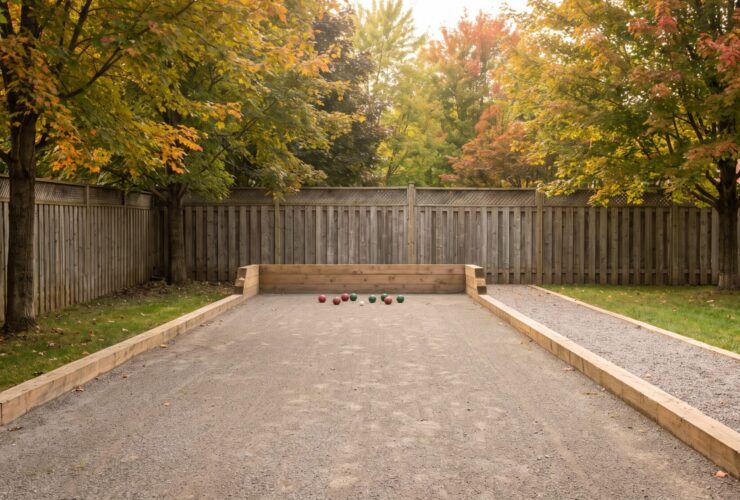
A regulation bocce court is a long, narrow rectangle, and getting that shape right on the ground matters more than people expect, since bocce is a precision game played over a long throw. According to the official Bocce Court Design Manual published by bocce.org, formal court dimensions run from a minimum of 18.29 metres by 3.05 metres (60 feet by 10 feet) up to a recommended maximum of 28.95 metres by 4.57 metres (95 feet by 15 feet), with tournament play commonly built around 13 feet wide by roughly 91 feet long. Most backyard and residential courts land well inside that range, since very few properties have room for a full 91-foot court. For a closer look at what the federation and government rule books say, see our guide to bocce court dimensions in Ontario.
| Court Type | Typical Width | Typical Length | Best Suited For |
|---|---|---|---|
| Official / tournament | 13 ft (4 m) | Up to 91-95 ft (up to 28.95 m) | Clubs, sanctioned league play |
| Community / club standard | 10-12 ft | 60-76 ft | Community centres, condo amenity courts, restaurants |
| Residential / backyard | 8-10 ft | 40-60 ft | Most Ontario backyard builds |
| Compact / small-yard | 6-8 ft | 30-40 ft | Narrow side yards, tight urban lots |
The minimum width matters more than most homeowners assume going in. A court under about 8 feet wide starts to feel cramped once two players are standing at the same end, and shorter courts change the character of the game since there is less room for a ball to curve or bank off the side border. If space allows, CrowAll generally recommends erring toward the longer end of whatever range fits the property, since length is what makes bocce feel like bocce.
Court Orientation and Site Selection
Orientation is a smaller detail with an outsized effect on how comfortable a court is to actually use. Running the long axis north-south, rather than east-west, keeps the low afternoon sun from shining straight down the length of the court into a player’s eyes at the exact moment they are trying to line up a throw. It also helps even out how snow melts off the surface in late winter, since one long edge will not spend the whole season in permanent shade.
Flat, open ground with no low spots is the starting point for site selection, but almost no residential lot is naturally level enough to skip grading altogether. What matters is that the site can be graded to a very slight, consistent cross-slope, typically in the range of 1 percent, so water sheds off the surface evenly rather than collecting in one corner. This is where a proper site assessment earns its keep. Our laser-guided grading process establishes that finished grade before any base material goes down, which matters even more on a bocce court than on a larger surface, since there is so little width to hide an inconsistency in.
Clearance Space and Multi-Court Layouts
Beyond the playing surface itself, plan for roughly 3 to 5 feet of clearance around the entire perimeter for players to stand, retrieve balls, and move without stepping into a neighbouring flower bed or fence line. Clubs and community facilities building more than one court side by side should plan a similar buffer between courts, both for player circulation and so each court’s border and drainage system can be built and maintained independently. Properties adding bocce alongside other sports, such as a multi-sport court or a volleyball setup, benefit from planning the whole footprint together rather than squeezing bocce into whatever space is left over after the other courts are laid out.
Choosing a Bocce Court Surface
Surface choice is where a bocce court build actually gets interesting, and it is also where the difference between a DIY project and a professionally built court shows up most clearly. Four surface families cover almost every court CrowAll builds or gets asked about, and each one plays differently and carries a different long-term maintenance profile.
Crushed Stone and Oyster Shell
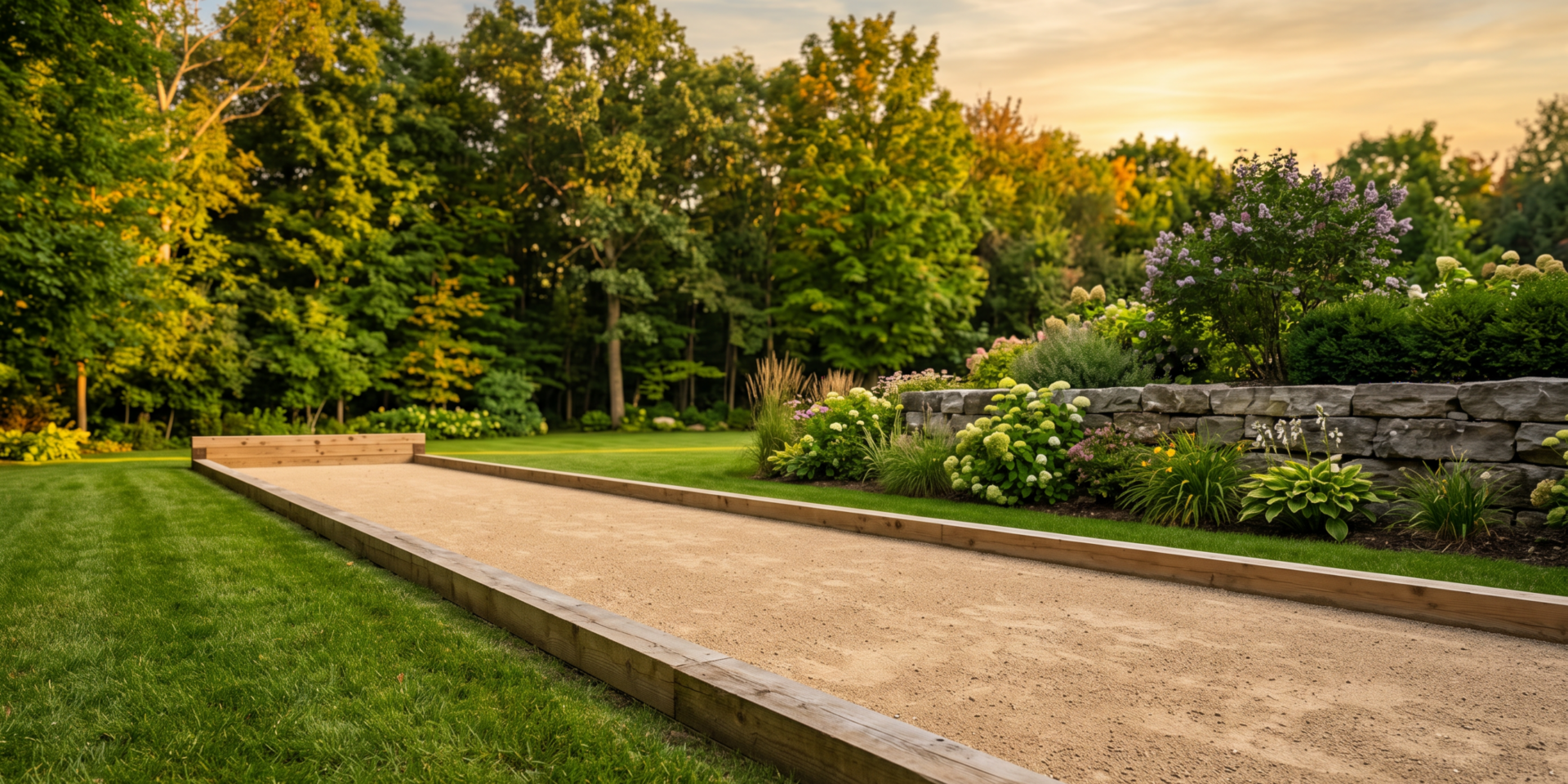
This is the traditional bocce surface, and for good reason: it is what most players who grew up around the game learned on. A crushed stone or decomposed granite base topped with a fine oyster shell flour or stone dust wearing course gives a true, predictable roll when it is built and compacted correctly. The tradeoff is maintenance. These natural surfaces need periodic watering, rolling, and occasional patching to stay level, and heavy rain or a hard freeze-thaw cycle can loosen the top layer if the base underneath was not compacted properly in the first place.
Artificial Turf
Turf has become a popular choice for Ontario builds specifically because it holds its grade through winter far better than a loose aggregate surface does. A short, dense pile with a sand or rubber infill gives consistent ball speed without the raking and watering a natural surface needs. CrowAll’s guide to building a bocce court with artificial turf covers the turf-specific installation details in more depth, and our broader look at how artificial turf compares to natural surfaces is useful background if turf is on the table for more than just the bocce court.
Clay and ClayTech Surfaces
Less common for bocce specifically, but worth considering on properties that already have clay or ClayTech tennis courts and want a consistent look and feel across the whole sports area. A well-built clay-based surface plays soft and slow, which some players prefer for bocce’s more finesse-oriented shots, though it carries similar seasonal maintenance needs to any clay surface.
Asphalt and Acrylic-Coated Bases
Some clubs and commercial properties build bocce on a paved base, either a plain compacted asphalt surface or one finished with an acrylic coating system. This is the lowest-maintenance option by a wide margin and holds up well to heavy commercial use, but it changes the character of play noticeably, since the ball rolls faster and truer on a hard, smooth surface than on any granular material. It is a reasonable option where a facility wants a court that needs almost no seasonal attention, though most players who grew up on traditional bocce notice the difference in feel right away.
| Surface | Ball Roll | Seasonal Maintenance | Winter Durability |
|---|---|---|---|
| Crushed stone / oyster shell | Traditional, true roll when properly built | Watering, rolling, periodic patching | Depends heavily on base compaction and drainage |
| Artificial turf | Consistent, moderate speed | Occasional brushing, infill top-up | Holds grade well through freeze-thaw |
| Clay / ClayTech | Soft, slower | Seasonal conditioning, moisture management | Moderate; benefits from a properly graded base |
| Asphalt / acrylic-coated | Fast, true, less traditional feel | Minimal; occasional resealing | Excellent when built on a properly compacted base |
The Professional Construction Process, Step by Step
This is the sequence CrowAll actually follows on a bocce court build, and it is worth walking through in full because most of what separates a court that lasts from one that does not happens before the surface material ever goes down.
Step 1: Site Assessment and Layout
Every build starts with a site visit to confirm the court will fit, check existing drainage patterns, and flag anything that changes the plan, like a slope, a tree with roots close to the surface, or an existing irrigation line running through the footprint. Layout comes next: marking the four corners, checking the diagonals to confirm the rectangle is square, and setting string lines at the finished dimensions before any digging starts.
Step 2: Excavation and Laser-Guided Grading
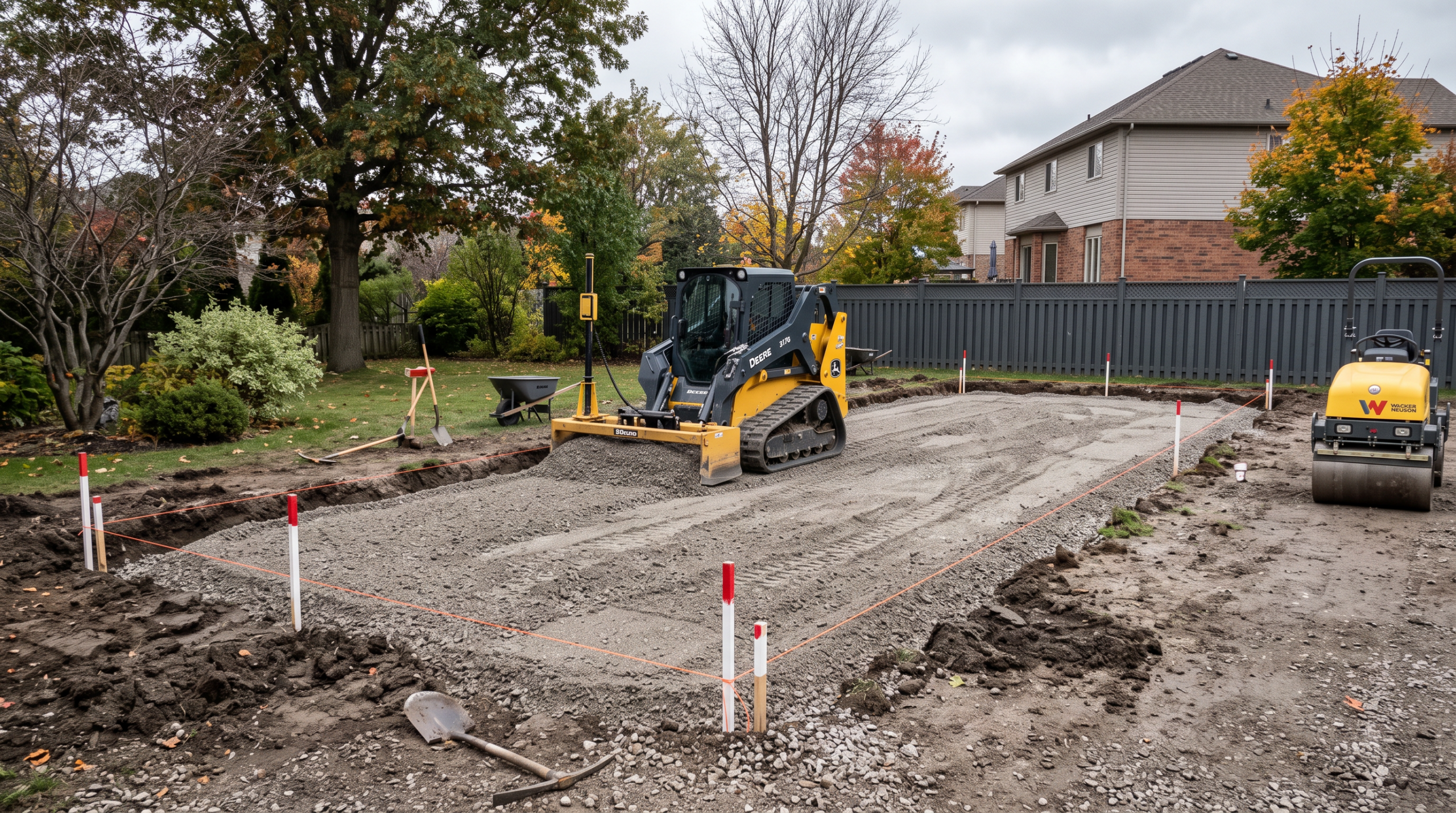
Once the layout is confirmed, the site is excavated to the depth needed for the base and surface system, typically several inches below finished grade depending on the surface chosen. This is where laser-guided grading does the real work. A laser level establishes the exact finished elevation and cross-slope across the full length of the court, which on a narrow 8 to 13-foot-wide surface leaves almost no room for error. A half-inch of unevenness that would be invisible on a basketball court shows up immediately on a bocce court, since players notice a ball drifting off line almost every throw.
Step 3: Drainage and Base Construction
With the site graded, a compacted layer of drainage gravel or crushed rock goes down first, typically several inches deep, to move water away from the playing surface rather than letting it pool underneath. On sites with poor natural percolation, a perforated drain line running the length of the court ties into the property’s broader drainage system. Our overview of drainage in sports surface construction covers why this step gets skipped so often on DIY builds and why it matters so much once winter arrives. A second, finer layer of compactable base material sits on top of the drainage layer and gets machine-compacted before the wearing surface goes on.
Step 4: Perimeter Border Installation
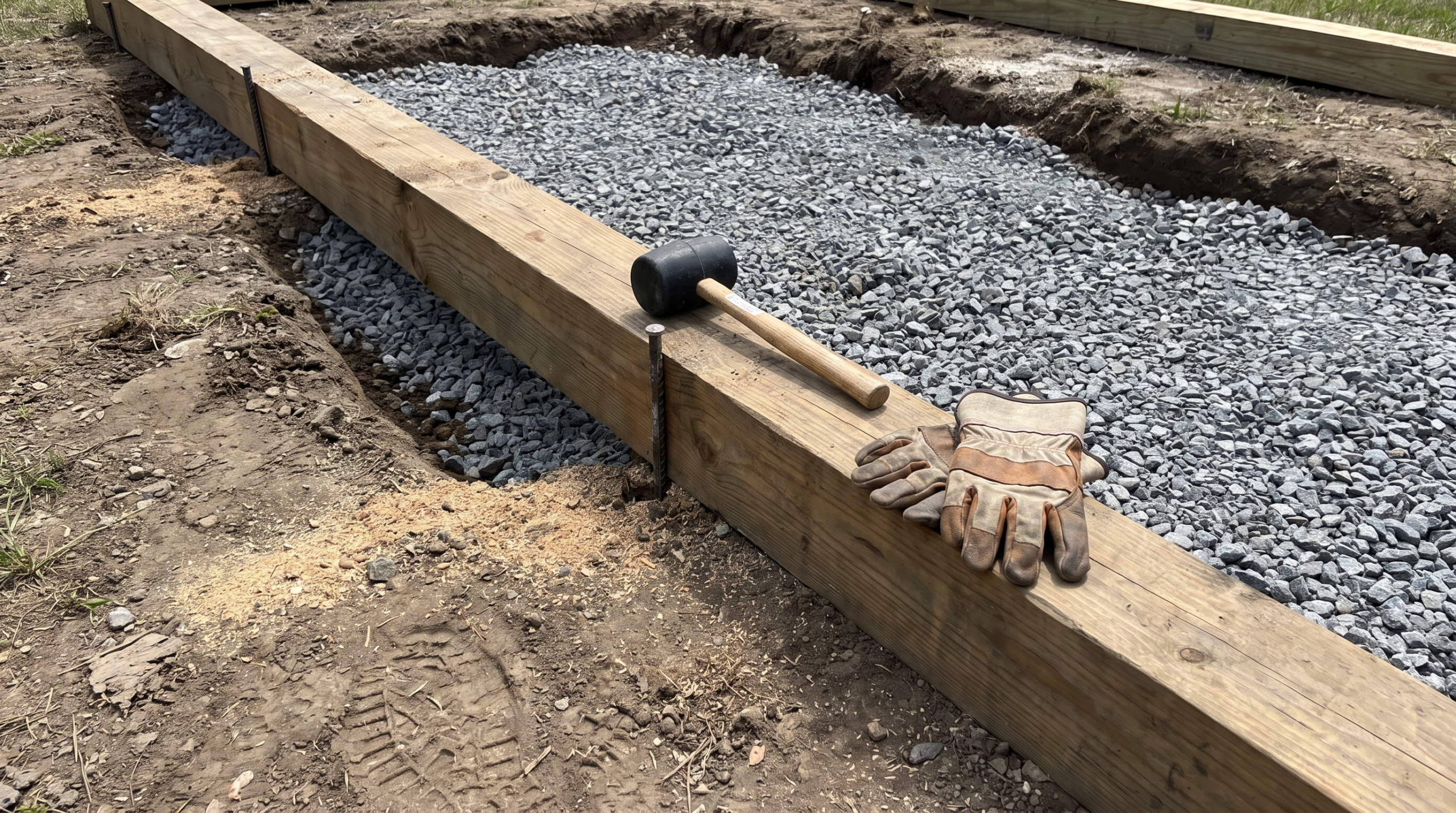
The border does more than mark the edge of the court. It holds the loose surface material in place, keeps balls from rolling out mid-game, and, on a properly built court, ties into the drainage system at its base. Timber borders, typically pressure-treated or rot-resistant hardwood, are the more common residential choice and can be replaced individually years down the line if a section weathers unevenly. Concrete or concrete-with-timber-facing borders cost more up front but hold their line and level longer, which matters more on a commercial or club court that sees heavy year-round use.
Step 5: Surface Installation and Finishing
The final wearing surface, whether that is a screeded oyster shell blend, artificial turf, a clay-based mix, or an acrylic-coated asphalt cap, goes on last and gets compacted or seamed to a tight tolerance. On loose-fill surfaces, this typically means multiple thin passes of material and compaction rather than one thick layer, since a single deep lift is much harder to compact evenly all the way through. Turf installations involve seaming panels, securing the perimeter, and brushing in infill to the manufacturer’s specified depth.
Step 6: Leveling Checks and Quality Control
Before a court is handed over, it gets checked with a straightedge and level across multiple points along its length, not just at the ends. A court can look flat to the eye and still have a subtle high or low spot in the middle that only shows up once balls start rolling across it. Catching that at this stage is far cheaper than fixing it after the border and surface are finished.
Drainage and Ontario’s Climate
Ontario’s freeze-thaw cycle is the single biggest reason a bocce court built without proper drainage fails within a few years. Water that sits in or under the base freezes, expands, and pushes the surface and border out of level, and that movement compounds every winter until the court needs a rebuild rather than a repair. This is the same principle covered in our piece on accurate grading for sports court drainage, and it applies just as much to an eight-foot-wide bocce court as it does to a full tennis court. A properly graded, well-drained base is genuinely the difference between a court that needs minor seasonal attention and one that needs to be rebuilt inside five years.
Snow load is a smaller factor but still worth planning around, particularly on turf or acrylic-coated surfaces where standing meltwater can refreeze into an ice sheet if the surface does not shed water efficiently. A court graded correctly from day one handles this without much thought. One that was not tends to develop the same problem spots every winter.
Bocce Court Construction Cost Drivers in Ontario
Every bocce court prices out differently based on size, surface, site conditions, and access, so a single number rarely means much without context. What is consistent across projects is which factors move the price the most.
| Cost Driver | Why It Matters |
|---|---|
| Court size | A longer, wider court means more excavation, base material, and border length |
| Surface type | Turf and acrylic-coated systems carry higher material costs than crushed stone; crushed stone needs less material but more skilled labour to finish correctly |
| Site access and prep | Equipment access, existing landscaping removal, tree roots, and slope all affect excavation cost |
| Border material | Timber borders cost less upfront than concrete or concrete-faced borders |
| Drainage requirements | Poor natural percolation may require a dedicated drain line tied into the property’s system |
| Site distance and mobilization | Remote or hard-to-access properties add equipment and labour time |
For a fuller breakdown of how these factors typically stack up across a sports court project generally, our cost breakdown guide and our article on sports court landscaping costs both cover the underlying cost mechanics in more detail. Since a bocce court is smaller than most of the surfaces CrowAll builds, it is often one of the more affordable additions to a larger property project, particularly when it is added alongside grading and drainage work already planned for another court.
Permits, Zoning, and Site Considerations in Ontario
A bocce court is a relatively low-profile structure compared to something like an enclosed padel court or a fenced tennis court, but that does not automatically mean it is permit-free. Municipal requirements vary, and factors like setback from property lines, total impervious surface area, and whether the project involves grading changes near a property boundary can all trigger a permit requirement. Ontario’s own guidance on when a building permit is required is a useful starting point before finalizing a design, and our article on permits for sports courts walks through the broader picture for court construction specifically. For commercial or multi-court installations, checking with the local municipality early avoids redesign work later.
Adding Bocce to an Existing Sports Facility or Backyard
One of the more common ways bocce gets added in Ontario is alongside an existing sports surface rather than as a standalone project. A club or backyard that already has a tennis or pickleball court, or has recently added something like a basketball court, often has the grading, drainage infrastructure, and site access already worked out, which can make adding a bocce court in the same project meaningfully more efficient than building it later as a separate job. This is also where working with a landscape design plan for the whole property pays off, since a bocce court tucked next to a patio or seating area gets used far more than one stuck in an awkward leftover corner of the yard. Our guide to sport court landscaping is a good next read for anyone planning a multi-feature backyard rather than a single court. Properties with room for a second, more active surface sometimes pair bocce with a faster-paced build like the one covered in our guide to roller hockey court construction in Ontario.
Bocce Court Maintenance
Maintenance needs vary a lot by surface, which is part of why surface choice deserves real thought upfront rather than defaulting to whatever a neighbour built.
| Task | Crushed Stone / Oyster Shell | Artificial Turf | Asphalt / Acrylic |
|---|---|---|---|
| Rolling / leveling | Weekly during active season | Not required | Not required |
| Watering | Light watering before play helps ball roll | Not required | Not required |
| Brushing / debris removal | Regular raking to redistribute fines | Periodic brushing to keep infill and pile upright | Occasional sweeping |
| Spring inspection | Check for frost heave, low spots, border movement | Check seams, infill depth, border anchoring | Check for cracking or coating wear |
| Resurfacing interval | Top-dress every few years depending on use | Infill top-up periodically; turf itself lasts many years | Reseal on the same cycle as other acrylic-coated courts |
A short annual walk-through catches most problems before they turn into an expensive fix. For properties already running a maintenance plan on other courts, our overview of sports court maintenance and the cost-benefit of professional upkeep are worth reading alongside this guide, since bocce fits naturally into a broader seasonal maintenance schedule rather than needing its own separate plan.
Accessories, Lighting, and Finishing Touches
A few finishing details make a real difference in how much a court actually gets used. A simple bench or seating area at one end gives players and spectators somewhere to wait between ends. Fencing is optional on most residential courts but worth considering where a court backs onto a neighbouring property or a pool area; our guide to court fencing materials covers options that apply just as well to a bocce court as to a tennis court. For anyone planning evening play, LED lighting positioned to minimize glare across the length of the court extends the season considerably, particularly in a climate where usable daylight shrinks fast by early fall.
Common Mistakes That Shorten a Bocce Court’s Lifespan
A handful of mistakes account for most of the bocce court problems CrowAll gets called to fix. Skipping proper drainage is the biggest one, since a court that looks fine the first summer can start heaving and settling unevenly the very next spring. Building the border directly on unstable or uncompacted soil is a close second, since even a well-built timber or concrete border will shift if what is underneath it was not properly prepared. Choosing a surface without accounting for how it holds up through an Ontario winter is another common regret, particularly with loose natural materials that were never compacted to the depth a true bocce roll needs. And skipping the layout and squaring step, or eyeballing the corners instead of measuring diagonals, is a small shortcut that shows up every time a ball drifts slightly off a straight line down the court.
Frequently Asked Questions
What is the standard size of a bocce court?
Official tournament courts run up to 91-95 feet long by 13-15 feet wide, per the bocce.org design manual. Most Ontario backyard and community courts are much smaller, typically 40 to 60 feet long and 8 to 10 feet wide, since few properties have room for a full regulation court.
How much does it cost to build a bocce court in Ontario?
Cost depends heavily on size, surface choice, and site conditions, so a single figure without site context rarely means much. Our cost breakdown and sports court landscaping cost guides cover the underlying drivers in detail, since the same factors that move any court’s price apply to bocce at a smaller scale.
Can bocce be played on concrete or asphalt?
Yes, and some clubs and commercial properties build bocce on a paved or acrylic-coated base specifically because it needs almost no seasonal maintenance. The ball rolls faster and truer on a hard surface than on loose material, which changes the feel of the game compared to a traditional court.
Do I need a permit to build a bocce court in Ontario?
Possibly, depending on the municipality, the court’s proximity to property lines, and whether the project involves significant grading. Checking with the local building department before finalizing a design is the safest approach, especially for commercial or multi-court projects.
What is the best surface for a bocce court?
There is no single best surface. Crushed stone or oyster shell gives the most traditional roll but needs the most upkeep. Artificial turf holds its grade through winter with less maintenance. Asphalt or acrylic-coated bases need the least attention but play noticeably faster and truer.
How deep does the base need to be for a bocce court?
Most professionally built courts use a compacted drainage layer several inches deep topped with a finer compactable base layer, with the exact depth depending on soil conditions and the chosen surface. A properly compacted base matters more to long-term levelness than the wearing surface on top of it.
Can a bocce court be built in a small backyard?
Yes, compact courts as narrow as 6 to 8 feet wide and 30 to 40 feet long are common on tighter urban and suburban lots. The game still works well at that size, though a longer court generally gives more room for balls to curve and bank off the side border.
Does a bocce court need to be perfectly level?
It needs to be graded to a very slight, consistent cross-slope, typically around 1 percent, so water sheds evenly rather than a perfectly flat surface. A true dead-flat court with no fall at all tends to hold standing water, which causes far more problems than a slight, consistent slope.
What is oyster shell bocce court material?
Oyster shell flour is a traditional fine wearing-course material ground from crushed oyster shells, used as the top layer over a compacted stone base. It gives a smooth, true roll when properly screeded and compacted, though it needs periodic watering and rolling to stay level through a full season.
How long does it take to build a bocce court?
A single residential court typically takes a few days to a couple of weeks from layout to finished surface, depending on size, surface type, and site access. Weather and material lead times can extend that timeline, particularly for artificial turf installations that require seaming and infill work.
Can an existing tennis or basketball court area be converted to include a bocce court?
Not by converting the existing surface directly, since bocce needs its own dedicated footprint and border system, but adding a bocce court alongside an existing court is common and often more efficient than a standalone project, since site access and drainage infrastructure may already be in place.
What kind of border does a bocce court need?
Most residential courts use a timber border, which is more affordable and can be replaced in sections over time. Concrete or concrete-faced borders cost more upfront but hold their line and level longer, which matters more on courts that see heavy or commercial use.
How much maintenance does a bocce court need?
It depends on the surface. Natural crushed stone or oyster shell courts need regular rolling, occasional watering, and periodic patching. Artificial turf needs only occasional brushing and infill top-up. Asphalt or acrylic-coated courts need the least attention, typically just occasional resealing on a multi-year cycle.
What is the best time of year to build a bocce court in Ontario?
Late spring through fall generally offers the most stable conditions for excavation, grading, and base compaction. Frozen ground rules out new construction in winter, which is why most Ontario court projects, bocce included, break ground between May and October.
Can a bocce court be built next to a patio or pool area?
Yes, and it is a common way to fit a bocce court into a smaller property, since it does not need the fencing or enclosure some other courts require. Planning it as part of a broader landscape design rather than an afterthought tends to produce a court that gets used far more.
Why does drainage matter so much on a court this small?
A bocce court’s narrow width leaves very little room to hide an uneven subgrade or a low spot that collects water. In Ontario’s freeze-thaw climate, water trapped under an unlevel base heaves and settles unevenly every winter, which is why proper grading matters more per square foot on a bocce court than on a larger surface.
Does a bocce court need lighting?
Not by default, but LED lighting positioned to minimize glare across the length of the court extends usable playing time considerably, particularly given how early daylight fades in an Ontario fall. It is a common add-on for courts that see regular evening use.
Plan Your Bocce Court Construction With CrowAll
Bocce is one of the simplest sports to add to an Ontario property, but a court that actually stays level and plays true for years still comes down to the same fundamentals as any other sports surface: correct grading, real drainage, and a base built to handle freeze-thaw rather than just look finished on installation day. Book a consultation with CrowAll Surface Contractors to talk through your site and surface options, or browse our product catalogue to see the full range of surfaces we build. If bocce is one piece of a bigger backyard plan, our why choose CrowAll page and our project gallery are good next stops.