
How to Build a Bocce Ball Court with Artificial Turf?
Backyard bocce is booming because it invites all ages to compete, socialize, and unwind. A professionally installed crushed-stone court is wonderful, yet the upkeep can be time-consuming.
Artificial turf trims maintenance to a quick brush-up while providing true roll, year-round play, and tidy edges that please any homeowners’ association.
This guide will show you how to size, site, and build a durable turf bocce court without hiring a full crew.
Why Pick Artificial Turf for Bocce?
Artificial turf courts mirror natural-surface speed but hold their grade through heat, rain, and winter freeze-thaw. The pile fibres keep fines in place, so you sweep instead of raking sand after every match. Turf is also:
- Low water, low work: No irrigation, weeding, or frequent top-dressing.
- All-weather ready: The Drainage layer below the backing moves water off quickly.
- Consistent pace: Even pile height stops the “dead zones” common on compacted shale.
- Kid- and pet-proof: Modern UV-stabilized polyethylene yarn resists fading and fraying.
Planning & Site Selection
A short plan saves labour later. Measure twice, dig once.
Court dimensions
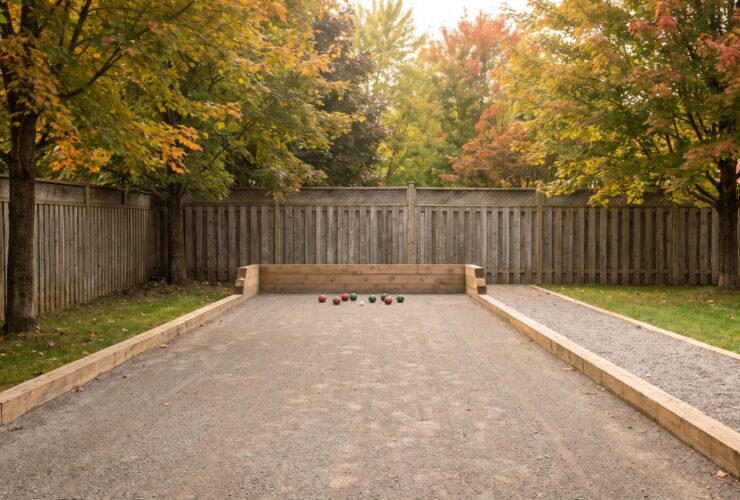
The official tournament size is 27.4 m × 3.7 m (90 ft × 12 ft). For most backyards, the popular compromise is 18.3 m × 3 m (60 ft × 10 ft). Keep at least 1 m of clearance around the perimeter for walking and drainage swales.
Orientation
Place the long axis north–south to reduce glare for players facing the sun. Avoid mature tree roots that heave sub-bases and drop debris.
Drainage
Stand back after rainfall: does water linger? If yes, include a French drain or raise the base 75 mm above grade with full-depth crushed stone.
Permitting
Most Canadian municipalities treat a bocce lane like a patio, yet check rules on impervious coverage and call utility-location services before you excavate.
Related Article: The Importance of Drainage in Sports Surface Construction: An In-depth Analysis

Materials & Tools Checklist
Gather everything before you break ground to maintain momentum.
- Excavation gear: shovels, wheelbarrow, landscape rake, builder’s string, line level
- Base aggregate: 100 mm of 20-mm clear crushed stone plus 50 mm of 6 mm limestone screenings
- Geotextile fabric: non-woven under base to curb weed growth
- Edging lumber or composite: 150 mm × 200 mm (6 in × 8 in) landscape ties or 50 mm recycled-plastic boards
- Rebar stakes / galvanized spikes: hold edging true
- Plate compactor: achieve ≥ 98 % standard proctor density on each lift
- Artificial turf roll: 4 m-wide sports-grade, short-pile (13–20 mm)
- Silica sand infill: 15–18 kg per square metre
- Seam tape and polyurethane adhesive
- Broom or power brush, roll-lawn tool, utility knife, chalk line
Related Article: Transform Your Backyard: Building a Tennis Court for Home Use
Step-by-Step Construction
The next few steps break the job into clear tasks, from digging the base to brushing in the final sand, so you finish with a court that drains fast, rolls true, and looks sharp year-round.
Drawing on proven sports court construction methods, every layer must be graded and compacted with precision to guarantee consistent play and long-term durability.
Layout & Excavation
- Snap chalk lines to outline the playing area, plus 150 mm on all sides. Excavate to 250 mm depth.
- Use a line level to establish a uniform 0.5 % cross-fall (about 5 mm drop across the width) to ensure surface water drains off without affecting ball run.
Sub-Base Preparation
- Lay geotextile fabric to separate soil from aggregate. Add 75 mm of clear crushed stone, mist lightly, then compact.
- Add a second 25 mm lift, compact again.
- Verify compaction with a simple heel test: a boot should not dent the surface.
Levelling Layer
- Spread 50 mm of limestone screenings. Screed using a straight 2 m board resting on temporary pipes to hit exact grade.
- Compact until firm. A laser level should read within ±3 mm end-to-end.
Edge Construction
- Set landscape ties or composite boards flush with finished grade, fixed with rebar stakes every 1.2 m. Inside faces must be plumb to stop balls from climbing walls.
- Seal timber with outdoor wood preservative to extend life.
Turf Placement
- Unroll turf across the width, pile grain facing the delivery end to reduce seams.
- Allow the roll to relax for two hours under the sun to shed wrinkles.
- Trim excess with a fresh utility blade, keeping fibres upright.
- If two panels are needed, butt factory edges, fold back 150 mm on each side, lay seam tape, butter with adhesive, then close and apply a 25 kg sandbag every 600 mm until set.
Infill & Fibre Grooming
- Broadcast silica sand evenly with a drop spreader.
- Work in multiple light passes rather than one heavy dump to avoid stripes.
- Target 10 mm of sand coverage so only fibre tips show.
- Brush fibres upright after each pass using a stiff broom or power brush.
- The infill weights the surface, cushions impact, and tunes ball speed.
Final Roll & Quality Check
- Run a water-filled lawn roller across the width, then length, to seat infill.
- Drop a regulation bocce ball from knee height at several spots: it should bounce less than 100 mm.
- Walk the court and feel for soft pockets; top-dress and re-roll any low areas.
Optional Accessories
- Court lines: Paint 25 mm white stripes using stencil tape for foul lines at 4.5 m from ends.
- Scoreboard: Mount to an end board, keeping players off the turf.
- Dark-sky lighting: Install low-glare LED bollards outside the perimeter for evening play.
Related Article: Are There Any Special Considerations for Weather-Resistant Sports Courts?

Maintenance Tips
Weekly, brush fibres and spot-pick leaves. Monthly, add 1–2 kg of sand if yarn tips are exposed. After heavy rain, inspect edges for washout. An annual plate-compactor pass on low-speed helps tighten the base through freeze-thaw cycles, extending surface life beyond ten years.
Budget & Timeline Snapshot
| Item | Cost Range (CAD) | Notes |
| Excavation & disposal | $400–$700 | DIY labour cuts cost |
| Aggregate & screenings | $800–$1 200 | Local quarry prices vary |
| Edging materials | $300–$600 | Composite lasts longer |
| Turf & infill | $1 800–$2 600 | Sports-grade, UV-stable |
| Tool rental (compactor, roller) | $180–$260 | Weekend rate |
| Estimated total | $3 500–$5 300 | 60 ft × 10 ft court |
Most homeowners finish in two full weekends: one for excavation and base, one for turf install and finishing touches.
Related Article: Maintenance 101: Keeping Your Sports Court in Prime Condition
Want bocce alongside another sport on the same pad? Our guide to multi-sport court construction in Ontario walks through combining bocce, pickleball, and basketball footprints.
Prefer an even lower-maintenance social court instead of bocce? Our guide to shuffleboard court construction in Ontario covers dimensions, base specs, and acrylic coating for a similarly compact court.
Prefer a net sport instead of bocce on that same turf footprint? Our guide to backyard volleyball court construction compares sand, grass, and turf-based setups.
Want the full picture beyond a turf finish, including dimensions, drainage, and other surface options? Our complete guide to bocce court construction in Ontario walks through the full professional build sequence from site grading to finished surface. If sizing is your main question, our bocce court dimensions guide compares the published rule books.
One detail that makes a bigger difference than most first-time builders expect is choosing the right infill material for a turf bocce court. The wrong infill depth or type can throw off how true the ball rolls, so it is worth getting right before the first game.
Ready to Roll?
Artificial turf turns a patch of lawn into a four-season entertainment zone that neighbours will envy. Gather your supplies, book a compactor rental, and enjoy smooth-rolling games without dragging a hose or rake.
Prefer a pro touch? Reach out for a complimentary site assessment, and we’ll organize everything from laser grading to the final brush-up so you can focus on the first pallino toss.