Padel vs Pickleball in Ontario: Court Size, Surface and Build Differences
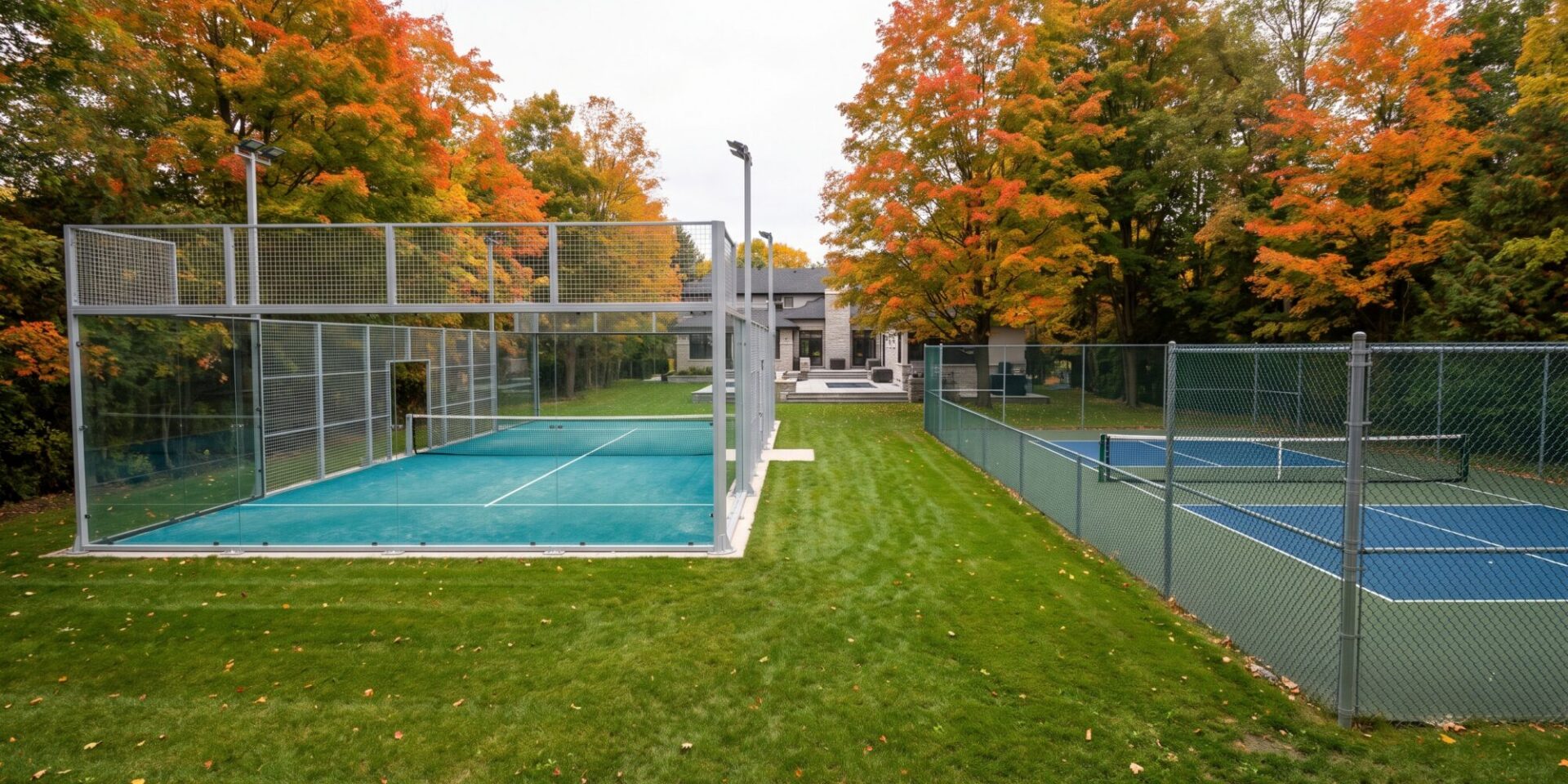
Walk past a recreation centre in Ontario this fall and you will probably see a pickleball court with a waiting list. Walk past a new racquet club and you may see something else: a glass box on turf, with four players hitting the ball off the walls. Padel is arriving in Canadian cities, pickleball is already everywhere, and owners with a piece of land or an underused tennis court are asking the same question. Which one should we build?
The two sports get lumped together because both are paddle games played in doubles, both are social and both are easy to pick up. As construction projects they are very different. One is a painted rectangle on a flat pad. The other is a small building made of steel and glass, standing on a slab, with its own wind load and its own set of drainage details. This guide compares padel and pickleball the way a court builder has to, which means looking at footprint, enclosure, surface, base, permits and neighbours before it gets to anything about who has more fun. If you want the wider build process for the simpler of the two, our guide to pickleball court construction in Ontario covers it step by step, and our guide to padel court construction in Ontario does the same for padel.
The Short Answer: Padel vs Pickleball
Padel is played on a 20 by 10 metre court enclosed by glass and mesh walls that stay in play, with tennis-style scoring and a bounce-and-wall serve. Pickleball is played on an open 20 by 44 foot court with a seven-foot non-volley zone, points scored only by the serving side, and a two-bounce rule. In build terms, padel is closer to a small structure, while pickleball is a flat surface with a fence around it.
That single difference drives almost everything else in this article. The enclosure is what makes padel a different kind of project, and the lack of one is what makes pickleball so easy to fit into a backyard, a school yard or a converted tennis court.
Padel vs Pickleball at a Glance
| Feature | Padel | Pickleball |
|---|---|---|
| Playing area | 10 m x 20 m (about 32.8 ft x 65.6 ft) | 20 ft x 44 ft |
| Enclosure | Glass and mesh walls, ball stays in play | None, open court with fencing set back |
| Net height | 0.88 m at the centre, 0.92 m at the ends | 34 in at the centre, 36 in at the sidelines |
| Net length | 10 m | At least 21 ft 9 in |
| Format | Written for pairs only | Singles or doubles |
| Scoring | Tennis-style 15, 30, 40, game, played in sets | Serving side scores, games to 11 and win by 2 |
| Serve | Bounce the ball, strike at or below waist, hit diagonally | Volley or drop serve, clear the kitchen, hit diagonally |
| Typical surface | Synthetic turf or artificial grass, cement also allowed | Acrylic-coated hard court is common |
| Build type | Structure on a slab or perimeter foundation | Flat pad with fencing |
The dimensions, net heights, scoring and serve rules in the table come from the International Padel Federation rules of padel and the USA Pickleball official rulebook. Surface and build type reflect common practice and CrowAll's own guides rather than a rule.
Where Each Sport Stands Today
Both sports are young compared with tennis, and both have grown quickly. Their paths are different enough to affect what a facility can expect from a new court.
Padel's Global Growth
The International Padel Federation reported in June 2026 that padel is played by about 38 million people across 178 countries and territories, on a network of roughly 85,000 courts, with 27,000 clubs and 100 affiliated national federations. Those numbers come from the federation's own Olympic Day update, so they reflect how the governing body counts, but they show a sport with real scale outside North America.
Padel and Pickleball in Canada
Pickleball is already a fixture at Ontario parks, schools and clubs, which is why the shortage of courts and the noise conversation around them are now regular topics. Padel is earlier on the curve. CTV News reported in May 2026 that Bill Stamile brought padel to Canada in 1992 and that the sport is growing in popularity across the country. In our own project conversations, interest in padel tends to come from private racquet clubs, condo developers, schools and a smaller group of homeowners with large lots, while pickleball questions come from almost every customer type.
That is a reason to think about demand locally before building. A pickleball court is easy to program and easy to share. A padel court is a bigger bet, and it pays off when you have a membership base or a community that will actually book it.
Court Size and Footprint
The first number most owners want is how much space each court takes. The playing areas are fixed by the rules. What a property needs is larger, and the difference between the two sports is bigger than it first looks.
Pickleball Court Dimensions
A pickleball court is 20 feet wide and 44 feet long for both singles and doubles, measured to the outside edge of the lines. The non-volley zone, often called the kitchen, extends 7 feet from the net on each side. Lines are 2 inches wide. The USA Pickleball rulebook sets a minimum playing surface of 30 by 60 feet and recommends 34 by 64 feet for new construction and tournament play. Our guide to the size and dimensions of a pickleball court goes through the layout line by line.
Padel Court Dimensions
A padel court is 10 metres wide and 20 metres long inside the walls, with a tolerance of 0.5 percent. Lines are 5 centimetres wide, the service line sits 6.95 metres from the net, and the central service line extends at least 20 centimetres past it. The federation sets a minimum free height of 6 metres above the court and advises 8 metres for new facilities. Those numbers matter most for indoor courts, where ceiling clearance is a fixed constraint. A padel court is not played in a flat open field the way pickleball is, so the footprint includes the structure that surrounds it.
| Measurement | Padel | Pickleball |
|---|---|---|
| Playing area, metric | 10 m x 20 m = 200 sq m | 6.1 m x 13.4 m = about 82 sq m |
| Playing area, imperial | About 32.8 ft x 65.6 ft = about 2,150 sq ft | 20 ft x 44 ft = 880 sq ft |
| Ratio of playing area | About 2.4 times a pickleball court | 1 |
| Recommended surrounding area | Enclosure structure plus access and maintenance clearance, confirm with your builder | 30 ft x 60 ft minimum, 34 ft x 64 ft recommended for new construction |
| Overhead clearance | Minimum 6 m free height, 8 m advised for new facilities | Not specified for outdoor courts |
The playing area of a padel court is roughly two and a half times that of a pickleball court, and that is before the walls, the gates and the maintenance access around the outside are counted. Our earlier padel guide suggests planning around 22 by 12 metres overall for clearance, which is a planning figure from our own experience rather than a federation rule.
How Much Yard Do You Actually Need?
For a homeowner, a single pickleball court fits in a space that a padel court would swallow. A recommended 34 by 64 foot pickleball pad is about 2,176 square feet. A padel playing area alone is close to the same size again, and the enclosure sits on top of that. If your lot is tight, pickleball is usually the realistic choice, and a padel court tends to make sense where a club, school or developer has a dedicated parcel. Our look at the pickleball court versus tennis court comparison shows the same footprint logic when you stack either sport against a full-size tennis court.
The Enclosure Is the Biggest Build Difference
A pickleball court has a fence. A padel court has walls that are part of the game. The two are not interchangeable, and the engineering behind them is different enough that padel projects should be scoped like small buildings.
What the Rules Say About Walls
The federation rules set the end walls at 4 metres total, with the first 3 metres as solid wall and the top metre as metal fence. The side walls have two permitted variants. In the first, stepped walls run 3 metres high for 2 metres and then 2 metres high for 2 metres at each end, with metal fencing rising to 3 metres in the centre 6 metres and 4 metres at the ends. In the second, glass walls are 3 metres high for 4 metres at each end zone with no step, and metal mesh rises to 4 metres over the outer 2 metres. The mesh openings are diagonal and measure 5 to 7.08 centimetres. In practice the glass and the posts that carry it are what players see, and the structure behind them is what the builder has to design.
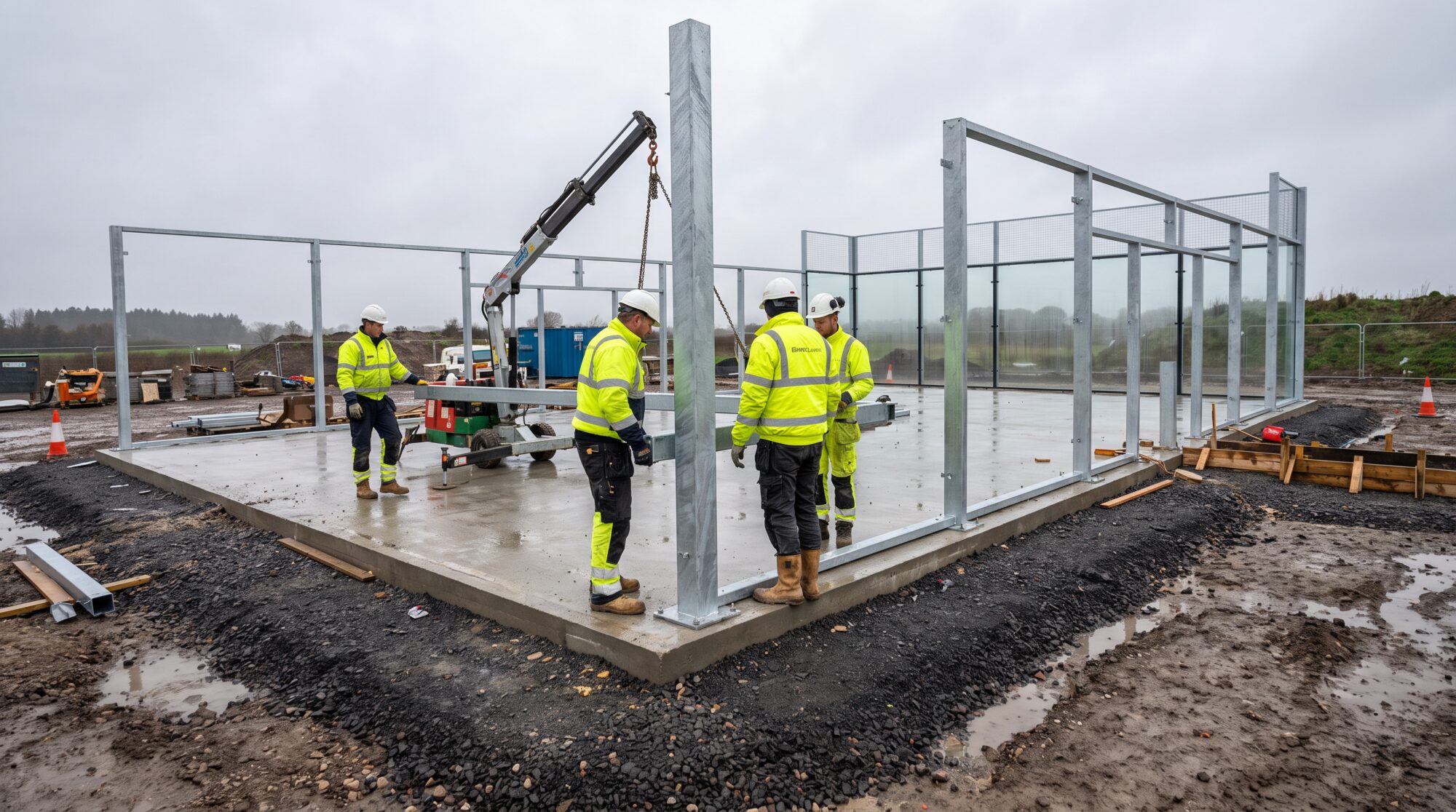
Why a Padel Enclosure Is Engineered Like a Structure
Every wall panel has to take repeated ball impact, resist wind and stay aligned over years of Ontario freeze-thaw cycles. A steel frame and tempered glass enclosure standing several metres tall acts like a sail in a strong wind, so the anchoring and the foundation matter as much as the glass itself. We cover the build sequence in our padel construction guide, and the short version is that the foundation is set out, cured and checked before any steel goes up. A pickleball fence is lighter, set back from the lines and designed mainly to contain balls and mark the boundary. Our guide to tennis court fencing materials, height and maintenance is a good primer on what a conventional court fence involves, and it shows how much simpler that component is.
Open Court vs Enclosed Court in Practice
The open layout of pickleball is why it fits so many places, including shared tennis courts. The enclosure of padel is why the ball stays in play so long, and why it has to be built as one system. If you have an existing court and want a quick change of use, pickleball is a paint job and a net. Padel is a rebuild. We walk through the quick option in our guide to converting a tennis court into a pickleball court.
Net Height, Posts and Equipment
The nets are closer than most people expect. A padel net is 0.88 metres high at the centre and 0.92 metres at the ends, which works out to about 34.6 inches and 36.2 inches. A pickleball net is 34 inches at the centre and 36 inches at the sidelines. Both rules allow a small tolerance, and in both sports the net is lower in the middle than at the posts.
Where they differ is length and post design. The padel net runs the full 10 metre width of the court, tucked into the enclosure walls, with posts no taller than 1.05 metres and a cable no thicker than 1 centimetre. The pickleball net is at least 21 feet 9 inches long, hung on posts about 22 feet apart, so the posts sit outside the sidelines. Our pickleball net height guide explains how the post spacing, centre strap and measurement points work on a real court.
| Item | Padel | Pickleball |
|---|---|---|
| Net height, centre | 0.88 m | 34 in |
| Net height, ends or sidelines | 0.92 m | 36 in |
| Net length | 10 m, full width of the court | At least 21 ft 9 in |
| Post placement | Inside the enclosure | About 22 ft apart, outside the sidelines |
| Ball | Pressurised, 6.35 to 6.77 cm, 56.0 to 59.4 g | Perforated plastic ball, smaller holes customary outdoors |
| Hitting tool | Solid stringless racket | Solid paddle |
The ball specification for padel comes from the federation rules, which list a diameter of 6.35 to 6.77 centimetres, a weight of 56.0 to 59.4 grams and a bounce of 135 to 145 centimetres when dropped from 2.54 metres. The USA Pickleball rulebook notes that balls with smaller holes are customarily used outdoors, and it does not specify court surfaces.
Rules and Gameplay Differences That Affect the Court
You do not need to be a player to design a court, but a few rule differences change what the builder has to deliver.
How Padel Is Played
Padel is written for pairs only. Scoring follows tennis, with points running 15, 30, 40 and game, sets won at six games with a margin of two, and matches played as best of three sets. The rules also describe a golden point option at deuce, where one deciding point is played and the receiver chooses the side. The server must bounce the ball on the ground inside the correct service box, then strike it at or below waist level and send it diagonally into the receiver's box. After the ball bounces once on the opponent's side, it may hit the walls or fence and stay in play, but a second bounce on the same side loses the point.
How Pickleball Is Played
Pickleball can be played as singles or doubles. In standard scoring only the serving side can score, and games are played to 11 points, win by 2. The serve may be a volley serve or a drop serve, and it has to clear the non-volley zone and land diagonally in the correct service court. The two-bounce rule requires the serve and the return to each bounce before the volleying begins, and volleying is not allowed while standing in the kitchen. There are no walls, so the ball is dead once it leaves the court.
| Rule area | Padel | Pickleball | What it means for construction |
|---|---|---|---|
| Ball off the walls | Allowed after a valid bounce | Not applicable | Enclosure must be built for impact, alignment and rebound |
| Minimum overhead space | 6 m, 8 m advised for new facilities | Not specified outdoors | Matters for indoor padel and for tree or wire clearance outdoors |
| Line width | 5 cm | 2 in | Line marking differs, padel lines are marked on turf or the surface used |
| Special zones | Service lines at 6.95 m from the net | 7 ft non-volley zone each side | Marking accuracy affects where players stand and move |
| Format | Doubles only in the rules | Singles or doubles | Court use and booking patterns differ |
Surfaces: Turf, Acrylic and Everything Between
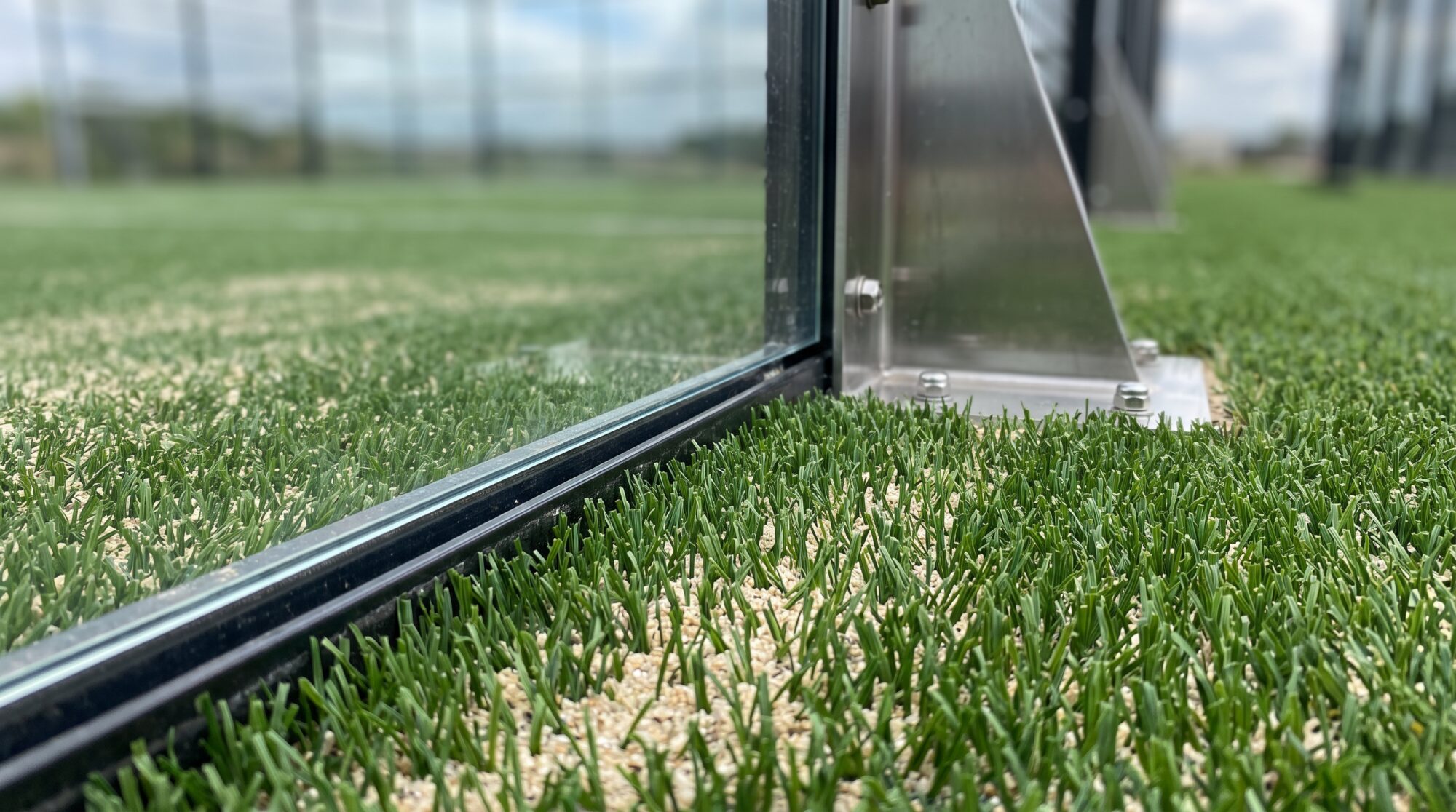
The federation rules allow padel courts to be made of cement, synthetic material or artificial grass that gives a regular bounce. The colour has to be one colour across the whole floor, usually green, blue or terracotta. The rules also say the surface must be level within 3 millimetres when checked with a 3 metre straightedge, and a maximum transverse slope of 1 percent on surfaces without drainage. That flatness requirement is tight, and it shapes the whole base build.
The USA Pickleball rulebook is more relaxed. It requires lines of one colour that contrast clearly with the surface, and it does not specify a court material. In Ontario the most common pickleball surface we see is an acrylic-coated hard court, because it can be built new or applied over an existing asphalt or concrete pad. Our guides on acrylic sports court coating and acrylic color options cover how those systems work.
| Surface factor | Padel | Pickleball |
|---|---|---|
| Typical surface | Short, dense synthetic turf with silica sand infill, or cement | Acrylic-coated asphalt or concrete, sometimes turf or modular tiles |
| Flatness target in the rules | Under 3 mm over a 3 m straightedge | Not specified in the USA Pickleball rulebook |
| Slope | Maximum 1 percent transverse without drainage | Set by the court designer for drainage |
| Colour choices | One colour across the court, often green, blue or terracotta | Court and surround colours chosen freely, lines must contrast |
| Maintenance focus | Turf infill, seams, glass and fixings | Crack repair, recoating, line paint |
| Noise behaviour | Glass and mesh change how sound behaves, confirm with a designer | Paddle and ball impact noise is the main neighbour issue |
Padel Turf and Infill
Padel turf is a shorter, denser product than a general landscaping lawn, and it is brushed with silica sand so the ball bounces consistently. The infill choice and the seam quality both influence how the ball plays. Our guide to sport court turf infill in Ontario explains the infill options on artificial turf courts, and our comparison of artificial turf and natural grass for sports courts shows how turf behaves over time.
Pickleball Acrylic and Cracks
An acrylic-coated pickleball court lives or dies on the pad beneath it. In Ontario, freeze-thaw cycles open cracks, and cracks left alone grow. Our guide to sport court crack repair in Ontario explains how repairs are made and why an acrylic coat should not be applied over an unrepaired crack. That is a different maintenance rhythm from turf, which is about infill levels, seams and brushing.
How the Build Differs in Ontario
Both courts begin with excavation, grading and drainage. What happens above the base is where the paths split.
Grading, Drainage and the Base
Both sports need a flat pad that sheds water. For padel, the federation sets a tight flatness tolerance, and a padel slab has no room for a sloppy subgrade because a heavy structure will stand on it. For pickleball, the pad also has to be flat and well drained, but the tolerance is easier to meet because there is nothing heavy to carry. Our explanation of accurate grading for sports court drainage and our page on laser guided grading cover how we set the finished grade before any base or concrete goes down.
Ontario's climate adds a layer. Frost can heave a footing that is too shallow, and water that pools beside a glass base can freeze and loosen fittings. For a padel court the foundation design has to account for frost depth, wind load and drainage around the glass, which is detailed engineering work rather than a standard pad pour. For pickleball, the main climate concern is the surface: freeze-thaw cracking, standing water and ice.
| Phase | Padel | Pickleball |
|---|---|---|
| Site assessment | Footprint, orientation, access, utilities, structure siting | Footprint, existing pad or new pad, fence and net layout |
| Excavation and grading | Laser-guided grade, tight flatness, drainage around the walls | Laser-guided grade, drainage across the pad |
| Foundation or base | Reinforced slab or perimeter foundation, frost depth designed in | Compacted aggregate base with asphalt or concrete pad |
| Structure | Steel frame, tempered glass, mesh, gates | Perimeter fencing, gates, net post sleeves |
| Surface | Turf with sand infill or other permitted surface | Acrylic coating system, colour coats, line painting |
| Finishing | Net, lighting, checks on glass and fixings | Net, lighting, windscreens where wanted |
A full padel build is a longer sequence than a pickleball build, and the concrete curing time alone can shape the schedule. We do not quote timelines in articles because they depend on the site, the weather and the supply of glass and steel, but our guides on how long sports court construction takes and the construction process for a backyard sports court explain what stretches or compresses a schedule.
Timing the Build
Concrete and excavation need stable ground, which is why late spring through early fall is the working window in most of Ontario. Our guide to the best time of year to build a sports court walks through the seasons. A padel build has less flexibility than a pickleball resurfacing because of the foundation and structure work.
Permits, Zoning and Utility Locates in Ontario
A padel court is a structure, and municipalities tend to treat structures differently from flat surfaces. Expect questions about setbacks, structural drawings for the enclosure, height, drainage impact on neighbours and, if you add lighting, spill and glare. A pickleball pad with a fence is usually a simpler conversation, although fencing height, lighting and noise can still trigger review. We cannot tell you what your municipality requires, and the answer varies, so call the local building and zoning office before you commit to a design. Our guide on permits for a sports court lists what to ask.
Before any digging, whether for padel footings or pickleball post sleeves, Ontario requires utility locates. The Ontario Dig Authority is the place to start the process, and locates need to be in place before excavation begins.
Noise, Neighbours and Lighting
Pickleball noise is well documented, and it is one of the reasons municipalities now ask about court placement and hours. Our article on pickleball court noise in Ontario explains why the sharp sound of the ball carries and what site design can do about it. Padel is played in an enclosure, and glass and mesh walls change how sound travels, but we have not measured padel noise against pickleball, so we would not promise a quieter or louder court. If a neighbour is close, ask your designer to look at orientation, distance and hours of play for either sport.
Lighting matters for both. A padel enclosure makes glare and reflection a design question as well as a fixture question, and a pickleball court needs even light across the playing area. Our guide to sport court lighting in Ontario covers LED systems for night play and what to consider before you commit to fixtures.
What Drives the Cost Difference
We do not publish prices in articles because they depend on the site, the soil, access, the surface and the market at the time of the build. What we can do is explain which parts of each project carry the cost, so you can compare quotes sensibly.
| Cost driver | Padel | Pickleball |
|---|---|---|
| Structure | Steel frame, tempered glass, mesh, gates are the largest items | Perimeter fencing and gates |
| Foundation and civil work | Reinforced slab or perimeter foundation, frost depth, drainage around the walls | Excavation, compacted base, pad construction or repair |
| Surface | Padel turf and silica sand infill | Acrylic coating system, colour coats, line painting |
| Site conditions | Access for cranes and glass delivery, grade, orientation | Existing pad condition, grade, access |
| Extras | Lighting, seating, indoor envelope | Lighting, windscreens, benches, net system |
Our existing cost guides are the best next step for numbers and drivers: how much a padel court costs, how much it costs to build a pickleball court and pickleball court cost in Toronto. If you are weighing an indoor option for either sport, our comparison of outdoor and indoor pickleball court costs shows which line items change.
Which Court Fits Which Owner
The right choice depends more on who will use the court and how much land you have than on which sport is more fashionable this year.
| Owner | Padel tends to fit when | Pickleball tends to fit when |
|---|---|---|
| Homeowner | You have a large lot, a firm budget for a structure and players who want padel specifically | You want the most play for the least space and cost, or you want a court that can double for other sports |
| Private racquet or tennis club | You want a second membership draw and can program doubles play | You want a high volume of play on a small footprint |
| School or university | You have a dedicated parcel and want a distinctive program | You want a court that works for classes, intramurals and community use |
| Municipality or recreation department | You have a pilot site and a plan to measure demand | You need low-cost, shareable courts for a wide range of ages |
| Condo or residential developer | You want a visible amenity and have space for the structure | You want a flexible amenity that fits in a smaller courtyard |
A club with a tennis programme and a bit of land is the most natural padel customer. A homeowner on a normal Ontario lot, a school with a busy yard or a municipality trying to open more play hours is more likely to land on pickleball. Our guide to opening a pickleball club is useful for operators thinking about booking and revenue, and our article on customizing pickleball courts shows how much flexibility a pickleball layout offers.
Can You Build Both?
You can build both on the same property, as long as the land and the budget allow it. Because pickleball needs no structure, it pairs easily with other courts. Our guide to multi-sport court construction in Ontario covers combined layouts, and our guide to backyard pickleball court installation describes the simplest version of the build. Padel stands alone because of its enclosure, so it is usually planned as its own court next to other facilities rather than layered over them.
If you already own a tennis court, the question is whether to repurpose it or build beside it. Our tennis court cost guide and how large is a tennis court give the dimensions and drivers so you can see what a tennis footprint can and cannot hold. Whether a padel enclosure can sit inside an existing tennis fence depends on clearance, structure and drainage, so it needs a site visit rather than an online answer.
A Planning Checklist for Either Court
Before you ask for quotes, gather the answers to these questions so every contractor is pricing the same project.
- Who will play, how often and in what format, doubles only or a mix of singles and doubles.
- How much open land you have, including space around the court for access and maintenance.
- Whether the court is outdoor or indoor, and if indoor, the ceiling height available.
- The condition of any existing pad, including cracks, ponding and slope.
- Where water will go, including the neighbouring properties.
- Whether you need lighting, seating, windscreens or storage.
- What your municipality requires for permits, setbacks, height and noise.
- Which utility lines run through the site, and when locates will be requested.
- How you plan to maintain the court, including the surface and any enclosure.
Our guide to keeping a sports court in prime condition is a good starting point for the maintenance side, and our look at resurfacing a backyard pickleball court explains what long-term care involves for an acrylic surface.
Padel vs Pickleball FAQ
What is the main difference between padel and pickleball?
Padel is played inside a glass and mesh enclosure on a 10 by 20 metre court with tennis-style scoring, and the ball can play off the walls. Pickleball is played on an open 20 by 44 foot court with a seven-foot non-volley zone and no walls. The enclosure is the biggest difference for builders.
Is a padel court bigger than a pickleball court?
Yes. A padel court is 10 by 20 metres, about 200 square metres, while a pickleball court is 20 by 44 feet, about 82 square metres. The padel playing area is roughly two and a half times larger, and the enclosure adds more footprint on top.
What are the dimensions of a padel court?
The International Padel Federation sets the interior at 10 metres wide by 20 metres long with a 0.5 percent tolerance. Lines are 5 centimetres wide, and the service line sits 6.95 metres from the net. The federation requires at least 6 metres of free height above the court.
What are the dimensions of a pickleball court?
A pickleball court is 20 feet wide and 44 feet long, measured to the outside edge of the 2 inch lines, with a 7 foot non-volley zone on each side of the net. The USA Pickleball rulebook recommends a 34 by 64 foot playing surface for new construction.
How high is a padel net compared with a pickleball net?
The padel net is 0.88 metres high at the centre and 0.92 metres at the ends. A pickleball net is 34 inches at the centre and 36 inches at the sidelines. Those heights are close, but the padel net is 10 metres long, while a pickleball net is at least 21 feet 9 inches.
Is padel harder than pickleball?
Many players find padel more physically demanding because the court is larger, the rallies use the walls and scoring follows tennis. Pickleball is smaller and the kitchen rule changes tactics. Difficulty depends on the player, so a builder cannot answer it for you, but we can say the courts support very different play.
Do padel courts need walls?
Yes. The federation rules describe end walls 4 metres high, 3 metres of wall plus 1 metre of metal fence, and side walls in one of two permitted layouts using glass, mesh and steel. The walls are part of play, so they are built as a structural enclosure.
What surface is used for a padel court?
The rules allow cement, synthetic material or artificial grass that gives a regular bounce, in one colour across the floor. The most common choice is synthetic turf with silica sand infill. The surface must be level within 3 millimetres over a 3 metre straightedge.
What surface is used for a pickleball court?
The USA Pickleball rulebook does not specify a surface. It requires lines that contrast with the court. In Ontario, acrylic-coated hard courts are common because they can be built on a new or existing asphalt or concrete pad, and turf and modular options exist too.
Can you play padel on a tennis court?
Not without a rebuild. A padel court needs a glass and mesh enclosure and a surface that meets the federation's flatness tolerance, so painting lines is not enough. Whether an enclosure can fit inside an existing tennis fence depends on clearance, foundation and drainage, which needs a site visit.
Can you play pickleball on a tennis court?
Yes, with the right lines and a net. Many tennis courts are converted or shared with pickleball, using temporary or permanent lines and portable or permanent posts. Our conversion guide explains how it works, and Tennis Canada has published guidance on shared use.
Which is cheaper to build, padel or pickleball?
A pickleball court is usually less expensive because it needs no enclosure, but the real price depends on the site, the surface and the market. A padel build carries the steel, glass and foundation work. Request quotes for each with the same site details to compare fairly.
Do you need a permit to build a padel court in Ontario?
It depends on your municipality. A padel court is a structure, so setbacks, height, structural drawings and drainage may all come up, and lighting can add questions. Contact your local building and zoning office, and arrange utility locates before any digging.
Is padel popular in Canada?
Padel is growing. CTV News reported in May 2026 that padel was introduced to Canada in 1992 and is gaining popularity across the country. Globally, the International Padel Federation reports about 38 million players in 178 countries, so the sport has real scale outside North America.
Which is quieter, padel or pickleball?
We do not have measured noise comparisons, so we cannot say. Pickleball is known for the sharp sound of paddle on ball, and padel is played in an enclosure that changes how sound travels. A designer can look at orientation, distance and hours of play for either sport.
Does CrowAll build padel and pickleball courts?
CrowAll's website describes padel court construction and pickleball court construction across Ontario, along with free consultations and quotes. Contact the team to talk through your site, your players and the surface and structure that suit your goals.
Plan Your Padel or Pickleball Court With CrowAll
Choosing between a glass-walled padel court and an open pickleball court comes down to land, budget, users and neighbours. CrowAll builds sports courts across Ontario, and our why choose us and company profile pages explain how we work. You can browse finished work in our gallery, look at the range of surfaces and products, or check our service areas to see whether your property is covered.
If you are a homeowner, a club, a school, a municipality or a developer weighing the two sports, contact CrowAll to talk through your site conditions, your players and your project goals. Our website describes free consultations and quotes, and we are glad to compare the options with you before anything is poured.