Pickleball Court Noise in Ontario: Why It Happens and How to Keep the Peace With Neighbours
Nobody complains about a quiet court. The trouble with pickleball is that the game makes one of the sharpest, most repetitive sounds in outdoor recreation, and it does it at a hundred small moments an hour per court, often within earshot of somebody’s back deck. Ontario municipalities have felt it. Pickering’s council voted in March 2025 to cut an outdoor pickleball site from four courts to two and add noise abatement panels, and Toronto councillors reported a run of resident complaints later that year.
If you are planning a court, or you already own one and the neighbours have started to notice, this guide covers what actually causes the noise, how Ontario’s noise guidance treats it, and which fixes are worth paying for. Most of the good decisions get made before anyone breaks ground, which is why the site layout, the fence line and the landscaping matter as much as the paddles. If you are still at the idea stage, our overview of backyard pickleball court installation shows how a residential project comes together from the start.
Why Pickleball Sounds Different From Other Court Sports
A hard paddle hitting a hard perforated plastic ball produces a short, sharp pop. Tennis strings hitting a fuzzy felt ball make a duller thunk, and a basketball on asphalt is heavy and low. Pickleball’s sound is higher pitched and much more abrupt, and that is why people who can tolerate a tennis court next door often cannot tolerate a pickleball court at the same distance.
The Pop, the Pitch and the Rhythm
Researchers who analysed public complaints for a presentation at the Acoustical Society of America’s 188th meeting in May 2025 put the pitch of the pop at about 1,200 Hertz, which sits in the range where human hearing is most sensitive. Their content analysis, which the authors noted may not yet have been peer reviewed, also described exposure of up to 2,800 pops in an hour at a busy site and more than 21,000 in a single day at one location. You can read the summary on the Acoustical Society of America’s public press page.
A separate ASA write-up from its 186th meeting reported roughly 900 pops per hour on a single court and quoted consultant Charles Leahy on the core problem: people react mainly to the impulsive sharpness and randomness of the pops, more than to raw loudness. That review looked at more than 70 acoustic reports and found that many of them measured decibels only and ignored impulsiveness and timing. That is a useful warning if you ever commission a noise study, because the wrong metric can pass a court that neighbours still hate.
Pickleball Compared With Other Sports
The comparison below is qualitative on purpose. Measured levels change with distance, ground cover, paddle, ball and how many courts are in use, so we are not going to print a decibel number that varies from site to site.
| Court Sport | Typical Sound Character | Why Neighbours React |
|---|---|---|
| Pickleball | Sharp, high-pitched pop at frequent intervals | Impulsive and random, sits in a sensitive hearing range, many players per small footprint |
| Tennis | Duller thunk, fewer players per court | Lower pitch and slower rally rhythm, though it still carries |
| Basketball | Rhythmic dribble, backboard and rim impacts | Low-frequency thumps and shouting, often later into the evening |
| Padel | Ball against glass walls plus racket hits | Reflective walls carry sound, similar attention to siting applies |
| Bocce | Soft rolling, occasional clack | Low impact noise, mostly voices |
The same logic applies if you are weighing a shared footprint. A multi-sport court that adds pickleball lines to a tennis or basketball surface brings the pickleball sound to that footprint, so it should be sited with the loudest use in mind. Our guide to padel court construction in Ontario covers a sport with a similar reflective-noise issue.
How Loud Is Too Loud? What Ontario Noise Guidance Says
There is no single Ontario rule that says a pickleball court may not exceed a certain number of decibels. What exists is a provincial guideline that planners and acousticians lean on, and a patchwork of municipal noise by-laws that decide what happens on the ground in your town.
NPC-300 in Plain Terms
The provincial reference is NPC-300, the Environmental Noise Guideline for stationary and transportation sources, published by the Ontario ministry responsible for the environment in August 2013. It sets sound level limits used for environmental approvals, supports land use planning decisions under the Planning Act, and is a common reference for municipal noise by-laws. A backyard court is not usually assessed the way a factory is, but a club, school or municipal facility near homes often is, and consultants use NPC-300 numbers when they model a site.
For a stationary source, the guideline lists these one-hour equivalent sound levels (Leq) at a receiver:
| Receiver Location | Area Class | Daytime (07:00 to 19:00) | Evening (19:00 to 23:00) | Night (23:00 to 07:00) |
|---|---|---|---|---|
| Outdoor point of reception | Class 1 and 2 | 50 | 50 | Not listed for outdoors |
| Outdoor point of reception | Class 3 | 45 | 40 | Not listed for outdoors |
| Plane of a noise-sensitive window | Class 1 and 2 | 50 | 50 | 45 |
| Plane of a noise-sensitive window | Class 3 | 45 | 40 | 40 |
Class 1 generally describes urban areas and Class 3 rural ones, but the guideline itself defines them, and your site’s class is a question for a qualified acoustical consultant or your municipality.
Why Impulse Sound Is Handled Separately
NPC-300 treats impulsive sound differently from steady sound because a single short bang is judged differently from a constant hum. According to the guideline, a source with nine or more impulses in an hour is held to the same limits as steady sound, while fewer impulses per hour are allowed progressively higher levels, up to 80 dBA for a single impulse in daytime in Class 1 and 2 areas. A pickleball court sits at the hard end of that scale. Even one court produces hundreds of impulses per hour, so the steady-sound limits are the ones that matter, and they are not generous.
Municipal By-Laws, Permits and Hours
Your town writes the rules you will actually be enforced under. Some municipalities regulate hours, some regulate measured levels, and some address it only through nuisance language. Before you build, read the by-law, and read our guides to whether you need permits to build a sports court and to zoning rules for residential court installation. A conversation with the municipality up front is far cheaper than a complaint file later.
Where Noise Complaints Actually Come From
Complaints rarely come from the sport alone. They come from a specific combination of distance, number of courts, hours, hard surfaces and how tightly the neighbours are packed around the site. The Pickering case involved a home about 28 metres from the courts, which is close enough that the pop reaches a bedroom window at full strength. The first thing to do with any site is to measure that distance carefully.
| Factor | Higher Risk | Lower Risk |
|---|---|---|
| Distance to nearest home | Tens of metres, open line of sight | Hundreds of metres, or a building between court and home |
| Number of courts | Four or more courts playing together | One or two courts |
| Hours of play | Early mornings, evenings under lights, all-day round robins | Mid-morning to late afternoon, defined schedule |
| Surrounding surfaces | Hard fences, walls and pavement that reflect sound | Soft ground, planting and buildings that absorb or block |
| Ownership | Public or club courts used by many people | Private residential court used by one household |
| Ambient noise | Quiet cul-de-sac or rural setting | Near a road, rail line or other steady background noise |
Ambient noise deserves a note. A court next to a busy road disappears into the background in a way that the same court in a quiet subdivision never will. That is one reason an acoustical consultant measures the existing sound before proposing a design.
Layer One: Siting and Setback Distance
Distance is the only mitigation that does not need maintenance. Sound falls off as it travels, and it falls off faster over soft ground than over pavement or water. The published guidance on how far is far enough varies a lot. The Quiet Communities researchers behind the 2025 ASA presentation recommended that courts not be placed within 100 feet of homes and that sites within 1,000 feet get close attention. The consultant summary from the 186th meeting called for 600 to 800 feet where separation is the chosen fix. Those numbers are not the same, and there is no Ontario law that picks between them, so treat them as ends of a range rather than as a standard.
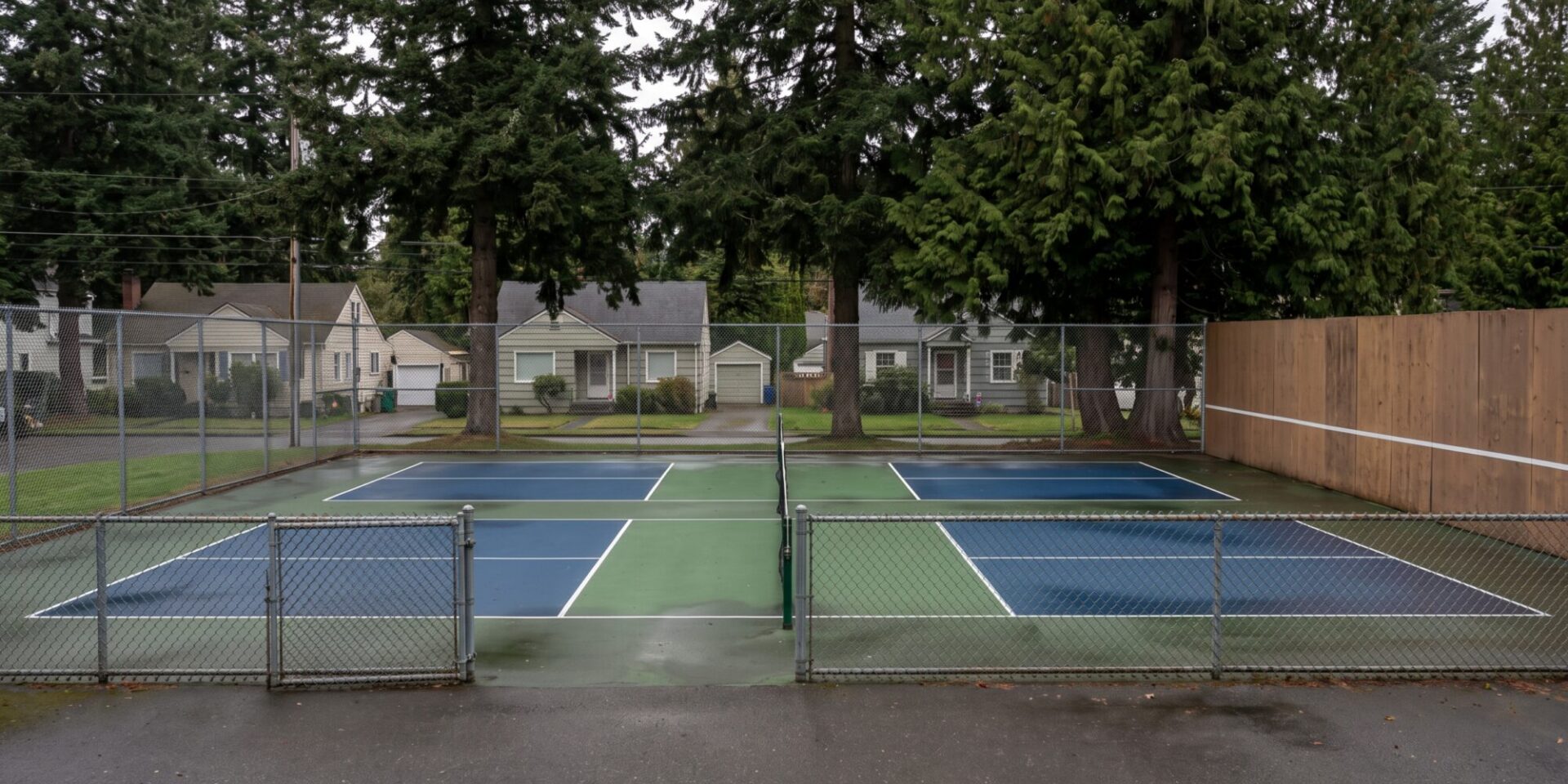
For a typical Ontario residential lot, 600 feet is not possible. The realistic goals on a residential lot are to keep the court as far as the lot allows from the neighbour’s sleeping areas, to place it behind the house or an accessory building, and to avoid a line of sight to the nearest windows. Our page on pickleball court size and dimensions gives the footprint you need to fit on the lot, and it helps to remember that the surround adds a lot to the playing area itself. USA Pickleball’s outdoor court construction guidance gives the playing lines as 20 by 44 feet and recommends a total court area of at least 30 by 60 feet, with 34 by 64 feet preferred.
Use Buildings and Grade Changes
A garage, a pool house or a change in ground level between the court and the neighbour blocks the direct path of sound better than most add-ons. If your lot slopes, sinking the court a little below the surrounding grade can turn the cut face into a barrier. That is a grading decision, which is why noise planning belongs in the same conversation as laser-guided grading and drainage. Any change in elevation has to work with the drainage design, and that should be settled with a grading plan rather than improvised on site.
Layer Two: Court Orientation and Layout
USA Pickleball recommends a north-south court orientation so that the low sun is not in players’ eyes, and that will usually govern the layout. Within that constraint, there is still choice about which end of the court faces the neighbour and where the gate, the benches and the players’ waiting areas go. Sound spreads from where people stand as well as from where the ball is struck, so keeping shouting, cheering and gathering areas away from the property line helps.
Layout also decides how many courts share a footprint. Two side-by-side courts double the pops for the same setback. If the site is tight, one court is often the right answer, and it is the honest one to give a client who wants four. Resurfacing an existing tennis court for pickleball is a common route, and our guide to converting a tennis court into a pickleball court explains why the noise question should be asked before the lines are painted. A tennis court that was a fine neighbour for thirty years can become a problem once four pickleball courts are squeezed onto it.
Layer Three: Acoustic Barriers That Work and Ones That Don’t
When distance is not available, the next tool is a barrier between the court and the people hearing it. A good barrier can make a real difference. A bad one is an expensive fence.
How a Barrier Actually Works
Sound travels in straight lines from the source and bends only a little over the top and around the edges of an obstacle. A solid barrier that interrupts the line between the court and the neighbour’s window reduces the level behind it. Four things decide whether it works:
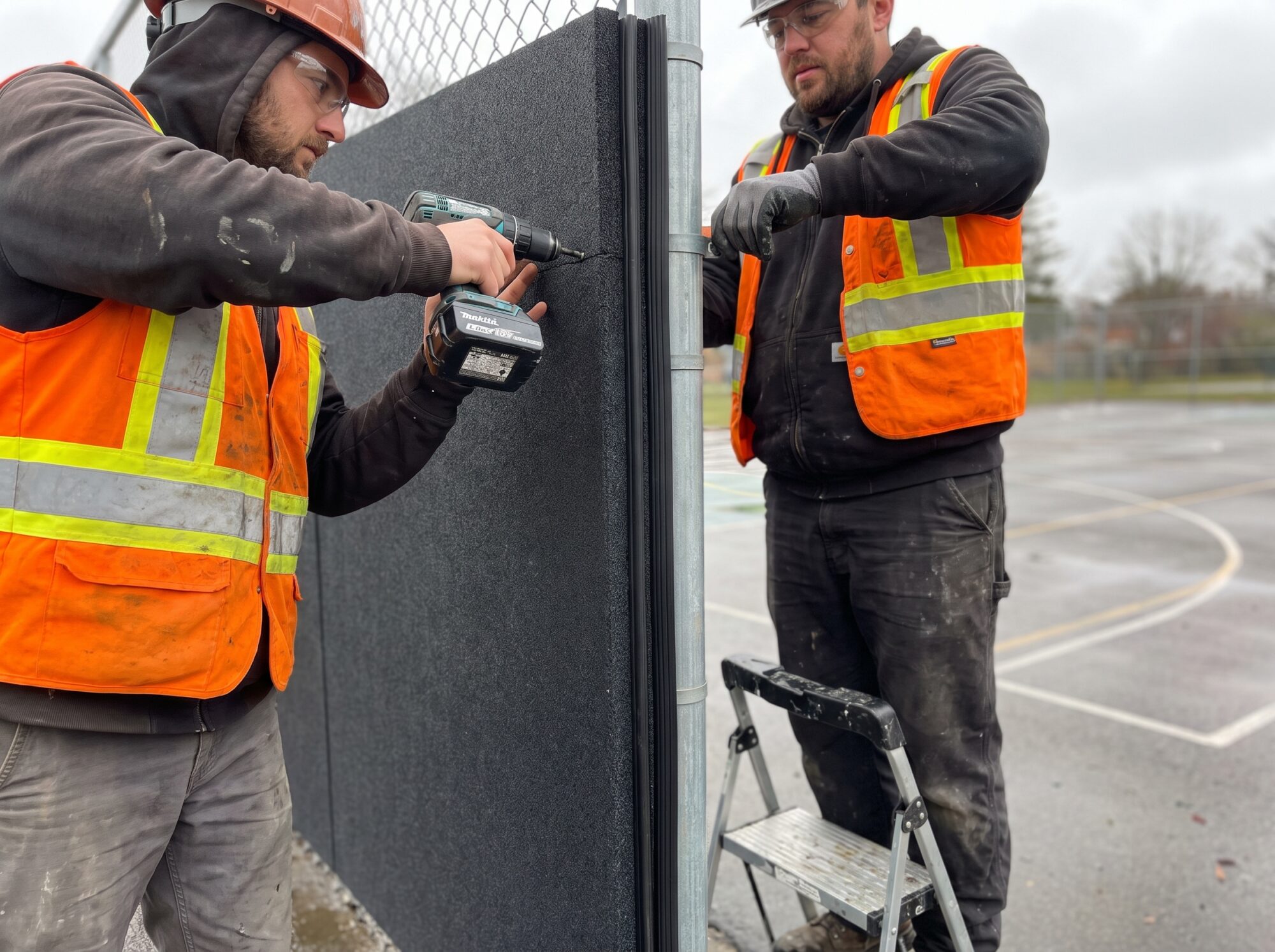
Mass and density matter, because a light mesh or a screen with gaps lets sound straight through. Height matters, because the barrier has to be tall enough to break the line of sight to the receiver, and a lower or shorter barrier is bypassed by sound that goes over or around. Continuity matters, because gaps at the bottom, at posts and at panel joints leak a lot of sound relative to their size. Absorption on the court side matters, because a hard reflective face bounces the pop back onto the court and out the open end.
This is general acoustic principle rather than a promise of any particular decibel reduction. The performance of a specific product depends on the manufacturer’s test data, the geometry of your site and the quality of the installation. Ask for third-party test results, and do not accept a single marketing number without knowing how it was measured.
Barrier Types Compared
| Option | How It Works | Strengths | Watch-Outs |
|---|---|---|---|
| Acoustic panels or curtains on the existing fence | Mass and absorptive layers fixed to the fence line | Retrofit friendly, can be added to one side only | Adds wind load to posts, seams and bottom gaps leak sound |
| Purpose-built solid barrier wall | Dense panel system on engineered footings | Strong blocking performance, designed for the site | Higher cost, may need a permit, can look imposing to neighbours |
| Earth berm | Mounded soil between court and receiver | Durable, good for planting, can use site fill | Needs space, must be designed with drainage |
| Dense planting alone | Visual screen and light scattering | Attractive, softens the view | Limited real sound reduction, takes years to fill in |
| Solid building or existing structure | Blocks the path completely | Free if it is already there | Only works if it sits between court and receiver |
| Enclosure (indoor court) | Walls and roof contain the sound | Most complete control, all-season play | Highest cost and permitting |
Installation Details That Decide the Result
USA Pickleball’s construction guidance lists sound-proofing products as an optional amenity and gives no specific noise limits or setbacks, so do not expect the governing body to hand you a spec. The design has to come from the site. On solid panels, the fence posts and footings must be sized for the added wind load, and that is an engineering question, not something to eyeball. The chain link recommended for the enclosure (45 or 55 millimetre mesh to hold the ball) keeps its job, so an acoustic layer is usually added to it, not substituted for it. Our post on court fencing materials, height and maintenance explains the base fence that any barrier would attach to.
Layer Four: Berms, Trees and Landscaping
Landscaping earns its place on a pickleball site, but it needs an honest description. A row of shrubs hides the court from view and makes neighbours feel better about it, which is worth something. It does very little to stop a 1,200 Hertz pop. The reduction from a hedge is small compared with a solid barrier, and it takes years for new plantings to reach a useful height.
Where planting does real work is as a companion to a berm or a barrier. A mounded earth berm gives you actual mass, and evergreens planted on top of and behind it add height, a softer look and some scattering of high-frequency sound. Cedars and other dense evergreens keep their cover through winter, which matters because the long Ontario play season now stretches into November for a lot of clubs. The same plan can handle stormwater, because a berm changes where water goes. Our piece on sport court landscaping covers how planting is laid out around a court, and our landscaping design service page explains how the outdoor space is planned as a whole.
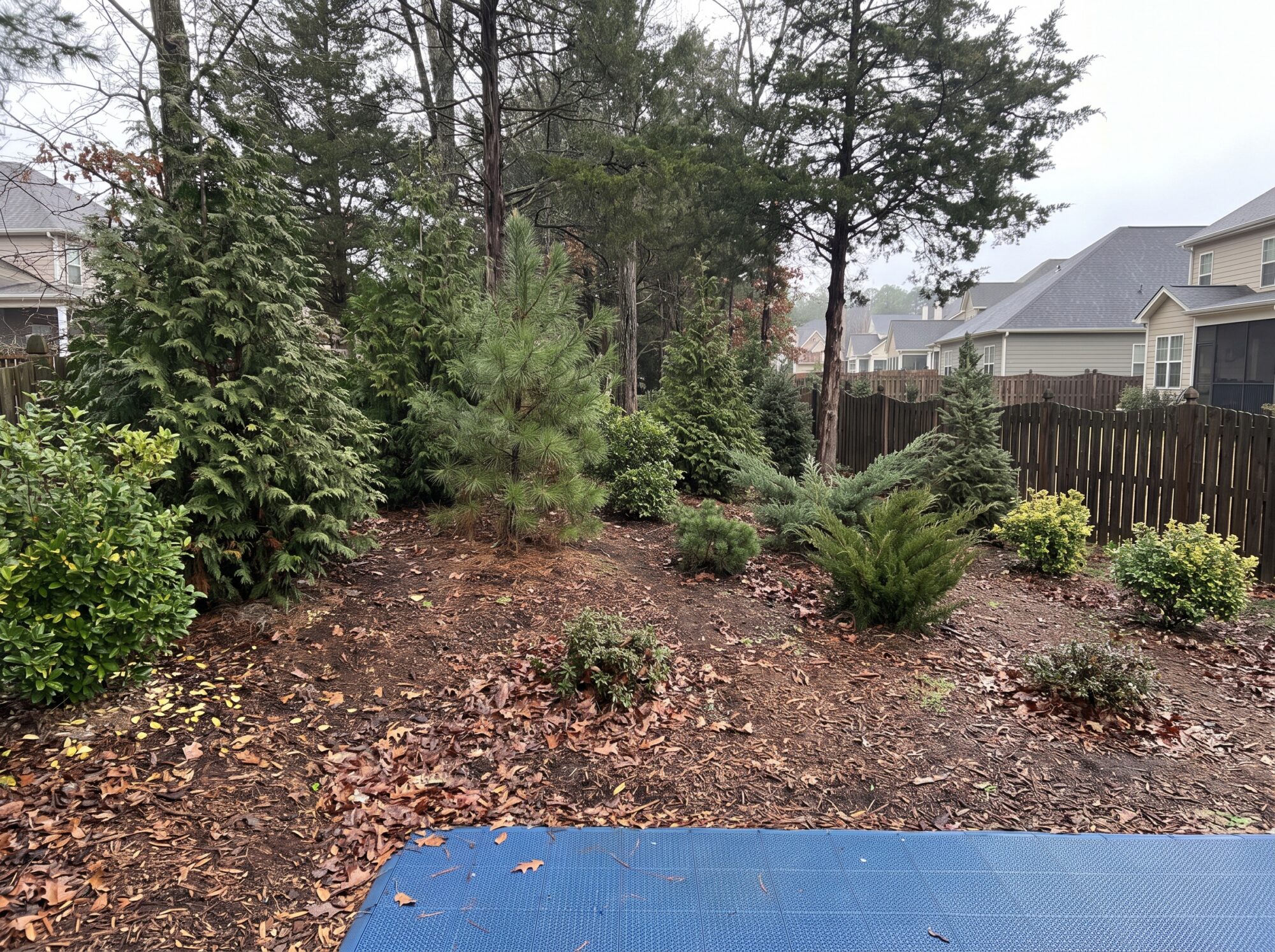
Remember that a berm and a tree line take up ground. On a small lot, the strip you give to planting is strip you cannot give to the playing surface, so decide early what the priority is.
Layer Five: Equipment, Hours and House Rules
Some of the most effective changes cost little and need no construction. They are also the ones a homeowner or club can put in place this week.
Quieter Paddles and Balls
Paddle and ball choice changes the sound. Softer-faced paddles and foam or low-noise balls make a duller, lower pop, and several are marketed specifically for noise-sensitive sites. They also change how the game plays, so many clubs use them for evening sessions or on the courts closest to homes rather than mandating them across the board. Try them before you commit a club to them, and check with your league or association about what is allowed in sanctioned play.
Hours of Play
Hours matter more than most owners expect. The NPC-300 limits step down in the evening, and neighbours are far more sensitive at 7:30 in the morning or 9 at night than they are at noon. A posted schedule that keeps play inside the middle of the day removes the sharpest complaints at almost no cost. If you plan to add lights, read our guide to sport court lighting in Ontario first, because lighting is what extends play into the hours when noise is least welcome.
Number of Courts and Court Rotation
Limiting how many courts run at once reduces the pop count. Clubs with a multi-court site sometimes rotate use so that the courts nearest the property line are used only for a portion of the day. Pickering’s decision to cut its site to two courts and add panels is an example of a public body combining fewer courts with a barrier, and you can read the details in the Insauga report on the Pickering vote.
Going Indoors
The only way to close the noise question for good is to put a roof and walls around the game. An indoor facility also removes weather from the schedule, which is why it has become popular with clubs and municipalities in Ontario. It costs more, needs a building permit and design team, and is a different scale of project from a backyard court. If you are weighing this, our articles on the benefits of an indoor pickleball court and on outdoor versus indoor pickleball court costs cover the trade-offs, and our pickleball court cost guide gives the outdoor baseline for comparison.
Fixing an Existing Court After Complaints Start
Retrofits are harder than planning, but they are not hopeless. The sensible order is to start with the cheap and reversible measures and work up.
| Step | Action | Typical Effort |
|---|---|---|
| 1 | Talk to the complaining neighbour and record when and how the noise bothers them | An afternoon |
| 2 | Adjust hours, court use and player behaviour | Immediate |
| 3 | Trial quieter paddles and balls during sensitive hours | Days to weeks |
| 4 | Have an acoustical consultant measure on site, including impulsiveness and timing | Weeks |
| 5 | Design a barrier on the fence line facing the complaint, sealed at posts and ground | Design plus install |
| 6 | Add berm or planting to support the barrier | Season-dependent |
| 7 | Reduce the number of courts if the site still cannot meet its limits | Last resort |
Step four is the one owners skip, and it is the one that stops you paying for the wrong solution. Measuring only average decibels can pass a court that still sounds terrible to the people next door, so ask the consultant to address impulsiveness and time of day as well.
A Neighbour-Friendly Planning Checklist for New Courts
If you are starting from a clean lot, most of the risk can be designed out. Work through these before the excavator arrives.
| Question | What to Decide |
|---|---|
| Where are the neighbours’ bedrooms and outdoor living spaces? | Keep the court, gate and player areas away from them |
| Is there a building or grade change we can use? | Place the court so it blocks the direct line |
| How many courts do we really need? | Choose the number the site can support, not the number on the wish list |
| Which hours will we play? | Write them down and post them |
| Do we need lights? | Weigh evening use against the neighbours before ordering poles |
| What does the by-law say and do we need a permit? | Confirm with the municipality first |
| Should the fence line carry a barrier now or later? | Size posts and footings for it up front if there is any chance |
| What planting and berm can the lot hold? | Plan drainage and planting in one design |
| Who talks to the neighbours before construction? | Someone should, early and in person |
The surface choice is part of this conversation too. None of the noise guidance we reviewed treats the coating as a noise control. Coatings are chosen for play and durability, and an acrylic-coated hard court is the standard pickleball surface. Our guide to acrylic sports court coating covers how it wears. Court base construction is where drainage and grading are settled, so noise berms and swales are designed together.
Talking to the Neighbours Before and After You Build
Most noise disputes are also relationship disputes. A neighbour who was told about the court, shown where it goes and asked what would bother them tends to behave differently from one who wakes up to an excavator. Bring the plan, mention the hours you intend to play, and give them a phone number. If a complaint arrives, respond quickly and change something visible, even if it is small. Councils get involved when people feel ignored, not merely when a court is close.
For clubs and municipal projects, public consultation is often part of the approval process anyway. Hold it early and bring the numbers, including the sound assessment, so the conversation is about facts and not about who is louder.
What Noise Control Costs
We are not going to quote a price here, because noise control ranges from free to a large line item and depends on the site. What we can say is what drives the cost.
| Cost Driver | Effect |
|---|---|
| Length and height of barrier | More linear feet and taller panels mean more material, more posts and more footing work |
| Barrier type | Panels on an existing fence, a purpose-built wall and an enclosure sit at very different price points |
| Post and footing upgrades | Solid panels add wind load, so posts and footings may need to be larger |
| Acoustical consultant fees | Measuring and modelling a site is a separate professional cost |
| Earthwork and planting | Berms need fill and grading, and mature evergreens cost more than young stock |
| Permits and approvals | Taller structures and public sites may trigger extra review |
| Lost court time | Reducing courts or hours has a real cost to a club or facility |
For the wider budget picture on a new court, see our sports court cost breakdown. Planning for a barrier from day one is almost always cheaper than adding it later, since the footings can be built into the original fence design.
Common Mistakes to Avoid
The mistakes we see are consistent. Owners buy a barrier before anyone has measured the problem. They install panels with gaps at the bottom and at the posts, which leak a large share of the sound. They rely on a hedge that will not be tall enough for a decade. They pack four courts onto a footprint that can only support two. They add lights and then are surprised that the complaints arrive after dark. And they ignore the neighbours until the neighbours contact the council.
One more mistake sits on the maintenance side. Fences with loose panels, worn hinges and rattling gates make their own noise, and a tidy court is easier to defend. Our list of maintenance basics and the notes on net systems cover the upkeep that keeps a court quiet and safe.
Planning a Pickleball Court With CrowAll
CrowAll builds and resurfaces courts across Ontario, and the work that decides how a court sounds is work we already do: siting the court, grading and drainage, the fence line and the landscaping around it. You can see the range of what we build in our product catalogue, and our local pages, such as pickleball court construction in Toronto, explain how a project runs in the GTA. Acoustic barrier products are a specialist category, and we do not manufacture them. If you want one, bring it up in the first conversation so the fence, footings and grading can be planned around it, and so we can talk through what we can coordinate for your site.
Whether you are a homeowner, a club, a school or a municipality, the first step is a conversation about your lot, your neighbours and how you plan to use the court. Contact CrowAll to discuss your project, browse finished work in the project gallery, and read why Ontario court owners choose CrowAll and our company profile to learn how we work. Our tennis courts page is a good place to start if you are converting an existing court.
FAQ
Why is pickleball so loud?
The hard paddle striking a hard plastic ball makes a sharp, high-pitched pop at about 1,200 Hertz, a range where hearing is most sensitive. The sound is also impulsive and random, and a court can produce hundreds of pops an hour.
Is pickleball noise a problem in Ontario?
Yes. Ontario municipalities including Pickering have cut courts and added noise panels after resident complaints, and Toronto councillors reported complaints in 2025. Whether it is a problem on your site depends on distance, court count and hours.
How do you stop pickleball noise?
No single fix removes it. The most effective measure is distance from homes. After that come solid acoustic barriers, berms, quieter paddles and balls, limited hours and fewer courts. Most sites use several together.
How can I soundproof a pickleball court?
Fully soundproofing an outdoor court is not realistic. You can reduce noise reaching neighbours with a sealed acoustic barrier on the fence line facing them, added earth or buildings between court and receiver, and rules on hours and equipment.
Do acoustic barriers for pickleball courts work?
A solid, sealed, tall enough barrier that breaks the line of sight to the receiver does reduce noise behind it. Gaps, short panels or a hard reflective face on the court side reduce the benefit. Ask for third-party test data for any product.
How far away can you hear pickleball noise?
It depends on ground cover, wind, background noise and the number of courts. Published guidance ranges widely, from not placing courts within 100 feet of homes to seeking 600 to 800 feet where separation is the fix.
How far should a pickleball court be from a house?
There is no single Ontario rule. Researchers have recommended not less than 100 feet and closer attention within 1,000 feet, and one consultant summary favours 600 to 800 feet. Your municipal by-law and a site assessment decide the practical answer.
Is pickleball louder than tennis?
Most people find the pickleball pop more irritating than the tennis thunk because it is higher pitched, sharper and more frequent. Exact levels vary by site, so compare on your own lot rather than by a single number.
Does Ontario have a noise limit for pickleball courts?
There is no pickleball-specific provincial limit. NPC-300 sets sound level limits for stationary sources that planners and acousticians use, and municipalities set their own by-laws. In Class 1 and 2 areas the outdoor limit is 50 dBA in daytime and evening.
What is NPC-300?
NPC-300 is Ontario’s Environmental Noise Guideline for stationary and transportation sources, published in August 2013. It sets sound level limits for approvals, guides land use planning under the Planning Act and supports municipal noise by-laws.
Can neighbours complain about a backyard pickleball court?
Yes. Complaints usually go to the municipality under its noise or nuisance by-law. Talking to neighbours early, keeping sensible hours and planning the court away from their bedrooms lowers the risk considerably.
Do quiet pickleball paddles and balls help?
They can. Softer-faced paddles and low-noise balls make a duller pop. They also change how the game plays, so try them first and check what your league allows.
Do trees and hedges block pickleball noise?
They help the view more than the sound. Dense evergreens on a berm add some scattering and hide the court, but they do not block noise the way a solid barrier does, and young plantings take years to grow.
Can a tennis court be converted to pickleball without noise problems?
It can, but the noise question should be asked first. A tennis court that had two players now holds several pickleball courts, and the pop travels differently. Consider court count, hours and a barrier before painting lines.
Does an indoor pickleball court solve the noise problem?
An indoor court contains most of the sound and removes weather from the schedule. It costs more and needs building permits and design, so it suits clubs, schools and facilities more than a typical backyard.
Should I plan for a barrier when building a new court?
Yes, if there is any chance you will need one. Sizing fence posts and footings for solid panels up front is cheaper than rebuilding later, and it keeps your options open.
Who measures pickleball noise?
A qualified acoustical consultant can measure on site and model mitigation. Ask them to look at impulsiveness, frequency and time of day as well as average decibels.
Does CrowAll build pickleball courts in Ontario?
Yes. CrowAll builds pickleball courts and resurfaces existing courts across Ontario, including the grading, drainage, fencing and landscaping that shape how a court fits its neighbourhood.