Pickleball Court vs Tennis Court in Ontario: Size, Surface and Build Differences
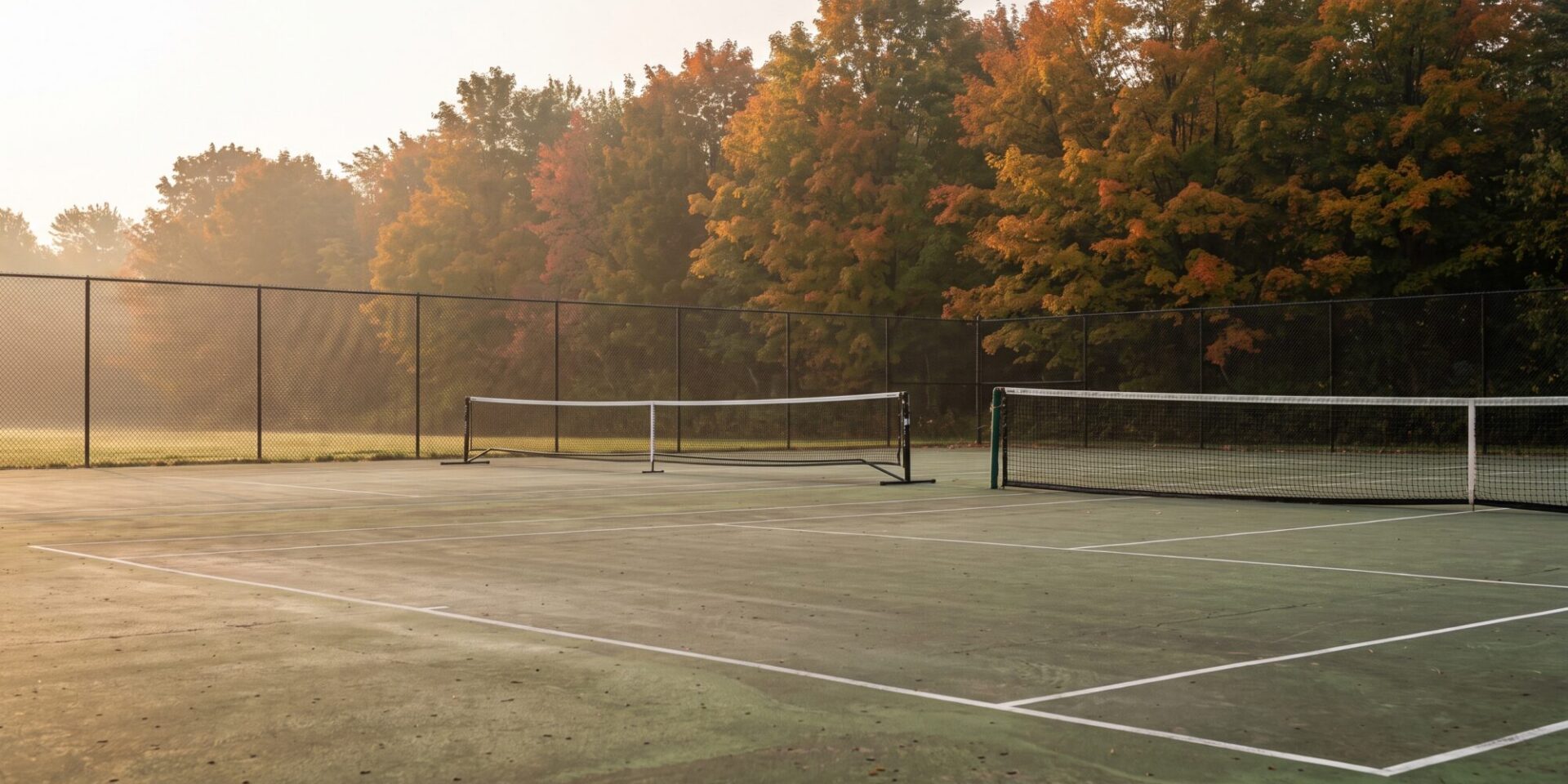
A tennis court and a pickleball court look like cousins from a distance. Same net in the middle, same painted lines, same acrylic colours. Then someone gets a quote, or a drawing, or a site survey, and the differences show up fast. One needs roughly the footprint of a two-car driveway plus a bit. The other needs a lot more land, a bigger drainage plan and a much bigger fence.
If you are deciding which court to build, or whether the tennis court you already own should become a pickleball facility, this guide lays out the real differences the way a court contractor would explain them on a site visit. It covers official dimensions, the pad you actually need, nets and posts, lines, surfaces, base and drainage, fencing, noise, lighting, shared-use rules, cost drivers and which court suits which owner. Where a figure comes from a governing body we say so, and where it depends on your site we say that too. For the build sequence itself, our guides to pickleball court construction in Ontario and the steps involved in building a tennis court from scratch go deeper.
The Short Answer: How a Pickleball Court Differs From a Tennis Court
A pickleball court is 20 feet wide by 44 feet long, while a tennis court is 78 feet long and 27 feet (singles) or 36 feet (doubles) wide. Pickleball also uses a lower net, a 7 foot non-volley zone and the same lines for singles and doubles. The ground work is the same kind of work, just at a smaller scale.
That one paragraph answers most of what people search for. The rest of the decision comes down to land, budget, who will play and how the court will be shared. Tennis Canada’s facility guidance, which we quote below, is blunt about one point: where possible, keep tennis courts for tennis and build dedicated courts for pickleball.
Quick Comparison
| Item | Pickleball | Tennis | Source |
|---|---|---|---|
| Playing court length | 44 ft (13.41 m) | 78 ft (23.77 m) | USA Pickleball rule 3.A.1, ITF Rules of Tennis |
| Playing court width | 20 ft (6.10 m), singles and doubles | 27 ft (8.23 m) singles, 36 ft (10.97 m) doubles | USA Pickleball, ITF |
| Net height at the sides | 36 in (91.4 cm) | 42 in (1.07 m) at the posts | USA Pickleball rule 3.B.6, ITF |
| Net height at the centre | 34 in (86.4 cm) | 36 in (0.914 m) | USA Pickleball rule 3.B.7, ITF |
| Playing surface area | 880 sq ft | 2,808 sq ft (doubles) | Calculated from the lines above |
| Special zone | 7 ft non-volley zone on each side of the net | None | USA Pickleball definitions |
| Standard line width | 2 in (5.08 cm) | 1 to 2 in, baselines up to 4 in | USA Pickleball rule 3.A.4.e, ITF |
The surface-area line in Table 1 is simple multiplication, not a rule. A doubles tennis court inside its lines is 78 by 36 feet, or 2,808 square feet. A pickleball court inside its lines is 20 by 44 feet, or 880 square feet. On paper, one pickleball court is a little under a third of a tennis court. The paved pad and fence around each court are a different story, and that is where owners get surprised.
Official Dimensions and Layout
Both sports publish their court dimensions, and both are precise. The numbers below come from the governing documents, not from a contractor’s rule of thumb.
Pickleball Court Dimensions
The USA Pickleball rulebook states that the court is a rectangle 20 feet wide and 44 feet long, used for both singles and doubles. The non-volley zone, often called the kitchen, is 7 feet deep and spans the full 20 foot width on each side of the net. Lines are 2 inches wide and should contrast clearly with the playing surface. You can read the rules on the USA Pickleball official rulebook. We cover the layout line by line in our pickleball court size and dimensions article.
Tennis Court Dimensions
The International Tennis Federation sets the court at 78 feet (23.77 m) long. Singles play is 27 feet (8.23 m) wide and doubles is 36 feet (10.97 m) wide, and most recreational courts are built to the doubles width so the same pad serves both formats. The 2026 ITF Rules of Tennis also list the net at 3.5 feet (1.07 m) at the posts and 3 feet (0.914 m) at the centre. For a wider look at how tennis compares with other racket sports, see our piece on tennis court dimensions compared with other racket sports, and for the basics, how large a tennis court is.
Why the Line Layouts Feel So Different
A tennis court has a baseline, singles and doubles sidelines, service lines and a centre service line. A pickleball court has far fewer lines, but the non-volley zone line sits close to the net, so footwork and positioning are tight. That matters for construction because a pickleball court’s lines are packed into a small area, and a slightly wavy surface or a poorly aligned line is much easier to notice in a space where players spend most of the rally within a few steps of the kitchen.
The Pad You Actually Need: Run-Off Space Changes the Math
Nobody plays only inside the lines. Players back up past the baseline, chase wide balls and need room to stop. Governing bodies publish guidance on the paved area, and it is larger than most owners expect.
For tennis, Appendix X of the ITF Rules lists guidance of 18 feet (5.48 m) from the baseline to the backstop and 10 feet (3.05 m) from the sideline to the sidestop for recreational and club play. For international competition the figures are 21 feet (6.40 m) and 12 feet (3.66 m). For pickleball, the USA Pickleball rulebook gives a minimum playing surface of 30 by 60 feet, with 34 by 64 feet recommended for new construction.
| Court | Inside the lines | Recommended pad (guidance) | Pad area | How the pad figure is built |
|---|---|---|---|---|
| Pickleball, minimum | 20 x 44 ft | 30 x 60 ft | 1,800 sq ft | USA Pickleball minimum playing surface |
| Pickleball, new construction | 20 x 44 ft | 34 x 64 ft | 2,176 sq ft | USA Pickleball recommendation for new courts |
| Tennis, recreational or club | 36 x 78 ft | 56 x 114 ft | 6,384 sq ft | 78 ft plus 18 ft each end, 36 ft plus 10 ft each side (ITF Appendix X guidance) |
| Tennis, international level | 36 x 78 ft | 60 x 120 ft | 7,200 sq ft | 78 ft plus 21 ft each end, 36 ft plus 12 ft each side (ITF Appendix X guidance) |
The pad areas in Table 2 are arithmetic from the published run-off figures, so treat them as planning numbers, not design drawings. They still make the point. A recreational tennis pad of roughly 6,400 square feet is about three and a half times the minimum pickleball pad, and about three times the recommended new-construction pad. That ratio drives excavation volume, base stone, asphalt or concrete quantity, coating area, drainage design and fencing length.
How Many Pickleball Courts Fit on One Tennis Court Pad?
Roughly three, give or take, once you respect run-off and fence lines. You will see “four pickleball courts per tennis court” in plenty of search results, and that is true of the playing lines alone. With proper clearances between courts, a pad that holds one recreational tennis court usually holds somewhere between two and four pickleball courts depending on fence layout, orientation and how tight the club is willing to go. Tennis Canada’s facility guidance adds a caution: its research on the 100 largest Canadian municipalities concluded that a 1:1 conversion ratio of pickleball to tennis courts is not the optimal solution for either sport. We unpack the layout options in our guide to converting a tennis court into pickleball courts in Ontario.
Nets, Posts and Hardware
The net is the other place where a tennis court and a pickleball court cannot simply swap. A tennis net is 42 inches high at the posts and 36 inches in the middle. A pickleball net is 36 inches at the sidelines and 34 inches at the centre, with a tolerance of a quarter inch either way in the USA Pickleball rules. Post spacing is different too, because the posts sit outside the court width.
Tennis Canada’s guidance warns that tennis nets are not appropriate for recreational pickleball, and notes that damaged nets from players lowering tennis nets are raising costs for municipalities. Its recommended fix for shared sites is a portable pickleball net, so the tennis net is never lowered. For permanent builds, net posts are set in footings, and those footings are easiest to build into the base rather than cut in later. Our guide to tennis court net systems covers post types and installation in more detail.
| Item | Pickleball | Tennis |
|---|---|---|
| Net height, edges | 36 in | 42 in at the posts |
| Net height, centre | 34 in | 36 in at the centre |
| Net system on a dedicated court | Permanent posts sized to the pickleball court width | Permanent posts set outside the tennis court width |
| Net system on a shared tennis pad | Portable pickleball net recommended by Tennis Canada | Tennis net stays at full height |
| Footing planning | Place during base construction | Place during base construction |
Lines and Markings: Where Blended Courts Come From
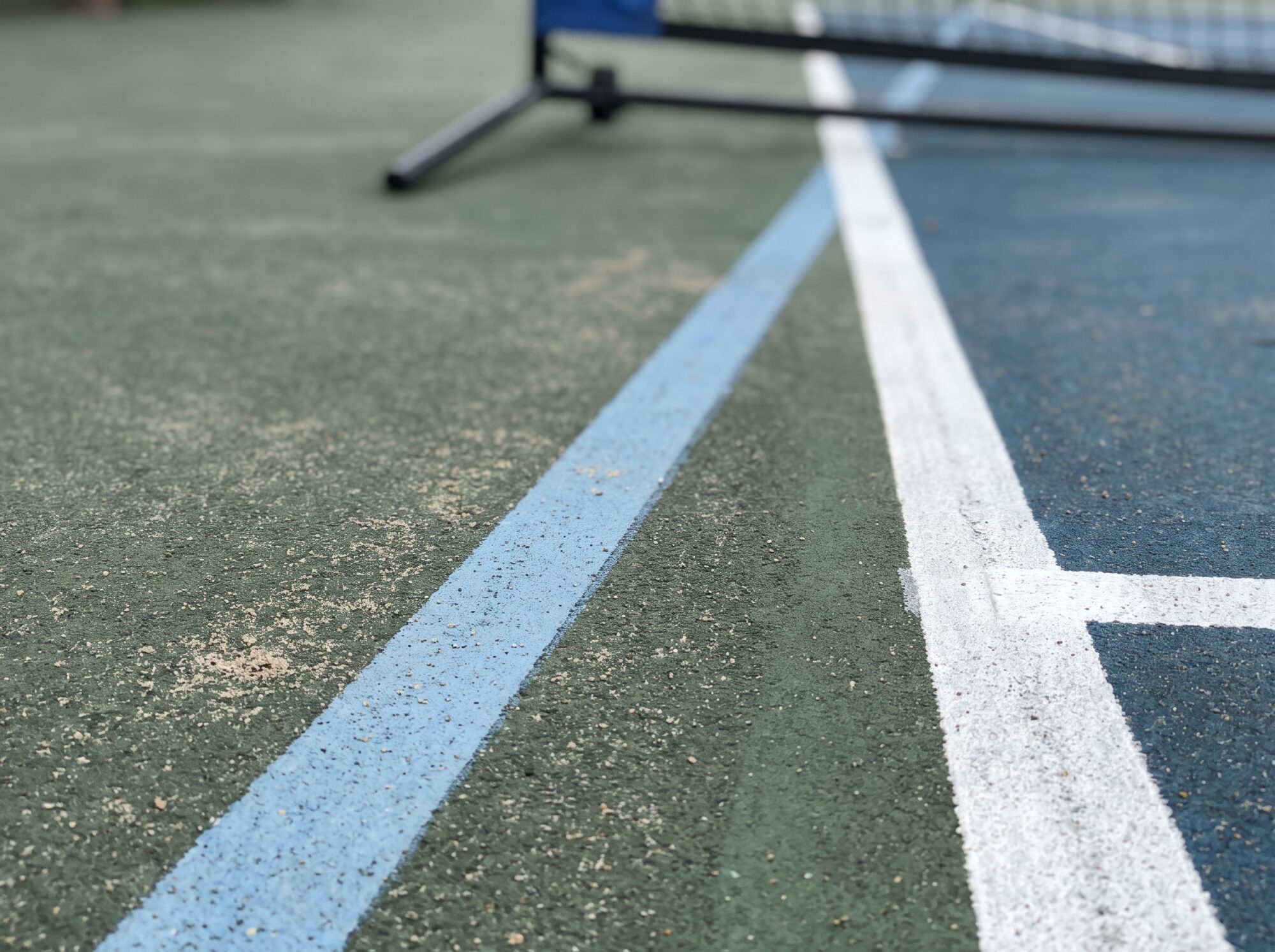
Painting lines is the cheapest part of a court and the part that generates the most arguments. On a dedicated pickleball court the lines are 2 inches wide, in a colour that contrasts with the surface. On a tennis court they are white or another high-contrast colour at the widths the ITF specifies.
Shared courts add a third option. Tennis Canada describes blended pickleball lines, which are painted in a shade close to the court colour so they read as part of the surface to tennis players and still show up for pickleball players. Its guidance for shared sites says up to two pickleball courts can be blended onto a 78 foot tennis court, one on each side of the net, using a shared tennis service line or baseline where possible. The lines should be a textured paint a shade lighter than the surface within the same colour family, about 1.5 inches wide, and should stop 3 inches short of the tennis lines. Temporary lines can be laid with painters’ tape, which avoids damaging an acrylic surface. The full set of recommendations is in Tennis Canada’s Facilities Approach to Tennis and Pickleball.
Colour choice matters more than people expect. A line that is too faint disappears in low light, and one that is too strong turns a tennis court into a maze. Our guide to sport court colour options in Ontario walks through how coating colours affect visibility and heat.
Surfaces: Same Acrylic, Different Demands
Many outdoor pickleball courts and tennis courts in Ontario use the same basic hard-court build: an asphalt or concrete pad topped with an acrylic playing surface. That is why a tennis court can host pickleball at all. The differences are in the options each sport tends to use and in how forgiving the surface is of the sport’s wear patterns.
CrowAll’s pickleball page lists asphalt, concrete and modular tiles as surfaces, with asphalt described as balancing playability and shock absorption, concrete as long-lasting and low-maintenance with consistent ball bounce, and modular tiles as interlocking panels that go over an existing surface with drainage and colour options. CrowAll’s tennis page lists a wider range: clay surfaces including Har-Tru made from crushed basalt, ClayTech, soft asphalt (penetration), artificial turf, acrylic coatings and conventional hard courts in asphalt or concrete.
| Surface | Listed for pickleball | Listed for tennis | Notes from CrowAll’s pages |
|---|---|---|---|
| Asphalt pad with acrylic coating | Yes | Yes, as a hard court | Balances playability and shock absorption, may need resurfacing over time |
| Concrete pad with acrylic coating | Yes | Yes, as a hard court | Long-lasting, low maintenance, consistent bounce |
| Modular tile | Yes | Not listed | Interlocking tiles that install over an existing surface |
| Clay (Har-Tru and similar) | Not listed | Yes | Crushed basalt, allows sliding, easier on the body |
| ClayTech | Not listed | Yes | Low upkeep, resistant to cracking and peeling |
| Soft asphalt (penetration) | Not listed | Yes | Stone layers topped with asphalt, can go over an existing hard court |
| Artificial turf | Not listed | Yes | Softer than natural grass with less upkeep |
For a fuller comparison of tennis surface families, see our overviews of the four types of tennis courts, soft asphalt in tennis court installation and ClayTech versus Har-Tru. If you are leaning toward a hard court, the role of acrylic sports court coating explains what the coating actually does.
Can Pickleball Be Played on Clay or Turf?
It can be played, but CrowAll’s pickleball page does not list those surfaces for dedicated pickleball courts, and we would not promise a pickleball experience on a surface that is tuned for tennis. A soft clay surface changes how the ball bounces and how lines are maintained, and a loose-fill surface needs different upkeep from a sealed acrylic one. If a club wants both sports on a clay site, the practical route is a separate hard-surface pickleball area.
Base, Grading and Drainage: Where Ontario Courts Succeed or Fail
Both courts depend on what is under the coating. In Ontario that means building for freeze-thaw cycles, spring melt and heavy summer rain. A pad that holds water develops birdbaths, a base that moves heaves the surface in winter, and either shows up as cracks.
The ground work is the same sequence for both sports: excavation, subgrade preparation, a compacted granular base, grading to a designed slope, a pad of asphalt or concrete, curing and then the playing surface. We walk through that sequence for pickleball in our pickleball construction guide. What differs is scale. A tennis pad is several times the area, so subgrade variation, drainage length and the risk of a soft spot all grow with it. Water also has farther to travel on a big pad, which makes slope design and the outfall more important.
Accuracy matters more on a small court than people assume. In a 20 by 44 foot space, a low spot near the kitchen line is where players stand and the ball lands over and over. CrowAll uses laser-guided grading to hold designed elevations across the base, and the same discipline applies to either court. For the drainage side, our articles on tennis court drainage systems and accurate grading for sports court drainage explain what to ask a builder.
Base Depth and Slope: What We Will and Will Not Say
Published base depths and slopes vary between governing bodies, manufacturers and regions, and we have not found a single Ontario standard that applies to every site. The depth of stone, the slope and the drain layout depend on soil, groundwater, frost exposure and the surface system. Those numbers should come from the project design and the coating manufacturer’s requirements, and any contractor who quotes them without seeing the site is guessing. Our guide to the laser-guided grading process shows what a proper site conversation looks like.
Fencing and Enclosure
A tennis court needs a lot of fence. A pad of about 56 by 114 feet means roughly 340 feet of perimeter before any dividing fence, and a ball hit over a short fence ends up in a neighbour’s yard or the road. A pickleball court’s pad is far smaller, but the sound is sharper, so the fence does more than keep balls in.
Fence height, post spacing, gates, windscreens and surface of the fabric all change with the sport and the site. Our article on tennis court fencing materials, height and maintenance covers the options. Whichever sport you pick, the footings should be planned alongside the base so posts are not cut into a finished pad.
Noise: The Pickleball Factor
Pickleball’s paddle-on-ball sound is higher pitched and more repetitive than tennis, and neighbours often notice it more even though the court is smaller. If the court sits near homes, that should influence orientation, distance from property lines, fence choice and any sound-mitigation plan before the first drawing is finalized. We explain the options in pickleball court noise in Ontario.
Lighting
Lighting is a larger decision on a tennis court because the playing area and pole layout are bigger, and a smaller pickleball court can often be lit with fewer poles. Either way, conduit and pole bases are cheaper to build into the base than to retrofit. Glare control, spill light on neighbours and municipal limits all matter. Our guide to sport court lighting in Ontario covers LED systems for night play, and CrowAll lists lighting as an optional feature on its backyard pickleball court installation page.
Can You Play Pickleball on a Tennis Court?
Yes, a sound tennis court can host pickleball with a portable net and temporary or blended lines. CrowAll’s tennis page says the same, noting that pickleball can be played on a tennis court with temporary modifications because net height and dimensions differ. Whether you should is a separate question, and the answer depends on how many tennis courts you have.
What Tennis Canada Recommends
Tennis Canada’s facility guidance sets out three options in order of preference. The first is dedicated sites for each sport, either as one complex or as separate developments. The second is non-traditional spaces such as multi-sport courts, concrete slabs, outdoor hockey rinks outside winter, or vacant parking lots, with safety as the first consideration. The third is shared use of tennis courts, and only after the first two have been fully explored. The document says that recommendation stands for sites with two or fewer tennis courts, and that for sites with three or more tennis courts every effort should be made to use the first or second option. It also reports that some municipalities reversed shared-court designs after dissatisfaction from both sets of players.
Read plainly, that is advice for clubs and municipalities. A private owner with one court and no space for a second pad is in a different position. A homeowner can decide how the court will be used, how often the net comes down and who supervises it, and a sound court with a portable net is a perfectly reasonable answer. Our tennis-to-pickleball conversion guide covers layout and hardware in detail, and multi-sport court construction shows what a purpose-built shared court looks like.
| Situation | Tennis Canada direction | Practical takeaway |
|---|---|---|
| One or two tennis courts, no room for new pickleball courts | Shared use acceptable once dedicated options are explored | Use portable nets and blended lines, and agree booking rules |
| Three or more tennis courts | Use dedicated sites or non-traditional spaces wherever possible | Build separate pickleball courts rather than splitting tennis courts |
| New complex on open land | Preferred option is sport-specific sites | Plan pad sizes, fencing and noise separately for each sport |
| Existing parking lot, slab or hockey rink available | Listed as a non-traditional option, with safety first | Check drainage, surface condition and clearances before marking lines |
When Sharing Goes Wrong
The usual problems are mundane. Tennis nets get lowered for pickleball and the cable or strap wears out. Pickleball players stay on a court long after a tennis booking should have started. Temporary tape lines peel in the sun, and blended lines get repainted in the wrong shade. A good plan names who sets the net, who owns the lines and how the surface is maintained. If the surface itself is tired, resurface first. Our guide to when it is time to resurface your tennis court lists the signs.
Cost and Timeline Drivers
Nobody should quote a firm price for a court they have not seen, and we will not list one here. What we can do is rank the drivers. Cost follows pad area, site access, soil, drainage complexity, pad material, surface system, fencing, lighting and landscaping. Tennis courts push every one of those up because of area. Pickleball courts keep them low until the owner adds several courts, a viewing area or sound control.
| Driver | Pickleball effect | Tennis effect |
|---|---|---|
| Pad area | About 1,800 to 2,200 sq ft per court | About 6,400 to 7,200 sq ft per court |
| Excavation and base stone | Smaller volume per court | Several times the volume |
| Grading and drainage | Simpler outfall for one court, more complex for a bank of courts | Longer water path and larger outfall design |
| Pad material | Asphalt or concrete, chosen for soil and budget | Asphalt or concrete, chosen for soil and budget |
| Surface system | Acrylic over asphalt or concrete, or modular tile | Acrylic, clay, ClayTech, soft asphalt or turf |
| Fencing | Shorter perimeter, but sound and ball control matter | Long perimeter, taller fence common |
| Lighting | Fewer poles, glare control still required | More poles over a larger area |
| Approvals | Zoning, setbacks, lighting and noise | Zoning, setbacks, lot coverage, fence height |
| Schedule | Cure time and weather dominate | Same, with a longer paving and fencing scope |
For ballpark figures that match your market, our cost articles are the right next step: how much it costs to build a pickleball court, pickleball court costs in Toronto and what it costs to build a tennis court in 2026. If a covered or heated building is on your list, outdoor versus indoor pickleball costs frames that choice. CrowAll’s pages state that site conditions, materials and features drive the final figure and that quotes are free after a consultation.
How Long Does Each Take?
Both builds follow the same order, and both are slowed by the same things: wet ground, curing time, coating weather windows and permits. CrowAll’s backyard pickleball page says a typical project runs from one to three weeks depending on complexity, site condition and weather. Its tennis page says installation typically takes a few weeks to a few months, with late fall and winter weather causing delays. Treat both as ranges for planning, not promises, because your site decides. Our guide to how long tennis court construction takes breaks down the phases.
Permits, Zoning and Setbacks in Ontario
Approvals can decide the choice before design does. A single pickleball court may fit within lot coverage and setback limits that a full tennis court cannot. Lighting, fence height and noise rules vary by municipality, and conservation authorities may need to review work near regulated areas. CrowAll’s tennis page notes that a building permit may be required in Ontario depending on the municipality. Our articles on permits for sports courts and zoning for residential tennis courts explain what to ask your municipality, and Ontario’s one-call locate service should be contacted before any ground is broken.
Which Court Should You Build? A Guide by Owner Type
There is no universal winner. The right court depends on space, who will play and how you want the property to work year-round.
| Owner | Often a good fit | Why | Watch for |
|---|---|---|---|
| Homeowner with a modest yard | Pickleball court | Small footprint, quicker to plan, easier to fence | Noise toward neighbours, setbacks |
| Homeowner with a large lot who plays tennis | Tennis court, possibly with blended pickleball lines | Full-size game and flexible use | Pad size, drainage, fence height |
| Tennis club | Keep tennis courts and add dedicated pickleball courts | Matches Tennis Canada’s preferred approach | Booking conflicts, sound toward neighbours |
| Pickleball club or business | Multiple dedicated pickleball courts | Many courts fit in a small area | Noise, parking, lighting |
| School or community centre | Multi-sport court or separate pickleball area | Serves several programs | Line clutter, supervision, drainage |
| Municipality or recreation department | Dedicated sites or non-traditional spaces first | Follows Tennis Canada’s three-option sequence | Net damage, shared bookings |
| Condo or HOA community | Pickleball court | Smaller footprint, easier to place | Approvals, resident noise concerns |
Clubs weighing a business model can read business plan basics for a pickleball club, and anyone curious about a third racket-sport option can look at padel court construction in Ontario.
Ontario Climate and Timing
Freeze-thaw cycles, spring melt and summer heat all shape both courts. Late-season weather limits asphalt placement and acrylic application, which is why timing is part of the plan and not an afterthought. Our guide to the best time of year to build a sports court and the summer versus fall comparison cover seasonal windows. For an existing court, cracks need prompt attention, and sport court crack repair explains what professionals do.
Maintenance Differences
Both courts need cleaning, crack repair, drainage checks and periodic recoating. Tennis courts have more area to maintain, and the baseline and service-line areas see concentrated wear. Pickleball courts see heavy wear in a small area, particularly near the non-volley zone line. CrowAll’s pickleball page lists surface cleaning, repainting lines and repairing wear as part of maintenance, and notes that asphalt and concrete may need crack repair and resurfacing while modular tiles need less frequent upkeep. See our guides to sports court maintenance and resurfacing a backyard pickleball court.
Common Mistakes When Choosing Between the Two
Most regrets trace back to a handful of decisions made early. Owners pick a tennis court because it feels like the premium option and then rarely fill four players. Others build a pickleball court at the property line without a noise plan. Some assume lines painted on a worn tennis court will fix a failing surface. Others forget that drawings need space for the fence, the net posts and the light poles, not just the lines.
- Choosing a sport before measuring the usable site, including slopes, trees, utilities and setbacks.
- Treating the pad as the court and forgetting run-off, fence lines and entry gates.
- Assuming a tennis net can be lowered to pickleball height without wear.
- Skipping a drainage plan because the site looks flat.
- Painting lines over a cracked or heaving surface instead of repairing it first.
- Leaving fencing, lighting and landscaping out of the first design and cutting into a finished pad later.
Landscaping also plays a bigger role than many owners expect, from screening to runoff control. Our articles on sport court landscaping and CrowAll’s landscaping design service are the place to start.
Planning a Court With CrowAll
CrowAll builds and resurfaces tennis courts and builds pickleball courts across Ontario, with service pages for Barrie, Brampton, Toronto, Vaughan, Markham, Mississauga, Oakville, Oshawa, Ajax, Whitby, Newmarket, North York, Hamilton, Woodbridge, Milton and Scarborough. Its pages describe free consultations and free quotes, ground preparation with laser-guided grading, surfacing, line markings, and optional fencing and lighting.
If you are weighing a new court, a conversion or a resurfacing project, a short site visit usually answers the question faster than any article. Bring your lot plan if you have one. You can learn about the team on the company profile and why choose us pages, browse the project gallery, or contact CrowAll for a consultation or quote. For a specific build, see the tennis court and backyard pickleball court pages, or your local page such as pickleball court construction in Toronto or tennis court construction in Toronto.
FAQ
What is the difference between a pickleball court and a tennis court?
A pickleball court is 20 by 44 feet, while a tennis court is 78 feet long and 27 or 36 feet wide. Pickleball uses a lower net, a 7 foot non-volley zone and the same lines for singles and doubles. A tennis court needs several times the paved area.
How big is a pickleball court compared with a tennis court?
Inside the lines, a pickleball court is 880 square feet and a doubles tennis court is 2,808 square feet. With recommended run-off, a pickleball pad is about 1,800 to 2,200 square feet and a recreational tennis pad about 6,400 square feet.
Can you play pickleball on a tennis court?
Yes, with a portable pickleball net and temporary or blended lines on a sound surface. Tennis Canada recommends this only when dedicated pickleball courts are not possible, and only for sites with two or fewer tennis courts.
How many pickleball courts fit on a tennis court?
The lines of up to four pickleball courts fit inside a tennis court footprint, but with proper run-off and fencing a tennis pad usually holds about two to four. Tennis Canada says up to two blended pickleball courts can be marked on a 78 foot tennis court.
Is a pickleball net lower than a tennis net?
Yes. A pickleball net is 36 inches at the sidelines and 34 inches at the centre. A tennis net is 42 inches at the posts and 36 inches at the centre.
Can you use a tennis net for pickleball?
Tennis Canada says tennis nets are not appropriate for recreational pickleball and recommends portable pickleball nets so the tennis net is not lowered and damaged.
What are blended pickleball lines?
Blended lines are pickleball lines painted in a shade close to the tennis court colour so they are visible to pickleball players without dominating the tennis markings. Tennis Canada suggests about 1.5 inches wide and 3 inches short of the tennis lines.
Which is cheaper to build, a pickleball court or a tennis court?
A single pickleball court usually costs less because the pad, base stone, fence and coating area are much smaller. Exact pricing depends on the site, so a site visit is needed for a real number.
Do pickleball and tennis courts use the same surface?
Both are commonly built as acrylic-coated asphalt or concrete. CrowAll also lists clay, ClayTech, soft asphalt and turf for tennis, and modular tile for pickleball.
Is pickleball noisier than tennis?
Pickleball has a sharper paddle sound that carries, so neighbours often notice it. Orientation, distance from homes, fencing and sound control should be planned before construction.
How much space do I need for a backyard pickleball court?
USA Pickleball lists a minimum playing surface of 30 by 60 feet and recommends 34 by 64 feet for new construction. Add room for fencing, entry and any landscaping.
How much space do I need for a backyard tennis court?
ITF guidance for recreational and club play adds 18 feet behind each baseline and 10 feet beside each sideline, which gives a pad of about 56 by 114 feet before fence and landscaping.
Do I need a permit to build a pickleball or tennis court in Ontario?
Often yes. Zoning, setbacks, lot coverage, fence height, lighting and conservation authority rules vary by municipality, so check with yours before work begins.
How long does it take to build each court?
CrowAll’s pages give typical ranges of one to three weeks for a backyard pickleball court and a few weeks to a few months for tennis, depending on site, weather and scope. Your site decides the actual timeline.
Can I convert a tennis court to pickleball courts?
Often, if the surface and fencing are in good shape. Layout, net and line decisions matter, and Tennis Canada advises against a simple 1:1 swap for municipal sites.
Should a tennis club add pickleball courts or share tennis courts?
Tennis Canada’s preferred approach is dedicated pickleball courts, with shared use only after other options are explored and mainly for sites with two or fewer tennis courts.
Which court is better for a family backyard?
A pickleball court is usually easier to fit and fence on a typical residential lot, while a tennis court suits larger properties and owners who want the full game. Space, noise and approvals usually decide it.
Does CrowAll build both pickleball and tennis courts?
Yes. CrowAll builds tennis courts and pickleball courts in Ontario, offers resurfacing and maintenance, and provides free consultations and quotes according to its website.