Volleyball Net Height: Official Measurements and Net Post Planning for Ontario Courts
Pick up a volleyball net on a backyard court in July and you will find the number everybody argues about is not the net at all. It is the height. A net set two inches low makes every spike easier, a net sagging in the middle turns a rally into a different game, and on a permanent court the height you end up with depends on posts, footings and a playing surface that has to be right long before the first serve.
This guide gives the official volleyball net height in metres, feet, inches and centimetres, shows where the numbers come from in the FIVB rules and Volleyball Canada’s age-group table, and explains how to measure and adjust a net the right way. It also covers the part most pages skip, which is how posts, sleeves, grading and surface choices affect the height you actually get on an Ontario court. If you are still working out the footprint, start with our guide to volleyball court dimensions for Ontario courts, then come back here for the net.
The Short Answer: How High Is a Volleyball Net?
A men’s volleyball net is 2.43 metres high (7 feet 11 5/8 inches) and a women’s net is 2.24 metres high (7 feet 4 1/8 inches). Height is measured from the playing surface to the top of the net at the centre of the court, and the two ends over the sidelines must match.
That is the senior rule under the Federation Internationale de Volleyball, and it applies to indoor courts and to beach volleyball. Younger age groups play on lower nets, and many recreational coed leagues pick a height between the two, so the rulebook for your league always has the last word.
Volleyball Net Height at a Glance
| Division | Metres | Centimetres | Inches (approx.) | Feet and inches (approx.) |
|---|---|---|---|---|
| Men | 2.43 | 243 | 95.6 | 7 ft 11 5/8 in |
| Women | 2.24 | 224 | 88.1 | 7 ft 4 1/8 in |
The metric figures come straight from the rulebook. The inch and foot conversions are ours, rounded, so use the metric value if you are setting a net for a sanctioned match. The FIVB rulebook gives only the men’s and women’s heights for senior play, which is why coed and youth nets come from national and league rules instead.
Net Height by Age Group in Canada
Volleyball Canada publishes a net height table for its competitions, and it is the table most Ontario clubs and school programs follow. The heights step up with age until players reach the adult figures at 17U.
| Age group | Female (m) | Male (m) | Female (in, approx.) | Male (in, approx.) |
|---|---|---|---|---|
| 14U | 2.15 | 2.20 | 84.6 | 86.6 |
| 15U | 2.20 | 2.35 | 86.6 | 92.5 |
| 16U | 2.24 | 2.35 | 88.2 | 92.5 |
| 17U to Senior | 2.24 | 2.43 | 88.2 | 95.7 |
The metric values are from the Volleyball Canada rules and guidelines page, section 2.4. The inch column is converted by us. If you coach a school or club team, confirm the table against the current rulebook and your association’s rules each season, because provincial and school leagues can set their own variations.
Coed and Recreational Nets
The Volleyball Canada page does not set a coed height, and the FIVB text does not either. In practice, coed leagues choose their own, and a height between the men’s and women’s nets is common. If you are building a backyard court for mixed play, an adjustable post system is the sensible answer, because you can set the net for the group on the court that day.
Sitting Volleyball
Sitting volleyball uses a much lower net and a smaller court under World ParaVolley rules. This guide covers standing volleyball only, so check the World ParaVolley rulebook if you are planning a sitting court.
What the FIVB Rules Say About the Net
The full rule text sits in the FIVB Official Volleyball Rules 2025 to 2028, where the net and posts are covered in Rule 2. Here is what matters for a builder or a facility manager.
Where and How the Height Is Measured
The height is taken at the centre of the court, from the playing surface to the top of the net. The two ends of the net, over the sidelines, must be at the same height and must not be more than 2 centimetres above the official height. That small tolerance is why a rigid measuring rod beats a flexible tape.
Net Size, Mesh and Bands
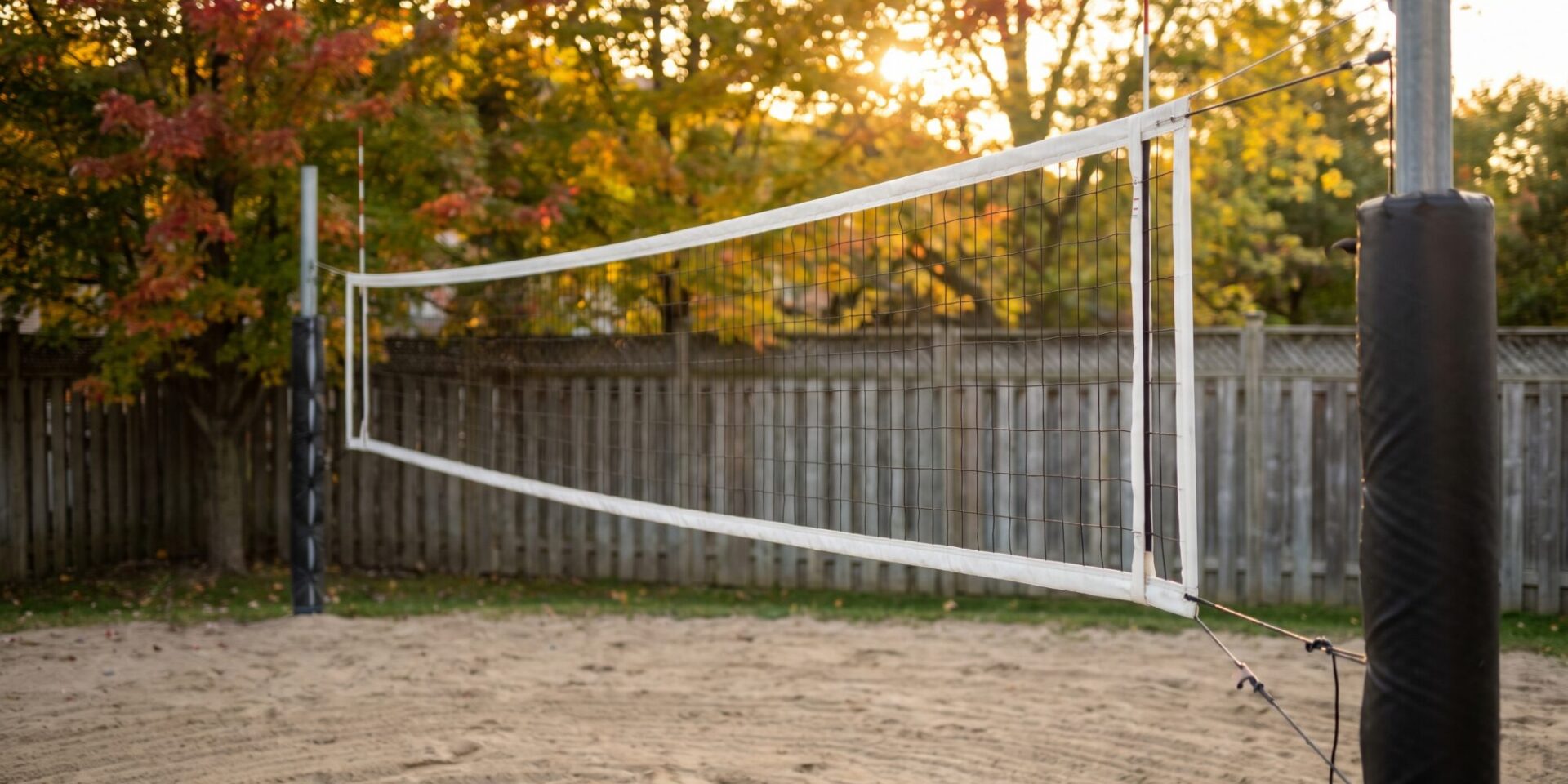
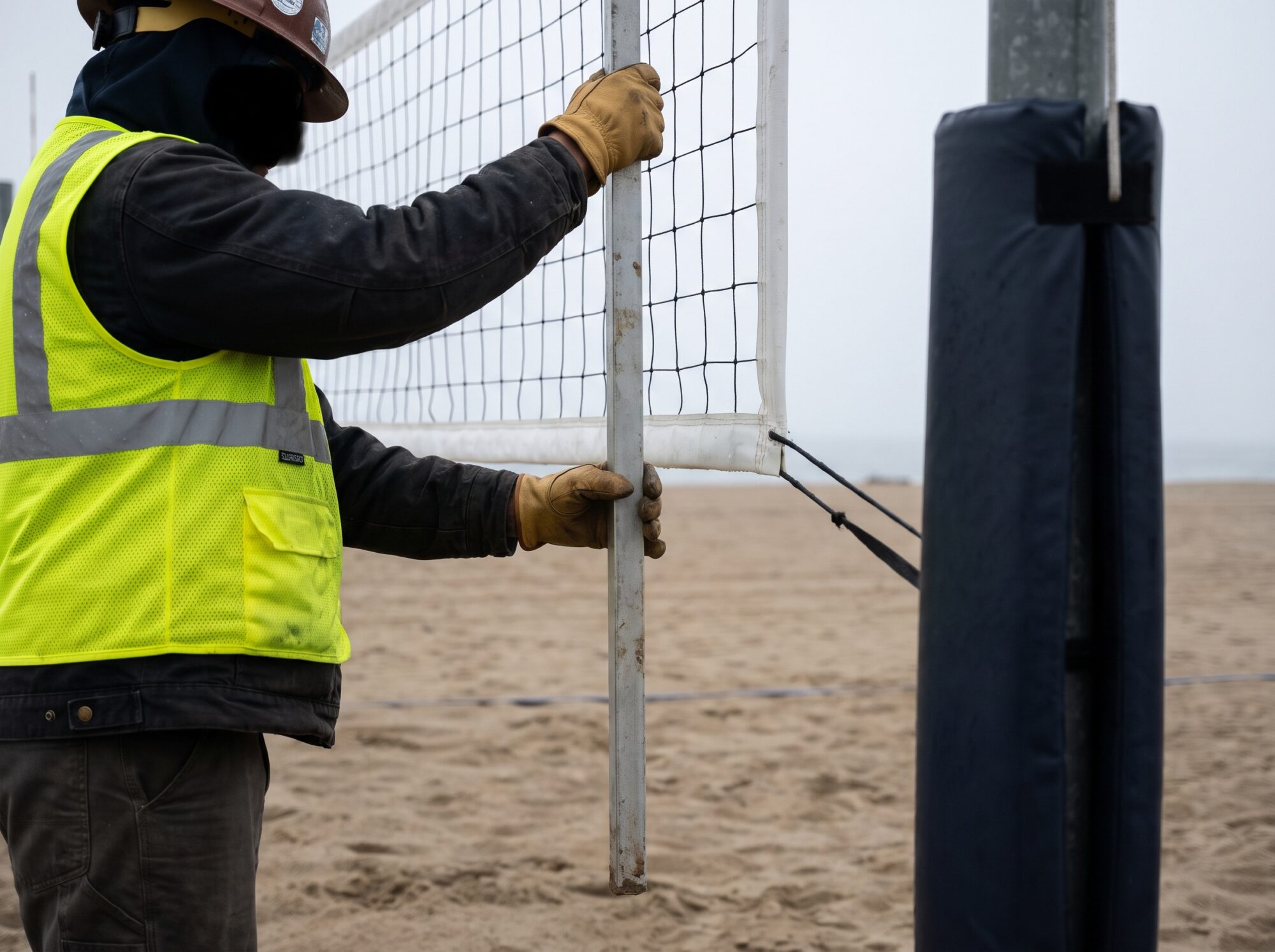
The senior net is 1 metre wide (plus or minus 3 centimetres) and between 9.5 and 10 metres long on an indoor court. The mesh is black and square, with 10 centimetre sides. A cable inside the top band keeps the top edge taut, and a rope through the bottom band does the same at the bottom.
| Component | Specification | Notes |
|---|---|---|
| Net width | 1 m (plus or minus 3 cm) | Measured when hung taut |
| Net length | 9.5 to 10 m | Includes 25 to 50 cm beyond each side band |
| Mesh | 10 cm square, black | Can be modified for sponsorship in FIVB competitions |
| Top band | 7 cm wide, white | Cable inside keeps it taut |
| Bottom band | 5 cm wide | Rope inside keeps it taut |
| Side bands | 5 cm wide, 1 m long, white | Fixed vertically above each sideline |
| Antennae | 1.80 m long, 10 mm diameter | 80 cm shows above the net, 10 cm contrasting stripes |
Side Bands and Antennae
Two white side bands sit directly above the sidelines and count as part of the net. An antenna is fixed to the outer edge of each band, a flexible fibreglass rod 1.80 metres long and 10 millimetres thick. The top 80 centimetres shows above the net and carries 10 centimetre stripes in contrasting colours, preferably red and white. The ball has to cross the net between the antennae, which is why the antennae matter to the layout of the court as well as the net.
Posts and How Far Apart They Stand
The posts are 2.55 metres high and preferably adjustable. They stand outside the sidelines, between 0.50 and 1 metre away in general, and 1 metre away in FIVB, World and Official competitions. They must be rounded and smooth, fixed to the ground without guy wires, and free of anything that could cause injury. The FIVB indoor rules require padded posts in its own competitions, and padding is a good idea on any court where players run toward the net.
A 9 metre wide court with posts 1 metre outside each sideline puts the post centres roughly 11 metres apart. That is a calculation from the rule figures, not a number in the rulebook, and the real spacing depends on the post diameter and the net system you buy.
Indoor vs Beach Volleyball Net Height
The net height is the same in beach volleyball: 2.43 metres for men and 2.24 metres for women, measured at the centre. What changes is the size of the court, the length of the net and where the posts stand. The FIVB Beach Volleyball Rules 2025 to 2028 note that lower heights apply to younger age groups.
| Item | Indoor (FIVB) | Beach (FIVB) |
|---|---|---|
| Court size | 18 m by 9 m | 16 m by 8 m |
| Net height, men | 2.43 m | 2.43 m |
| Net height, women | 2.24 m | 2.24 m |
| Net length | 9.5 to 10 m | 8.5 m |
| Net width | 1 m | 1 m |
| Post distance outside sidelines | 0.50 to 1 m (1 m in FIVB events) | 0.70 to 1 m (1 m in FIVB events) |
| Post height | 2.55 m, preferably adjustable | 2.55 m, preferably adjustable |
| Lines | 5 cm wide | 5 cm wide |
| Free zone | At least 3 m | At least 3 m |
| Free playing space | At least 7 m high | At least 7 m high |
Sand Courts in Ontario Backyards
A sand court is the most popular backyard format, and it adds one wrinkle. The net height is measured from the sand, so a surface that drifts, settles or gets raked changes the height you read. The FIVB beach rules call for sand at least 40 centimetres deep for its own events, with a levelled surface free of rocks and anything that could cause cuts. Our guide to backyard volleyball court construction in Ontario explains the base and sand options in more detail.
How to Measure Volleyball Net Height Properly
Measuring takes five minutes and saves arguments all season. The trick is to measure at the centre first, because the centre is the number the rulebook cares about.
Step by Step
- Set the net tight enough that the top band is straight and does not sag between the posts.
- Stand a rigid rod or marked stick on the playing surface at the centre of the court and read the height at the top of the net.
- Adjust the net until the centre reads 2.43 m for men, 2.24 m for women or your chosen coed height.
- Measure over each sideline. The two readings should match each other and should not be more than 2 cm above the official height.
- Re-check the centre after you tension the net, because pulling one end can lift the other.
Tools That Make It Easier
A rigid measuring rod is the best tool. Some clubs cut a plain stick to each height they use and mark it clearly, which is faster than a tape and removes reading errors. A long level or a laser level helps if you suspect the posts are not plumb or the court has a slope.
How the Height Gets Adjusted
Most adjustable systems use a crank, winch, pin or clamp on each post. Hardware varies a lot between systems, so follow the maker’s instructions for yours. Adjust both ends in small steps and recheck the centre after every change.
Volleyball Net Posts on a Permanent Court
On a portable set, the posts are whatever comes in the bag. On a permanent court, they are a construction detail, and the height you can hold for years depends on how they were set.
Where the Posts Go
Post position comes from the court layout. Mark the sidelines first, then offset each post by the distance you have chosen within the rule range. For a club or school that may host sanctioned play, 1 metre outside the sideline matches the FIVB figure. Our volleyball court dimensions guide has the full footprint, including the free zone around the court.
Sleeves and Footings
Permanent posts normally stand in sleeves set in concrete footings so the post can be lifted out for winter or for resurfacing. The size and depth of a footing depend on the post, the soil and the frost conditions on the site, so that is a design decision for your builder and not a number to copy from a web page. Ontario’s freeze-thaw cycles are the reason footings get this much attention: a footing that moves even slightly changes the net height and the tension.
The sleeve is set while the base is open, before the surface goes down. If you are planning a full build, our overview of the construction process for a backyard sports court shows where this step falls, and how long a sports court build takes helps with scheduling.
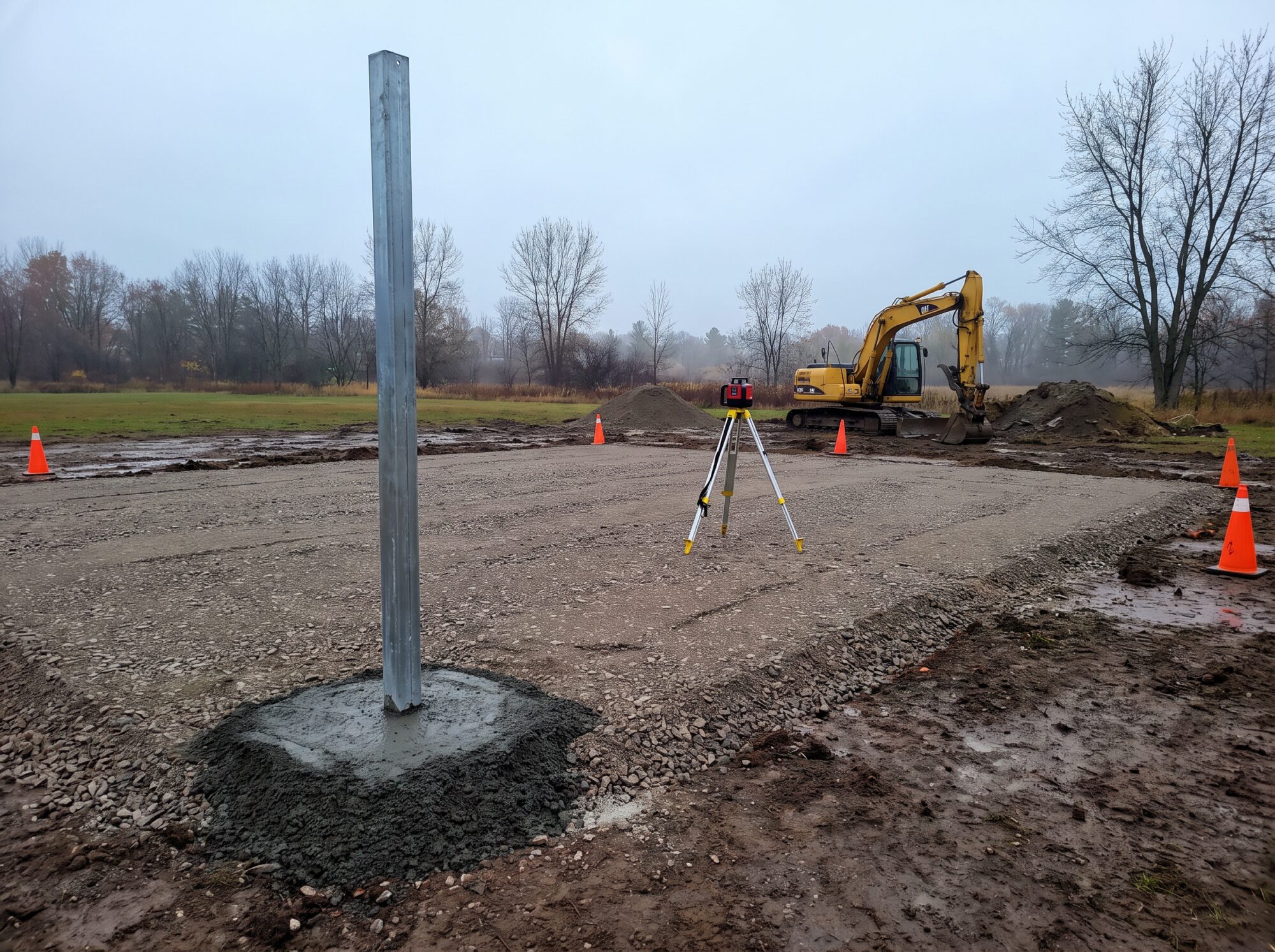
Why Grading and Slope Matter to Net Height
The FIVB asks for a playing surface that is flat, horizontal and uniform. A court that falls across its width will make the same net read differently at each end, because the height is measured from the surface under each post. Accurate grading is what keeps the surface honest, and it is also what keeps water moving off the court. We cover the method in the importance of accurate grading for sports court drainage and in the process of laser-guided grading, and CrowAll describes the service on its laser guided grading page.
If you want the wider picture on water, the importance of drainage in sports surface construction explains why a court that holds water also moves its posts.
Clearance Around the Net
The rules call for a free zone of at least 3 metres around the court and free playing space at least 7 metres high in general. Anything that sits inside that zone, such as a fence, a tree branch or a light pole, affects play and safety. If you plan evening games, read our guide to sport court lighting in Ontario before you fix pole locations.
Net Height on Different Court Surfaces
The rule is the same on every surface, but the thing you are measuring from is not. Each surface has its own habit that can nudge the height over a season.
| Surface | What can change the height | What to check |
|---|---|---|
| Sand | Raking, wind drift, settling and compaction | Re-measure from the sand surface after maintenance and after storms |
| Natural grass | Wear patches and seasonal growth | Measure at the centre and at both posts on a level spot |
| Artificial turf | Infill levels and surface settling | Re-measure after infill is topped up. See sport court turf infill in Ontario |
| Acrylic hard court | A new coating adds a thin layer | Re-measure after resurfacing |
For a deeper look at turf options, our comparison of artificial turf and natural grass for sports courts covers the maintenance side. If you are building a court that shares space with other sports, the layout notes in multi-sport court construction in Ontario help you place posts and sleeves that work for more than one net.
Common Net Height Problems and Likely Causes
Most net trouble comes from a short list of causes. The table below matches symptoms to the likeliest source so you know where to look first.
| What you see | Likely cause | First step |
|---|---|---|
| Net sags in the middle | Cable or rope too slack, posts leaning inward | Re-tension, then check the posts with a level |
| One end sits higher | Posts at different heights or a sloped surface | Measure both ends, then check the surface with a level |
| Height drifts over the season | Footing movement or shifting surface | Inspect the sleeve and the surface around each post |
| Height reads differently after maintenance | Surface level changed by raking, infill or recoating | Re-measure from the new surface |
| Posts wobble | Loose sleeve or cracked footing | Have a builder check the footing before play |
| Net twists or flaps | Wind and a net that is not tight enough | Check tension and the side band fixings |
If several of these show up on the same court, the cause is often the base and not the net. Our list of top mistakes that damage sports courts is a useful cross-check.
Seasonal Care for Nets and Posts in Ontario
Ontario winters are hard on nets. Many owners take the net down once the season ends, because snow load and ice can stretch the cable and fray the mesh. Posts in sleeves can be lifted out and stored, and the sleeve can be capped so water and debris stay out. In spring, re-measure at the centre and over each sideline before the first game, since frost can nudge a footing.
There is no single schedule that fits every court, so follow the net and post maker’s guidance and your own site experience. For wider upkeep, see maintenance 101 for keeping your sports court in prime condition, and plan any construction around the weather using our guide to the best time of year to build a sports court. Before any post or sleeve gets dug, have utilities located. The Ontario Dig Authority is where locate requests start.
Choosing a Net Setup for Your Property Type
Different owners need different things from a net, so the right setup depends on who plays and how often.
Homeowners and Private Estates
Families usually want flexibility. An adjustable post system lets you run a lower net for kids, a women’s height for mixed groups and a men’s height when the older players take over. Start with the footprint and surface, then pick the net system. Our guide to backyard volleyball court construction is a good first read.
Clubs and Schools
Clubs and school programs often follow the Volleyball Canada table, so adjustable posts that hold each age-group height precisely are worth the investment. A court that gets heavy use also needs footings that stay put, and surface care that keeps the playing level consistent across the year.
Municipalities and Facility Managers
Public courts need nets and posts that take rough treatment, padding where players run in, and a clear schedule for taking nets down and putting them up. Permits and approvals can apply to a public build, and our overview of permits for a sports court is a starting point.
Developers, Landscape Architects and Contractors
If a court is part of a larger site plan, settle post positions and sleeve locations early, then coordinate them with grading, drainage and landscaping. CrowAll’s landscaping design service and the service areas page describe how the team works across Ontario.
Planning a Volleyball Court With CrowAll
If you are a homeowner, a club, a school, a municipality or a developer planning a new court or a resurfacing, contact CrowAll to talk through your site conditions, your net and post options and your goals. Our website describes free consultations and quotes, and we are happy to go through the layout with you before anything is poured. You can also read why people choose CrowAll or compare surface finishes in our guide to sport court color options in Ontario.
If you play more than one racket sport on your property, our guides to pickleball net height, tennis net height and tennis court net systems work the same way, and our basketball court dimensions guide covers the next court over.
Frequently Asked Questions About Volleyball Net Height
How high is a volleyball net?
A men’s volleyball net is 2.43 metres (7 ft 11 5/8 in) and a women’s net is 2.24 metres (7 ft 4 1/8 in), measured from the playing surface to the top of the net at the centre of the court. Younger age groups play on lower nets set by national rules.
What is the women's volleyball net height?
The women’s net is 2.24 metres, which is about 88.1 inches or 7 feet 4 1/8 inches. The same height applies in indoor and beach volleyball under the FIVB rules.
What is the men's volleyball net height?
The men’s net is 2.43 metres, which is about 95.6 inches or 7 feet 11 5/8 inches. It is measured at the centre of the court, and the ends over the sidelines can be no more than 2 cm above that height.
How high is a volleyball net in feet and inches?
The men’s net is about 7 feet 11 5/8 inches and the women’s net is about 7 feet 4 1/8 inches. Those are conversions from the official metric heights, so use metres if you are setting a net for sanctioned play.
How high is a volleyball net in centimetres?
Men’s volleyball is 243 centimetres and women’s volleyball is 224 centimetres. The measurement is taken at the centre of the court from the playing surface to the top of the net.
What is the coed volleyball net height?
There is no coed height in the FIVB text or on the Volleyball Canada rules page we checked. Leagues set their own, and a height between the men’s and women’s nets is common. Check your league’s rules before you set the net.
What is the volleyball net height for 14U players?
Under the Volleyball Canada table, 14U nets are 2.15 metres for female players and 2.20 metres for male players. Confirm against the current rulebook and your association’s rules each season.
What is the volleyball net height for 15U and 16U players?
For 15U, Volleyball Canada lists 2.20 metres for females and 2.35 metres for males. For 16U, the figures are 2.24 metres for females and 2.35 metres for males.
Is the beach volleyball net the same height as indoor?
Yes. The FIVB beach rules use 2.43 metres for men and 2.24 metres for women, the same as indoor. The beach net is shorter at 8.5 metres long, because the court is 16 by 8 metres.
Where is volleyball net height measured?
At the centre of the court, from the playing surface to the top of the net. The net must also be the same height over both sidelines and cannot exceed the official height by more than 2 cm.
How wide is a volleyball net?
A senior net is 1 metre wide, plus or minus 3 centimetres. It is 9.5 to 10 metres long indoors and 8.5 metres long for beach volleyball.
How tall are volleyball net posts?
The FIVB rules give 2.55 metres, preferably adjustable. They stand outside the sidelines, between 0.50 and 1 metre away indoors and 0.70 to 1 metre away on a beach court, with 1 metre used in FIVB events.
How long are volleyball antennae?
Antennae are 1.80 metres long and 10 millimetres thick. The top 80 centimetres shows above the net and is marked with 10 cm stripes in contrasting colours, preferably red and white.
How do you measure volleyball net height?
Stand a rigid rod on the playing surface at the centre of the court and read the height at the top of the net, then measure over each sideline. A marked stick cut to the right height is faster than a tape.
Does net height change after a court is resurfaced or the sand is raked?
It can. Net height is measured from the playing surface, so a new coating, topped-up turf infill or raked sand can change the reading. Re-measure at the centre and at both posts after any surface work.
Do volleyball net posts need footings in Ontario?
Permanent posts normally stand in sleeves set in concrete footings. The size and depth depend on the post, the soil and frost conditions, so ask your builder to explain the design, and have utilities located before any digging.
Does CrowAll build volleyball courts with permanent net posts?
CrowAll builds and resurfaces courts across Ontario, and its website describes free consultations and quotes. Contact the team to talk through your site, your net and post options and how the court will be used.