Volleyball Court Dimensions: Indoor, Beach and Backyard Sizes for Ontario Courts
A volleyball net kit usually comes with a diagram and the suggestion that it will fit in any yard. Then you lay out string lines and find the court alone is almost 60 feet long, before you add a single foot of room to move. Facility managers run into the same wall from the other direction, holding a drawing that says 18 by 9 metres for a site that was surveyed in feet.
This guide gives you the official sizes for indoor, beach and youth volleyball, the net, post and line specifications, and the free space the rules expect around the court. Then it turns those numbers into pad sizes, sand volumes and slopes you can plan around in Ontario. Where a figure comes from the FIVB Official Volleyball Rules 2025 to 2028, the FIVB Official Beach Volleyball Rules 2025 to 2028 or Volleyball Canada’s rules and guidelines, we say so. Where it depends on your lot, your league or your surface, we say that too. If you are planning a build rather than just checking a number, our guide to backyard volleyball court construction in Ontario walks through the base, drainage and surface decisions in more detail.
The Short Answer: How Big Is a Volleyball Court?
A regulation indoor volleyball court is 18 metres long by 9 metres wide, which is about 59 by 29.5 feet. A beach volleyball court is 16 by 8 metres, about 52.5 by 26.25 feet. Under FIVB rules the net is 2.43 metres high for men and 2.24 metres for women, and the boundary lines are 5 centimetres wide.
That answers the question most people type into a search box. The harder part is everything outside the lines. A court can match the rulebook exactly and still play badly if the net posts sit in the wrong place, the fence is a metre too close, or water collects at one end after every storm.
Volleyball Court Dimensions at a Glance
| Format | Metres (length by width) | Feet (length by width) | Notes |
|---|---|---|---|
| Indoor and standard play | 18 by 9 | About 59 by 29.5 | Centre line splits the court into two 9 by 9 m halves (FIVB Rule 1.3.3) |
| Beach volleyball | 16 by 8 | About 52.5 by 26.25 | Played on levelled sand, two players per side (FIVB Beach Rule 1.1.1) |
| Volleyball Canada 12U | 14 by 7 overall | About 46 by 23 | Volleyball Canada sets each side at 7 by 7 m for 12U competition (Rule 1.1.1) |
If you want a sense of how these footprints compare with other sports we build for, our guides to basketball court dimensions and pickleball court dimensions use the same approach, official numbers first and then the real pad you need.
Indoor and Standard Volleyball Court Dimensions
The standard court is the one used for indoor play, school gyms, club leagues and most outdoor hard-court setups. It is a rectangle of 18 by 9 metres, and the same layout is the reference point for almost every backyard and community build that scales up or down from it.
The Playing Court and Centre Line
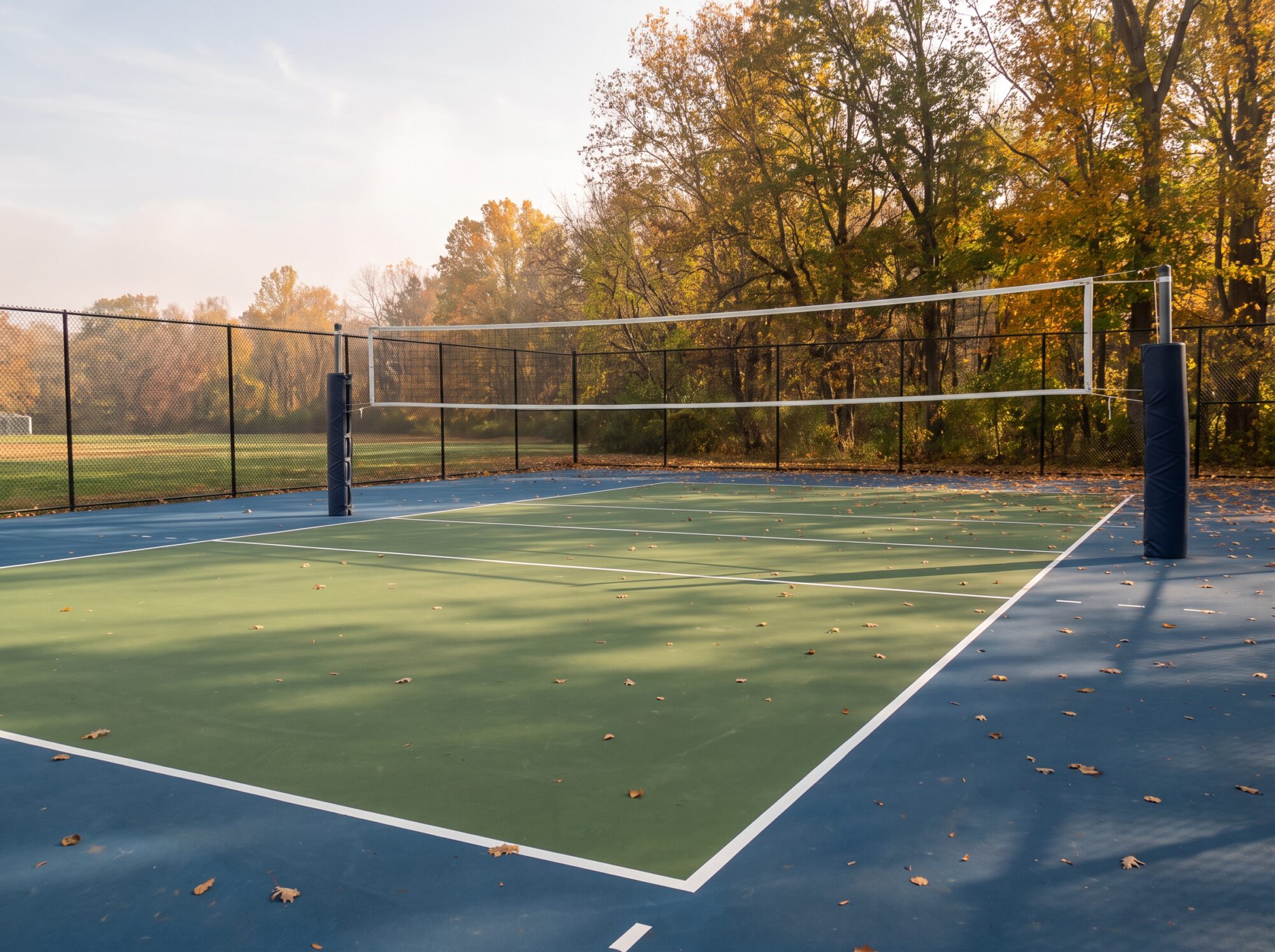
The FIVB rules describe a playing court of 18 by 9 metres surrounded by a free zone. A centre line runs under the net and splits the court into two equal halves of 9 by 9 metres. Every line on the court is 5 centimetres wide, which is a little under 2 inches, and the rules call for the playing surface to be flat, horizontal and uniform.
Volleyball Canada allows more latitude in its own competitions, with line widths between 2.5 and 8.0 centimetres. If you are building for a school board or a club that plays in Volleyball Canada events, ask the league which line width it expects before the court is painted, because repainting an acrylic surface to change line width is an avoidable expense.
The Attack Line and Front Zone
The attack line is drawn parallel to the net on each side. Its rear edge sits 3 metres from the centre line, which is about 9 feet 10 inches. The area between the centre line and the rear edge of the attack line is the front zone, and the rest of each half is the back zone. At FIVB, world and official competitions the attack line is extended outside the court by broken lines totalling 1.75 metres, made of five short lines 15 centimetres long and 5 centimetres wide, spaced 20 centimetres apart.
The Service Zone
Behind each end line sits the service zone, which is 9 metres wide under the FIVB indoor rules, the same as the court. It is marked by two short lines, each 15 centimetres long, drawn 20 centimetres behind the end line. In a backyard that distance is easy to forget, because the service zone is not part of the playing court and it usually has to be found inside the free zone.
Lines, Zones and Measurements
| Element | Metric | Imperial (approximate) | Source rule |
|---|---|---|---|
| Playing court | 18 by 9 m | 59 by 29.5 ft | FIVB Rule 1.1 |
| Line width | 5 cm | 2 in | FIVB Rule 1.3.1 |
| Centre line position | Middle of the court | 29.5 ft from each end line | FIVB Rule 1.3.3 |
| Attack line (rear edge from centre line) | 3 m | 9 ft 10 in | FIVB Rule 1.3.4 |
| Attack line extension (FIVB events) | 1.75 m of broken lines | About 5 ft 9 in | FIVB Rule 1.3.4 |
| Service zone width | 9 m | 29.5 ft | FIVB Rule 1.4.2 |
| Service zone short lines | 15 cm long, 20 cm behind end line | 6 in long, 8 in behind end line | FIVB Rule 1.4.2 |
Beach and Sand Volleyball Court Dimensions
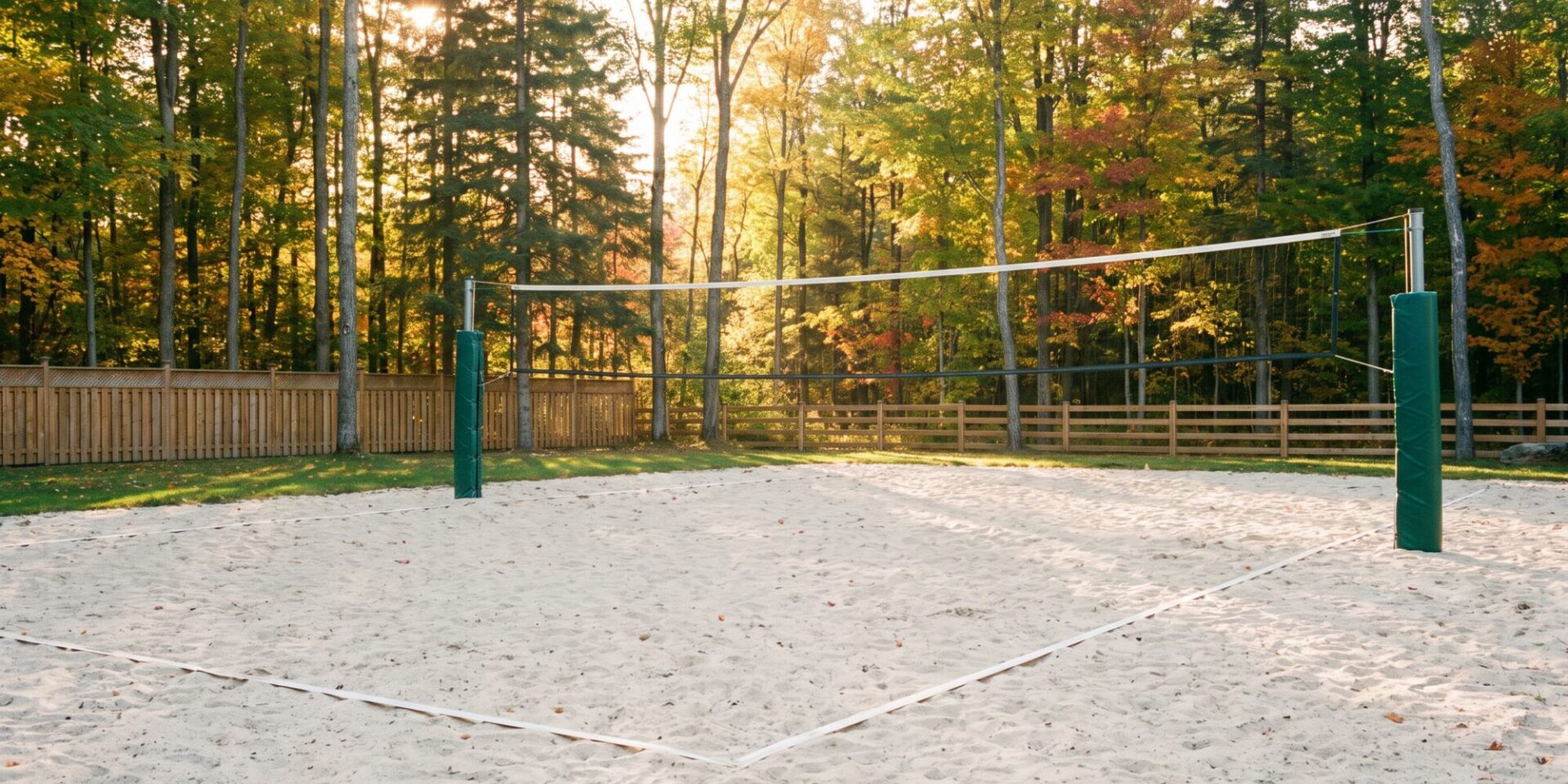
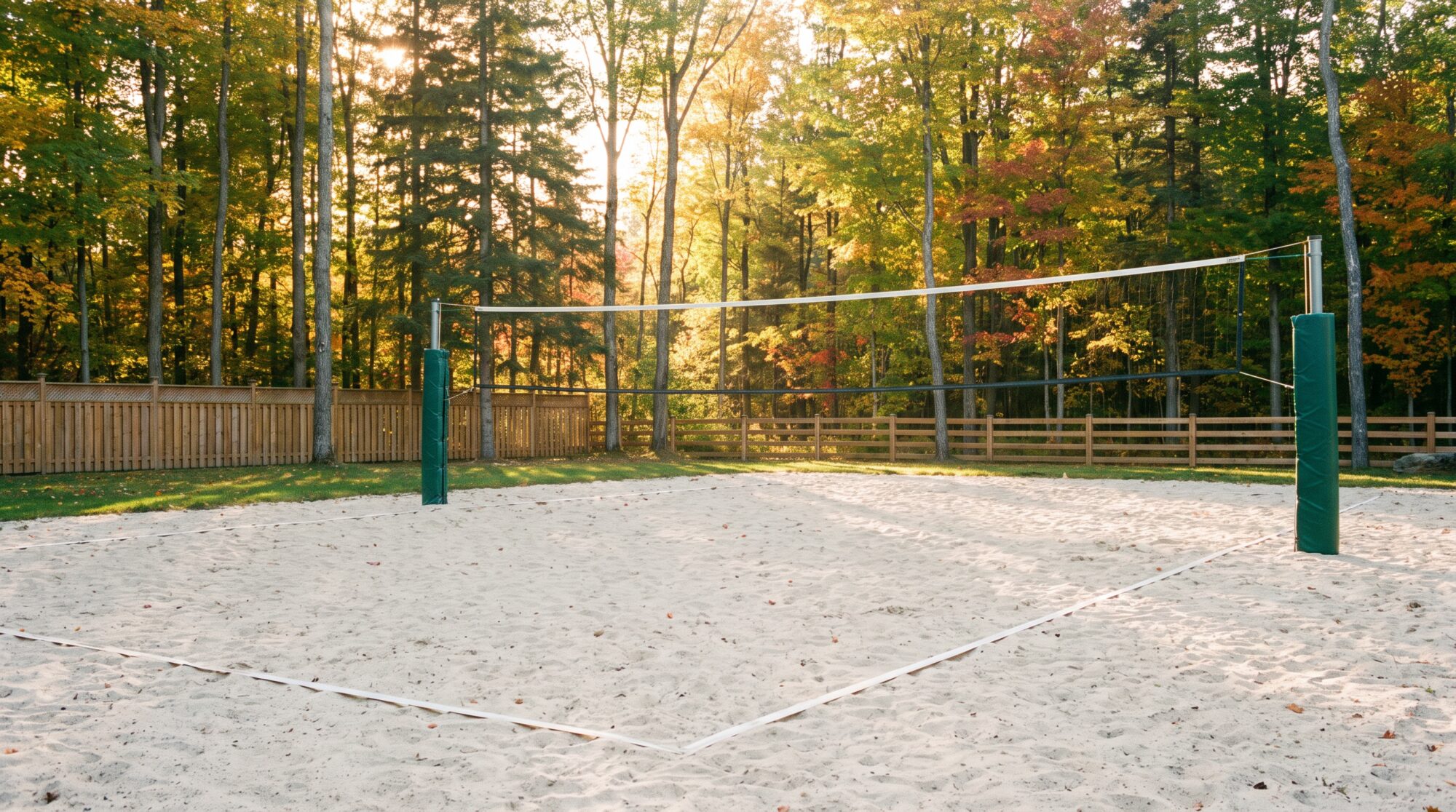
Beach volleyball uses a smaller court because only two players defend it. The FIVB beach rules set the playing court at 16 by 8 metres, which is about 52.5 by 26.25 feet, and divide it into two squares of 8 by 8 metres. There is no attack line. The service zone behind each end line is 8 metres wide.
The court is played on sand that should be levelled, flat and uniform. Lines are 5 centimetres wide and the rules ask for a colour that contrasts sharply with the sand, which in practice means a tape or rope that stays visible in bright sun. At FIVB, world and official events the sand must be at least 40 centimetres deep. That depth exists so players can dive and plant without hitting what is underneath, and it is one reason a proper sand court is an excavation project and not a weekend raking job.
Most Ontario homeowners do not need an FIVB event depth, and the right figure for a family court is a design decision that depends on your soil, drainage and how hard people play. What matters for planning is that the depth is real volume. We work through that arithmetic later in this guide, and our backyard volleyball court construction guide covers sand selection, which has a bigger effect on how the court plays than most people expect.
Volleyball Net Height, Posts and Antennae
The net is the other half of the layout. Its height, width and the position of its posts all feed into the final footprint, so it is worth fixing them early.
Net Height by Age and Level
For senior play the FIVB rules put the top of the net at 2.43 metres for men, which is 7 feet 11 5/8 inches, and 2.24 metres for women, which is 7 feet 4 1/4 inches. The height is measured from the centre of the court, and the net must be the same height over both side lines and must not exceed the official height by more than 2 centimetres. The same two heights apply in the FIVB beach rules.
Volleyball Canada lowers the net for younger age groups, which matters for school courts and club programs that need one net to serve several ages.
| Age group | Female (m) | Male (m) |
|---|---|---|
| 14U | 2.15 | 2.20 |
| 15U | 2.20 | 2.35 |
| 16U | 2.24 | 2.35 |
| 17U to Senior | 2.24 | 2.43 |
These figures come from Volleyball Canada’s published rule variations, so check the current document for your league before you order net hardware. Adjustable systems let one court serve every age group, and they are worth the extra planning at the footing stage.
Net Size, Posts and Antennae
The net is 1 metre wide, with a tolerance of 3 centimetres, and under the FIVB indoor rules it runs 9.5 to 10 metres long so that it extends 25 to 50 centimetres beyond each side band. The mesh is 10 centimetre squares. Two white side bands, each 5 centimetres wide and 1 metre long, sit directly above each side line, and antennae 1.8 metres long attach to the net at the outer edge of each band, extending 80 centimetres above the top.
The posts are 2.55 metres tall. Indoor rules place them 0.5 to 1.0 metres outside the side lines, and the FIVB events require 1 metre with padding. For beach volleyball the posts sit 0.7 to 1.0 metres outside the side lines, again with 1 metre at FIVB events, and the beach net is 8.5 metres long.
Those post distances are the dimension that most often surprises backyard builders, because the posts live outside the court and still sit inside the free zone. A post footing that is dug a metre outside the sideline needs to be counted in the pad, and it has to be solid enough to hold the net under tension without leaning. We see that as one of the more common weak points on DIY setups.
| Item | Indoor (FIVB Rules 2.1 to 2.5) | Beach (FIVB Beach Rules 2.1 to 2.5) |
|---|---|---|
| Net height, men | 2.43 m (7 ft 11 5/8 in) | 2.43 m (7 ft 11 5/8 in) |
| Net height, women | 2.24 m (7 ft 4 1/4 in) | 2.24 m (7 ft 4 1/4 in) |
| Net width | 1 m (plus or minus 3 cm) | 1 m (plus or minus 3 cm) |
| Net length | 9.5 to 10 m | 8.5 m |
| Antennae | 1.8 m long, top 80 cm above the net | 1.8 m long, top 80 cm above the net |
| Post height | 2.55 m | 2.55 m |
| Post distance outside side lines | 0.5 to 1.0 m (1 m at FIVB events, padded) | 0.7 to 1.0 m (1 m at FIVB events) |
Free Zone, Overhead Clearance and Lighting
The court lines are only part of the space a volleyball court needs. The rules also call for a free zone around the court and a minimum height of clear air above it, and both change the pad you build.
How Much Space Do You Need Around the Court?
Under the FIVB indoor rules the free zone must be at least 3 metres wide on all sides, which is about 9 feet 10 inches. At FIVB, world and official competitions it grows to at least 5 metres from the side lines and 6.5 metres from the end lines. The beach rules also ask for 3 metres at a minimum, and 5 to 6 metres at FIVB events.
Anything solid inside that space is a hazard, which includes fences, posts, benches, light poles, fixed seating and the edge of a pool deck. This is the dimension that most often decides whether a court fits in a yard, and it is why we recommend setting out the free zone with string lines before anyone commits to a location.
Ceiling and Overhead Height
The FIVB rules ask for at least 7 metres of free playing space above the court, measured from the playing surface, which is about 23 feet. At FIVB events that rises to 12.5 metres, about 41 feet. This is the number to check when a school or community centre wants a court in a gym, and it is also worth remembering outdoors, where overhead wires, tree branches and fixtures count the same way.
Lighting and Temperature
The FIVB indoor rules set a minimum of 300 lux on the playing surface for general play and 2,000 lux at FIVB events, measured 1 metre above the surface. They also set a minimum indoor temperature of 10 degrees Celsius. Outdoor courts that will be played in the evening need lighting designed for the layout, and our guide to sport court lighting in Ontario explains how fixture placement interacts with poles, fencing and neighbours.
| Requirement | Standard play | FIVB, world and official events |
|---|---|---|
| Free zone, indoor | 3 m on all sides | 5 m from side lines, 6.5 m from end lines |
| Free zone, beach | 3 m on all sides | 5 to 6 m |
| Overhead clearance | 7 m (about 23 ft) | 12.5 m (about 41 ft) |
| Lighting | 300 lux | 2,000 lux at 1 m above the surface |
| Sand depth, beach | Set by the designer | At least 40 cm |
Turning the Official Numbers Into a Pad You Can Build
Official dimensions describe the court. A contractor needs to know how big the pad is, how much stone and sand it holds, and how much room the fence and posts take. The arithmetic below uses the figures above, and it is a planning aid, not a replacement for a site survey or a designer’s drawings.
Footprints With the Free Zone Included
Add the free zone to every side of the court and the footprint grows quickly. A standard court with the 3 metre minimum zone needs 24 by 15 metres, which is about 79 by 49 feet. With the FIVB event zones of 5 metres on the sides and 6.5 metres on the ends, it needs 31 by 19 metres, about 102 by 62 feet. A beach court with 3 metres on every side needs 22 by 14 metres, about 72 by 46 feet.
| Layout | Overall size (metres) | Overall size (feet, approximate) | Area (square metres) |
|---|---|---|---|
| Standard court only | 18 by 9 | 59 by 29.5 | 162 |
| Standard court with 3 m free zone | 24 by 15 | 79 by 49 | 360 |
| Standard court with FIVB event free zone | 31 by 19 | 102 by 62 | 589 |
| Beach court only | 16 by 8 | 52.5 by 26 | 128 |
| Beach court with 3 m free zone | 22 by 14 | 72 by 46 | 308 |
| Beach court with 5 m free zone | 26 by 18 | 85 by 59 | 468 |
Published guidance often says a volleyball court is “30 by 60 feet”, and that is a handy rounding for sketching a lot plan. The actual court is 29.5 by 59 feet, and at least one widely read build guide describes it as measured from the outside edges of the boundary lines. Confirm that convention with your league or the rulebook before you set out the lines, since a few inches matter when a surface is going to be painted once and used for years.
Backyard and Recreational Layouts
Very few Ontario backyards have room for 79 by 49 feet. Most residential builds scale the court down. Our backyard guide describes reduced layouts of roughly 25 to 40 feet long for 2-on-2 or 3-on-3 games, with as much clear space around the lines as the property allows. A smaller court plays differently, with less room to chase balls near the edges, so it helps to decide upfront whether the household plays casual rallies or competitive games.
Net height is the other lever. A family with children can use the Volleyball Canada youth heights in Table 3 as a guide, and an adjustable net lets the same court serve a nine-year-old and a university player. In a backyard, the parts of the rulebook that matter most for safety are the free zone and the padding on the posts.
Sand Depth and Volume
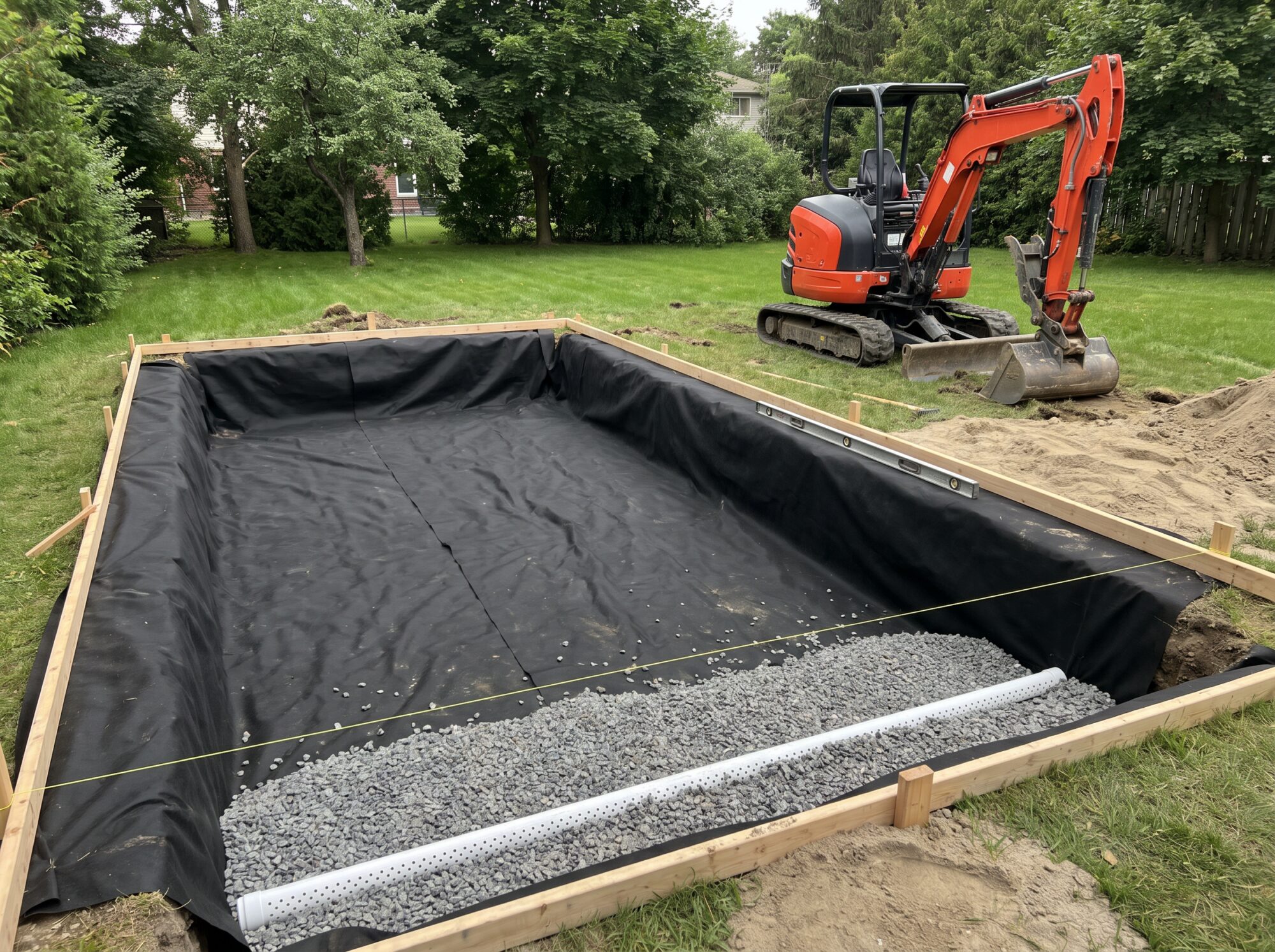
Sand depth is where a beach court turns into a material order. A court footprint of 22 by 14 metres filled to the FIVB event depth of 40 centimetres is 123.2 cubic metres of sand, which is a lot of truck traffic through a backyard gate. Many residential courts use a shallower layer chosen by the designer, and the base underneath matters just as much as the depth on top. Sand sits on a graded, free-draining base, and the sand itself needs to be the right kind. Masonry sand and general play sand carry too much fine material and tend to compact and turn dusty. We cover the choices in our backyard volleyball guide.
Slope and Drainage on Outdoor Courts
The FIVB rules allow outdoor courts a slope of 5 millimetres per metre for drainage only. That is half of one percent. Run in a single direction across the 9 metre width of an indoor-sized court it drops 45 millimetres, and along the 18 metre length it drops 90 millimetres. It is a small number, and on a hand-graded yard it is surprisingly hard to hold, which is where laser-guided grading earns its keep.
Drainage has to be decided before the sand or surface goes down. A court that holds water in one corner kills turf, softens sand into mud, and heaves in an Ontario freeze-thaw cycle. We go deeper on the reasoning in our posts on accurate grading for sports court drainage, drainage in sports surface construction and the laser-guided grading process.
Hard-Surface and Multi-Sport Pads
A hard court is a practical home for volleyball when the household wants one pad for several sports. Dimensions are the tricky part, because the pad has to hold the largest layout and its free zones, and the posts have to be sleeved or footed in a way that does not interfere with other games. We cover this approach in our guide to multi-sport court construction in Ontario, and in pickleball court versus tennis court and basketball court dimensions you can see how the layouts compare. Whether a shared pad works on your lot depends on the survey, the post locations and the line colours.
Line colours need thought on a shared court. The FIVB rules ask for lines that contrast with the surface, and every extra sport adds another set of lines. A designer who plans the colours at the start can keep the volleyball layout readable. The role of acrylic sports court coating and our post on sport court colour options in Ontario explain how coatings and colours are chosen.
Choosing a Surface That Fits the Layout
Surface choice changes how much ground you need to dig, what the base looks like and how the lines are marked. Table 7 compares the three surfaces we see most often for volleyball in Ontario.
| Surface | Line marking | Base and site work | Planning note |
|---|---|---|---|
| Sand | Tape or rope that contrasts with the sand | Excavation, geotextile and free-draining stone, with sand on top | Highest earthwork, and sand depth adds volume |
| Grass | Painted or taped lines on a level lawn | Grading and drainage only if the yard has meaningful slope | Lowest cost to start, firmer and faster play |
| Hard surface or multi-sport pad | Painted lines with colours that contrast | Engineered granular base, similar to a tennis or basketball pad | Posts need sleeves or footings, and several sports share the pad |
Our guide to backyard volleyball court construction compares the feel and upkeep of each surface in more detail. If artificial turf is on the table for a multi-use court, see how artificial turf compares to hard court for tennis, which raises many of the same questions about base and drainage.
Where Dimensions Get Checked During a Build
Dimensions are checked at several stages, and a mistake caught at layout is cheap while the same mistake after paving is a rebuild. The sequence below is the one we follow when a volleyball layout is part of a project.
| Phase | What gets set | Dimension check |
|---|---|---|
| Site survey | Court location and orientation | Court plus free zone fits inside setbacks, trees and overhead lines |
| Excavation and base | Pad grade and stone base | Pad size matches the footprint, and slope is within the design |
| Drainage | Perimeter drains and outlets | Water leaves the pad in the planned direction |
| Surface | Sand, turf or coating | Depth or thickness matches the design |
| Posts and net | Footings and sleeves | Posts sit the specified distance outside the side lines |
| Line marking | Boundary, centre and attack lines | Diagonals match, line width follows league rules |
| Fencing and lighting | Fence line and light poles | Everything solid sits outside the free zone |
The diagonal check in the line marking row is a quick way to confirm the court is square. Measure corner to corner on both diagonals and they should match. It takes a few minutes and catches layout errors that are invisible by eye.
Timing matters too. Ground work and coatings in Ontario depend on temperature and rain, so our posts on the best time of year to build a sports court and summer versus fall construction are worth reading before you set a start date. Many municipalities also have rules on fences, lighting and lot coverage, and our permits guide explains what to check before breaking ground.
Common Dimension Mistakes in Backyard Builds
Forgetting the Free Zone
The court fits, the fence is two feet from the end line, and nobody can serve without ducking. The 3 metre free zone is a minimum, and it is the first thing a tight yard runs out of.
Setting Posts Too Close or Too Loose
Posts driven into loose soil lean after a few games, and posts set too close to the sideline become a collision hazard. Footings should take the net tension for years, and padding is worth adding at the post.
Ignoring Slope Until the Sand Is Down
A court that looks flat to the eye can still hold a puddle. Set the grade before the surface goes on, and check it again after the base is compacted. Our list of top mistakes that damage sports courts covers the damage that follows when water is allowed to sit.
Treating Maintenance as an Afterthought
Sand needs raking and topping up, grass needs mowing, and hard surfaces need cleaning and eventual recoating. Our guide to keeping a sports court in prime condition sets out routines that apply to most surfaces.
Planning Your Volleyball Court With CrowAll
CrowAll builds sports courts across Ontario, including volleyball courts, and the team can walk through your site, your goals and your options. Our website describes free consultations and quotes, so the quickest path is to contact the CrowAll team with your lot dimensions and the way you plan to use the court. You can also read about our company, see why clients choose CrowAll and browse the project gallery before you call.
If volleyball is one of several sports you want on the same footprint, backyard pickleball court installation and backyard basketball court installation are good companions to read, and the CrowAll blog has more planning guides for homeowners, schools, clubs and municipalities. For landscaping around the court, see our landscaping design page and our guide to sports court landscaping costs.
Frequently Asked Questions About Volleyball Court Dimensions
What are the dimensions of a volleyball court?
A regulation indoor volleyball court is 18 metres by 9 metres, about 59 by 29.5 feet. A beach court is 16 by 8 metres, about 52.5 by 26.25 feet. The FIVB rules also call for a free zone of at least 3 metres around the court.
How long and wide is a volleyball court in feet?
A standard court is about 59 feet long and 29.5 feet wide. A beach court is about 52.5 feet long and 26.25 feet wide. Lines are 5 centimetres, or roughly 2 inches, wide under the FIVB rules.
What are volleyball court dimensions in metres?
A standard court is 18 by 9 metres, divided by the centre line into two 9 by 9 metre halves. A beach court is 16 by 8 metres, divided into two 8 by 8 metre halves. Volleyball Canada sets 12U play at 7 by 7 metres per side.
Is a volleyball court 30 by 60 feet?
It is close, but not exact. The official court is 29.5 by 59 feet. Many people round to 30 by 60 feet when sketching a lot plan, so confirm with your league whether lines are measured to their inside or outside edge before marking.
What are beach volleyball court dimensions?
Under the FIVB beach rules the court is 16 metres by 8 metres, with a free zone of at least 3 metres on all sides. At FIVB events the free zone is 5 to 6 metres and the sand must be at least 40 centimetres deep.
How far is the attack line from the net?
The rear edge of the attack line is 3 metres, about 9 feet 10 inches, from the centre line under the net. It separates the front zone from the back zone. Beach volleyball does not use an attack line.
How high is a volleyball net?
The FIVB rules set the net at 2.43 metres, or 7 feet 11 5/8 inches, for men and 2.24 metres, or 7 feet 4 1/4 inches, for women. Volleyball Canada uses lower heights for 14U and 15U players.
What is the net height for youth volleyball in Canada?
Volleyball Canada lists 2.15 metres for 14U female and 2.20 metres for 14U male. For 15U it is 2.20 and 2.35 metres, and for 16U it is 2.24 and 2.35 metres. Check the current rules for your league.
How wide are volleyball court lines?
FIVB rules set lines at 5 centimetres wide. Volleyball Canada allows 2.5 to 8.0 centimetres in its competitions. Beach lines need to contrast sharply with the sand so they stay visible.
How much space do I need around a volleyball court?
At least 3 metres, about 9 feet 10 inches, on all sides under the FIVB rules. At FIVB events the indoor free zone is 5 metres at the sides and 6.5 metres at the ends. Fences and posts should stay outside it.
How high does the ceiling need to be for a volleyball court?
The FIVB rules ask for at least 7 metres, about 23 feet, of free playing space above the court. At FIVB events it is 12.5 metres, about 41 feet. Overhead wires and tree branches outdoors count the same way.
How much space do I need for a backyard volleyball court?
A full standard court with a 3 metre free zone needs about 24 by 15 metres, or 79 by 49 feet. A beach court with the same zone needs about 22 by 14 metres. Many backyards use a smaller recreational layout instead.
How deep should the sand be on a volleyball court?
FIVB events require at least 40 centimetres of sand. A family court can be shallower, and the right depth depends on your soil, drainage and play style. The base under the sand matters as much as the depth.
What slope should an outdoor volleyball court have?
The FIVB rules allow 5 millimetres per metre for drainage only, which is half of one percent. Over 18 metres that is a 90 millimetre drop. Your designer sets the slope for your site and surface.
How far should the net posts be from the court?
Indoor posts sit 0.5 to 1.0 metres outside the side lines, and 1 metre with padding at FIVB events. Beach posts sit 0.7 to 1.0 metres outside the side lines. Posts are 2.55 metres tall.
Can volleyball be played on a multi-sport or tennis court?
Yes, if the pad is large enough for the volleyball court and its free zone, and the posts can be sleeved or footed without blocking other games. Line colours should contrast so each layout stays readable.
Do I need a permit to build a volleyball court in Ontario?
Often yes, depending on the municipality, the size of the pad, fencing, lighting and lot rules. Check with your local building and zoning office before signing a contract.
Does CrowAll build volleyball courts in Ontario?
Yes. CrowAll builds sports courts across Ontario, including volleyball courts, and its website describes free consultations and quotes. Contact the team to talk through your site and layout.